10 Advanced Plays: Advanced Carbon Footprint Analysis for Large Corporations

Advanced Carbon Footprint Analysis for Large Corporations lays out a CFO‑ready approach to inventory design, scope 2 dual reporting, scope 3 hotspot precision, and disclosure alignment amid GHG Protocol updates and converging global rules. The guidance below translates 2025 GHG Protocol update materials into concrete steps that keep enterprise inventories interoperable with IFRS S2, ESRS/CSRD, California SB 253, and evolving SEC expectations, while preparing for the ISO–GHG Protocol partnership to harmonize accounting across corporate and product footprints. See the GHG Protocol’s January 2025 overview of integration with major disclosure rules and the update hub for the corporate suite of standards and guidance milestones.
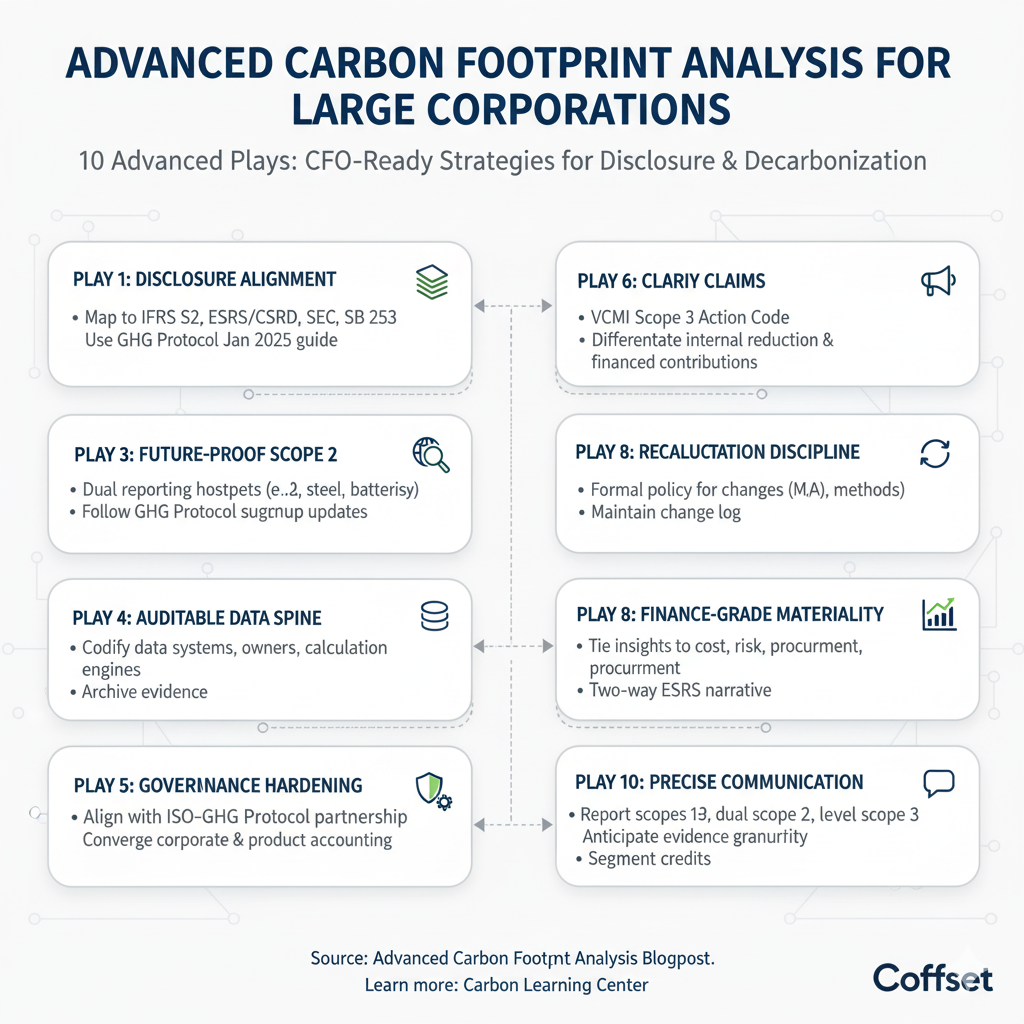
Table of Contents
The Playbook
This playbook also spotlights scope 2 revision priorities (clarifying location‑ vs market‑based objectives, alternative metrics, and higher‑frequency data) and scope 3 working documents that signal more targeted hotspot coverage, as well as claims initiatives shaping scope 3 action pathways. For scope‑specific revisions and briefs, consult the Scope 2 standard development plan and Phase 1 framework, and discussion papers and subgroup presentations for the scope 3 update.
Play 1 — Align inventory architecture with disclosure regimes
Design the corporate inventory to map 1:1 to IFRS S2, ESRS/CSRD, SEC, and California SB 253/219, using the GHG Protocol’s January 2025 “Overview of Integration in Mandatory Disclosure Rules” as the backbone for boundaries, methods, and report structure. This document explains how the Corporate Standard underpins each regime and summarizes timelines and scope expectations (including SEC’s litigation status), enabling a single inventory to cascade into multiple filings.
Keep a living crosswalk that maps inventory tables to each regime’s data fields and narrative requirements; use the GHG Protocol’s update hub for current milestones and the integration overview that tracks regulatory convergence and timing by jurisdiction.
Play 2 — Future‑proof scope 2 with dual reporting and higher‑fidelity data
Maintain robust location‑based and market‑based totals with explicit instrument quality checks; then pressure‑test for the incoming revision topics signaled by the Scope 2 Standard Development Plan (e.g., clarify objectives of both methods, potential inclusion of alternative metrics, and consideration of hourly or consumption‑based grid data). The plan also seeks clarity on on‑site generation treatment and the relationship to project accounting, offering design cues for data architecture.
Use the Scope 2 Phase 1 framework to prepare for potential changes in definitions, metrics, and evidence expectations; this will ease adoption of final revisions projected later in the decade and reduce restatement risk. Summaries from industry trackers can help stakeholder teams digest location‑ vs market‑based updates and timelines.
Play 3 — Treat scope 3 as a targeted hotspot program, not a monolith
Anticipate more nuanced expectations for Category 1 (purchased goods and services) and other priority categories; working inputs to SBTi’s Corporate Net‑Zero update and GHG Protocol scope 3 subgroup materials point to focusing on the few suppliers and materials that drive the majority of emissions. NewClimate’s April 2025 input suggests defining scope 3 boundaries around the major emission sources (e.g., steel, aluminum, batteries) to reach high coverage with practical depth.
Monitor Corporate Standard scope 3 discussion papers and subgroup slides to align category methods and evidence to the direction of travel; use UN Global Compact briefings on elevating scope 3 strategy to ready internal governance and supplier engagement.
Play 4 — Build an auditable scope 2/3 data spine
Codify source‑of‑truth systems, data owners, and calculation engines for each scope and category; include hourly or sub‑annual electricity data where feasible to prepare for potential scope 2 enhancements. Archive instrument attestations and residual mix datasets for market‑based scope 2 defensibility. Use the GHG Protocol integration notes to ensure calculated outputs can drop into ESRS climate disclosures and IFRS S2 appendices without rework.
Where supplier data are unavailable, document screening hierarchies and improvement roadmaps; align narratives with update‑process materials that stress convergence and comparability across regimes to reduce reviewer friction.
Play 5 — Harden governance ahead of ISO–GHG Protocol harmonization
The September 2025 partnership between ISO and the GHG Protocol signals longer‑run harmonization across corporate inventories, product footprints, and project accounting; prepare by aligning control frameworks, verification scopes, and evidence packs for corporate and product‑level use. Legal and FAQ briefs highlight how a unified framework should reduce duplication and integrate with regulatory disclosures.
Run a gap assessment so corporate accounting, LCA/product carbon footprint teams, and finance controls converge on shared terms, boundaries, and evidence standards well before final releases.
Play 6 — Clarify claims and scope 3 “action” financing
If using beyond‑value‑chain mitigation or credits while working down scope 3, align communications with claims initiatives such as VCMI’s Scope 3 Action Code of Practice, which outlines how high‑quality credits can complement—but not replace—decarbonization through 2040, with a trajectory to close the scope 3 gap. Build a claims policy that differentiates internal reductions, supplier interventions, and financed climate contributions, mapped to acceptable language tiers.
Ensure investor‑facing disclosures avoid implying equivalence between short‑lived reductions and durable neutralization at net‑zero; integrate this with SBTi and Oxford‑aligned approaches as governance evolves.
Play 7 — Engineer recalculation discipline and restatement resilience
Adopt a formal recalculation policy for structural changes (M&A, divestitures), methodology improvements, or factor updates; maintain a change log and pro‑forma baseline table to avoid inconsistent year‑over‑year signals in investor reports. The GHG Protocol integration overview shows how consistent baselines and scope boundaries support comparability across IFRS S2 and ESRS.
Where scope 2 revisions may alter historical metrics (e.g., alternate data or metrics adoption), simulate impacts across back years and disclose sensitivities in the MD&A‑style narrative.
Play 8 — Tie inventory improvements to finance‑grade materiality
Use inventory insights to identify financially material levers: procurement categories with concentrated emissions and cost exposure, energy tariff strategies under market‑based scope 2, and design changes that reduce embodied emissions of sold products. Scope 2 and scope 3 update tracks anticipate better comparability and integration into finance disclosures; align dashboards so CFOs see carbon, cost, and risk in one view.
Prepare “two‑way” materiality narratives for ESRS: how climate affects the business and how the business affects climate, using your updated inventory as quantitative evidence.
Play 9 — Stand up assurance readiness
Even where assurance is voluntary or phased, build verification files now: methodology memos, factor libraries, supplier data attestations, electricity instrument evidence, and sampling frames. Use the integration overview to scope assurance by regime and timeline, ensuring that inventory controls satisfy both financial and sustainability reviewers.
Track scope 2 and scope 3 update documents to anticipate evidence granularity (e.g., hourly data or supplier‑specific proofs) and develop a roadmap to uplift controls accordingly.
Play 10 — Communicate progress with precise, comparable metrics
Report scopes 1–3 totals with dual scope 2, category‑level scope 3, and year‑over‑year intensity per unit revenue and per product where relevant; disclose hotspot coverage percentage and supplier‑specific share to demonstrate precision gains. Cite the GHG Protocol integration overview to justify methodological continuity across filings and explain any changes driven by update tracks.
Where using credits, segment financed climate contributions separately from target progress and reference claims frameworks to avoid confusion; use VCMI’s scope 3 action documentation as a citation for interim financing constructs.
Opinion
The update cycle is an opportunity: inventories that adopt dual‑ready scope 2, hotspot‑focused scope 3, and CFO‑grade controls will flow cleanly into IFRS S2, ESRS, and state mandates—with less restatement pain when standards finalize. Preparing now for scope 2 enhancements and ISO–GHG Protocol harmonization will save years of technical debt and produce decision‑useful analytics for capital allocation. The January 2025 integration overview and scope 2/scope 3 working materials show exactly where to tune systems this year.
FAQs — Advanced Carbon Footprint Analysis for Large Corporations
What’s the single most important step to be disclosure‑ready?
Architect the inventory to map directly to IFRS S2, ESRS/CSRD, SEC, and California rules, using the GHG Protocol’s January 2025 integration overview as the master crosswalk for methods, boundaries, and tables.
How should scope 2 be handled ahead of revisions?
Maintain robust dual reporting and instrument evidence while piloting higher‑frequency data and alternate metrics consistent with the Scope 2 Standard Development Plan and Phase 1 framework.
What’s changing for scope 3?
Expect more targeted hotspot coverage, especially within Category 1, and align supplier programs accordingly; track Corporate Standard discussion papers and subgroup updates to anticipate data expectations.
How do ISO–GHG Protocol developments affect corporate teams?
Harmonization will align corporate inventories with ISO frameworks and product accounting, reducing duplication; begin aligning controls and verification scopes across corporate and product footprints now.
Learn More
Explore practical next steps and foundational concepts in one place: start by testing scenarios with the free Coffset Carbon Footprint Calculator, then build fluency with our explainers What Is a Carbon Footprint?, What Is Carbon Offsetting?, and Reduce vs Offset: Why Both Matter. For more resources, visit the Coffset homepage, explore the Carbon Learning Center, or take action via Buy Carbon Credits.
Sources
- GHG Protocol — Overview of Integration in Mandatory Disclosure Rules (Jan 2025): https://ghgprotocol.org/sites/default/files/2025-01/Overview-Integration-Disclosure-Rules-Jan-2025.pdf
- GHG Protocol — Corporate Suite update hub: https://ghgprotocol.org/ghg-protocol-corporate-suite-standards-and-guidance-update-process
- GHG Protocol — Scope 2 Standard Development Plan (Dec 2024): https://ghgprotocol.org/sites/default/files/2025-01/S2-SDP-20241220.pdf
- GHG Protocol — Scope 2 Phase 1 Revision Framework (Dec 2024): https://ghgprotocol.org/sites/default/files/2025-01/S2-RevisionGuideFramework-20241216.pdf
- GHG Protocol — Corporate Standard Scope 3 Discussion Paper (Feb 2025): https://ghgprotocol.org/sites/default/files/2025-02/CS-group3-Meeting4-Paper-20250218.pdf
- GHG Protocol — Scope 3 Subgroup C Presentation (July 2025): https://ghgprotocol.org/sites/default/files/2025-07/S3-GroupC-Meeting10-Presentation-20250710.pdf
- ISO–GHG Protocol partnership (legal brief): https://www.bdlaw.com/publications/ghg-protocol-announces-iso-partnership-to-develop-unified-carbon-accounting-standards/
- ISO–GHG Protocol partnership FAQ (GHG Protocol): https://ghgprotocol.org/blog/iso-ghg-protocol-partnership-frequently-asked-questions
- VCMI — Scope 3 Action Code of Practice (consultation report): https://vcmintegrity.org/wp-content/uploads/2025/04/VCMI-Beta-Scope-3-Claim-Public-Consultation-Report.pdf
Put your knowledge into action
Calculate your footprint and offset instantly with verified credits.
Continue reading
10 Pro Moves: Advanced Guide to Verified Carbon Offset Markets
Build a high-integrity carbon offset portfolio with verified strategies including CCP screening, Oxford-aligned durability protocols, and rigorous MRV systems.
7 Advanced Moves: Advanced Carbon Literacy for Professionals and Activists
Go beyond carbon basics with advanced toolkits, indicators, and misinformation defense strategies. Deliver certified, action-driven climate literacy across your teams and campaigns.
Sustainable Urban Design: Cities That Reduce Carbon
Learn how cities can reduce carbon emissions through sustainable urban design principles including 15-minute proximity planning, people-first streets, and low-emission zones. Discover innovative approaches that prioritize both environmental sustainability and social equity in urban development.