Home Energy Efficiency: Intermediate Techniques for Lower Bills and CO₂
Intermediate home energy efficiency focuses on upgrades and habits that meaningfully lower the household carbon footprint while improving comfort and control. This guide covers practical steps beyond the basics—smart controls, heat‑pump optimization, targeted air‑sealing, demand response, and envelope improvements—so efficiency gains compound over time and support a broader low‑carbon lifestyle.
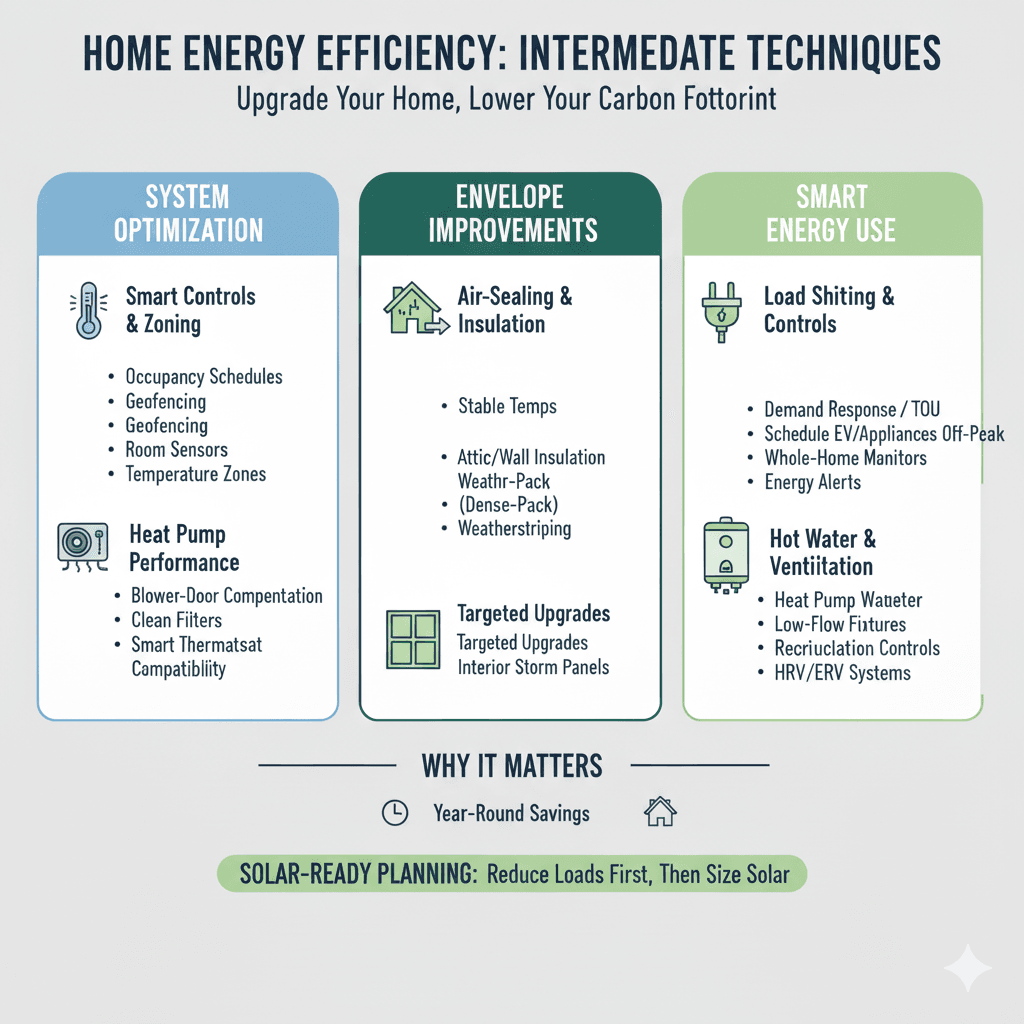
Table of Contents
Why intermediate efficiency matters
Intermediate techniques cut energy waste where it hides: poorly tuned heat pumps, leaky building envelopes, uncoordinated schedules, and unmanaged peak usage. By pairing smart controls with envelope fixes and off‑peak shifting, households can reduce emissions year‑round and create a strong foundation for electrification and renewables.
How to use this guide
Work in sprints. Pick one system (heating/cooling, envelope, or controls), complete the upgrades, then move to the next. Re‑calculate the footprint quarterly to confirm savings and catch rebound effects.
1) Optimize heat pump performance
- Set stable temperatures: Avoid large daily swings; small setpoint bands help heat pumps run efficiently.
- Use weather compensation/curves: Match output to outdoor temperature for smoother, lower‑lift operation.
- Maintain airflow: Keep filters clean, registers open, and outdoor units clear for proper heat exchange.
- Smart thermostat compatibility: Choose models designed for heat pumps (with adaptive/aux heat lockout) to prevent inefficient electric resistance backup.
2) Tune thermostats and zoning
- Program occupancy‑based schedules; add geofencing for automatic set‑back when away.
- Create temperature zones if ducting or hydronics allow; condition rooms in use and relax setpoints elsewhere.
- Pair with sensors in key rooms to avoid conditioning based on hallway temperatures.
3) Air‑seal with verification
- Target the attic plane, rim joists, top plates, and penetrations before adding insulation.
- Use blower‑door‑directed sealing to find and fix leaks; re‑test to confirm lower infiltration.
- Weatherstrip doors and insulate accessible ducts to reduce losses and drafts.
4) Upgrade the building envelope
- Add attic insulation to recommended R‑values; consider dense‑pack cellulose in walls during renovations.
- Replace or tune windows only when envelope priorities are met; focus first on air leakage and attic.
- Install interior storm panels where full window replacement isn’t feasible.
5) Shift loads with demand response
- Enroll in time‑of‑use or demand response programs to pre‑heat/cool during greener, cheaper hours.
- Schedule heat‑pump water heaters, EV charging, laundry, and dishwashers off‑peak.
- Use automation scenes so comfort is maintained while loads move outside peak windows.
6) Ventilation and IAQ efficiency
- Install a balanced ventilation strategy (HRV/ERV) to maintain fresh air with heat/moisture recovery.
- Right‑size kitchen and bath exhaust; add timers/humidity sensors to avoid over‑ventilation.
- Seal and balance ducts; verify static pressure and airflow for efficient distribution.
7) Hot water efficiency
- Consider heat‑pump water heaters; set temperatures appropriately with vacation modes enabled.
- Insulate hot water lines; install low‑flow fixtures where acceptable.
- Add recirculation controls (on‑demand or timer) to reduce standby and circulation losses.
8) Controls, monitoring, and alerts
- Use whole‑home energy monitors to identify phantom loads and faulty equipment.
- Set alerts for unusual kWh spikes, prolonged aux heat, or failed schedules.
- Track monthly intensity (kWh/m²) to normalize progress across seasons.
9) Appliance and plug‑load management
- Replace aging, high‑use appliances with high‑efficiency models at end‑of‑life.
- Use smart plugs or master switches on entertainment and office clusters.
- Standardize eco modes on TVs, gaming consoles, and set‑top boxes.
10) Solar‑ready planning
- Reduce loads first; then size rooftop solar to the lower baseline for better economics.
- Consider future electrification (EV, induction, heat pumps) when planning panel and service upgrades.
- Add load controllers to prioritize critical circuits during outages if pairing with storage.
Opinion: Structure beats willpower in home efficiency
The biggest efficiency breakthroughs come from structure, not heroic effort. Two things stand out. First, blower‑door‑directed air‑sealing before insulation—because tightening the envelope makes every system downstream perform better. Second, set‑and‑forget automation—smart thermostats, water heating schedules, and TOU pre‑heating—that quietly saves energy every day without extra thought. Once those are in place, heat pumps and renewables do their best work.
Learn More
To take the next step on your low-carbon journey, try the free Coffset Carbon Footprint Calculator to establish a precise baseline and identify your top opportunities for impact. After reducing what you can, offset the rest with verified projects that accelerate climate solutions. Explore more of our resources to stay informed: What Is a Carbon Footprint?, What Is Carbon Offsetting?, Reduce vs Offset: Why Both Matter. Each guide helps you cut emissions credibly while building lasting habits for a net-zero future.
FAQs – Home Energy Efficiency
What are the most effective intermediate home energy efficiency upgrades?
Focus on air‑sealing verified by a blower‑door test, heat‑pump optimization with smart controls, and time‑of‑use load shifting. These measures reduce heating/cooling demand and avoid peak power, delivering consistent savings.
How do smart thermostats improve heat‑pump efficiency?
Models designed for heat pumps use adaptive algorithms, aux‑heat lockout, geofencing, and occupancy sensors to maintain comfort with minimal energy use, preventing inefficient backup heat.
Is insulation or window replacement a better investment?
Air‑sealing plus attic insulation typically beats window replacement on cost‑per‑kWh saved. Consider windows during larger retrofits or when addressing comfort, condensation, or noise after envelope priorities.
What’s the best way to use demand response at home?
Pre‑heat/cool before peak periods, schedule heat‑pump water heating and EV charging off‑peak, and automate laundry/dishwashing. Pair with TOU tariffs to cut cost and carbon simultaneously.
Sources
- ENERGY STAR: Heat & Cool Efficiently – https://www.energystar.gov/saveathome/heating-cooling
- ENERGY STAR: Air Sealing factsheet (PDF) – https://www.energystar.gov/ia/home_improvement/home_sealing/AirSealingFS_2005.pdf
- U.S. DOE: Demand Response – https://www.energy.gov/oe/demand-response
- FEMP: Time‑Variable Pricing & DR – https://www.energy.gov/femp/demand-response-and-time-variable-pricing-programs
- Blower‑door‑directed sealing overview – https://zeroenergyproject.com/build/twelve-steps-affordable-zero-energy-home-construction-design/super-seal-net-zero-building-envelope/