Carbon Literacy for Professionals: Tools & Certifications
Carbon literacy for professionals is about more than climate facts—it is applied competence. It combines credible training, recognized certifications, and practical toolkits that enable informed decisions, measurable emission reductions, and trustworthy communication. This guide maps the carbon literacy landscape for teams and leaders, from The Carbon Literacy Project’s certificates and sector toolkits to ISO pathways that align skills with audit‑ready climate claims.
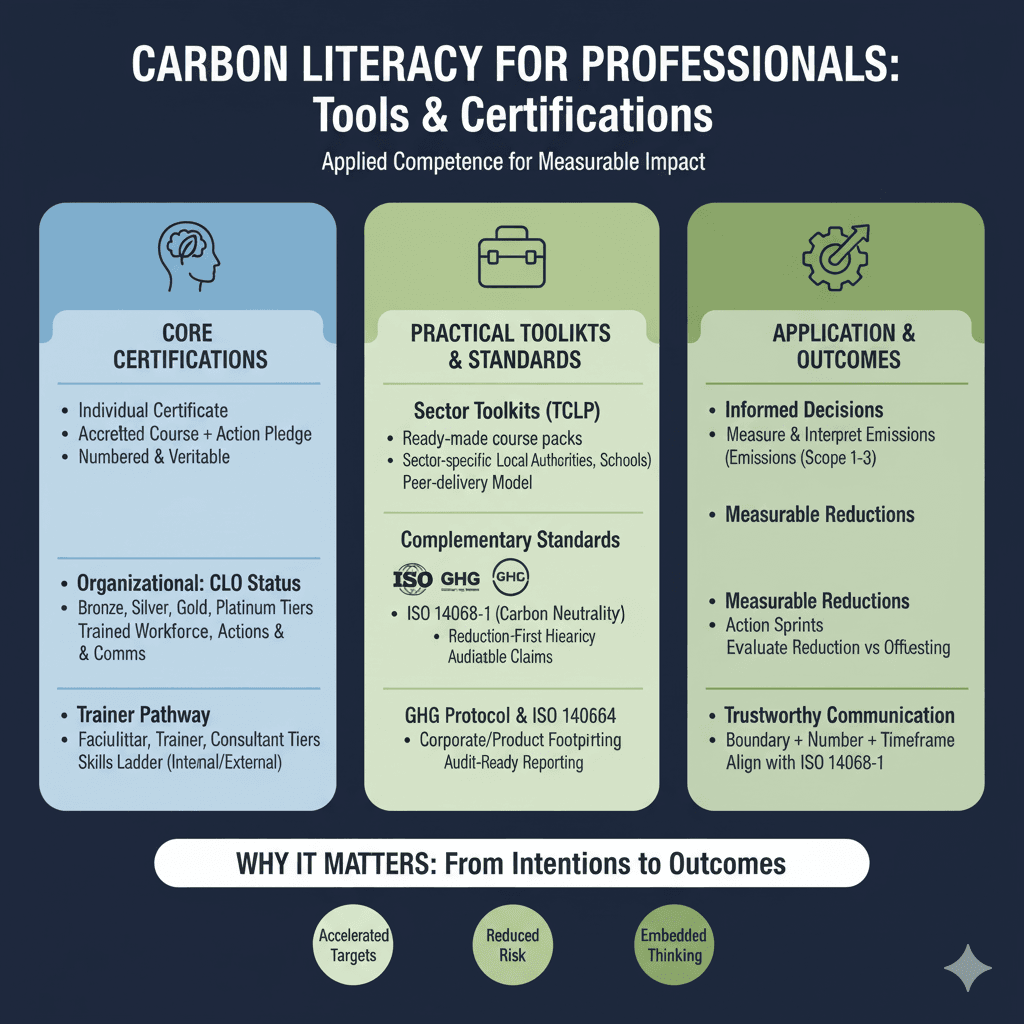
Table of Contents
Why carbon literacy for professionals matters
Carbon-literate professionals turn intentions into outcomes. They can read an emissions inventory, interpret scopes, evaluate reduction versus offsetting options, and craft claims that survive audit. For organizations, a shared foundation of carbon literacy accelerates delivery of targets, reduces reputational risk, and embeds climate thinking into everyday decisions across procurement, operations, finance, and communications.
What counts as “carbon literacy” in practice
The Carbon Literacy Project defines carbon literacy as awareness of the CO₂ costs and impacts of everyday activities, plus the ability and motivation to reduce emissions individually and collectively. Certification requires completing an approved course and making personal and group action pledges; each certificate is uniquely numbered and verifiable for employers and auditors. For trainers, tiered credentials—Facilitator, Trainer, and Consultant—form a skills ladder with clear, published criteria The Carbon Literacy Trainer Standard.
Core certifications and standards
- Individual Carbon Literacy certificate: Earned by completing an accredited course and pledging actions; certificates are recorded in a secure database and can be verified later. This is the baseline credential that many employers now recognize in job descriptions and training plans Getting Started – Certification overview.
- Carbon Literate Organisation (CLO): A four‑tier accreditation (Bronze, Silver, Gold, Platinum) for employers building a carbon‑literate workforce and evidencing implementation. CLO status signals sustained training plus action and communications across the organization Carbon Literacy – CLO overview.
- Trainer pathway (CLF, CLT, CLC): Professional tiers for facilitators, trainers, and consultants, with defined prerequisites, evidence, and scope of practice—useful for internal enablement leads and external advisors Trainer Standard.
- ISO 14068‑1 (Carbon neutrality): A management standard that provides principles and requirements for achieving and demonstrating carbon neutrality, emphasizing a reduction‑first hierarchy and auditable processes. It complements skills gained via carbon literacy and supports credible neutrality claims by aligning practice with an ISO framework ISO 14068‑1 overviewhttps://www.bsigroup.com/en-GB/training-courses/iso-14068-1-climate-change-management-carbon-neutrality/.
Sector toolkits and delivery models
- Carbon Literacy Project toolkits: Complete, sector‑specific course packs (slide decks, trainer manuals, activities, evidence forms) for local authorities, schools, and other sectors—designed for peer delivery and tailored action planning. Toolkits require participants to pledge individual and group actions, and trainers submit evidence for certification within set timelines Local Authorities Toolkit overviewhttps://carbonliteracy.com/trainer-consultant/the-carbon-literacy-resources-library/.
- Enterprise delivery: In‑house academies and legal, consulting, or sustainability firms deliver accredited training at scale, often pairing the Carbon Literacy certificate with role‑specific modules in procurement, finance, product, or communications. Many organizations pursue CLO status to formalize governance and signal external commitment Irwin Mitchell – Carbon Literacy training.
Tools that complement carbon literacy
- Carbon accounting platforms: Software aligned to GHG Protocol and ISO 14064 equips carbon‑literate teams to pull data, map factors, and track Scope 1–3 reductions. Training improves data requests, factor selection, and interpretation.
- LCA workbenches (SimaPro, GaBi, openLCA): For product teams, carbon literacy enables better scoping, dataset choices, and communication of PCF/EPD results. It also clarifies when to complement organizational inventories with product‑level insights.
- Policy and claims checklists: Carbon‑literate communicators apply “boundary + number + timeframe” to all public claims and align any neutrality statements with ISO 14068‑1 and offsetting best practice.
How to build a professional learning pathway
- Foundation: Deliver accredited Carbon Literacy training for core teams; certify individuals and set a target toward CLO status.
- Specialization: Layer role‑based modules (procurement, facilities, finance, product) and simulation exercises using live company data.
- Application: Run action sprints tied to quarterly emissions priorities; require boundary/number/timeframe in all climate claims.
- Assurance: Align neutrality or product claims with ISO 14068‑1; maintain evidence packs for audits; refresh training annually.
Opinion: Pair skills with systems
Carbon literacy unlocks real results only when paired with systems—clear targets, data access, empowered roles, and accountability. The strongest programs train widely at the start, certify trainers internally, and integrate toolkits into onboarding and quarterly planning. Teams that add ISO 14068‑1 when making neutrality claims safeguard credibility and reduce the risk of greenwashing. Skills plus systems beat slogans every time.
Learn More
To take the next step on your low-carbon journey, try the free Coffset Carbon Footprint Calculator to establish a precise baseline and identify your top opportunities for impact. After reducing what you can, offset the rest with verified projects that accelerate climate solutions. Explore more of our resources to stay informed: What Is a Carbon Footprint?, What Is Carbon Offsetting?, Reduce vs Offset: Why Both Matter. Each guide helps you cut emissions credibly while building lasting habits for a net-zero future.
FAQs – Carbon Literacy for Professionals
- What is Carbon Literacy for professionals?
It’s an applied skillset—understanding emissions sources and solutions and turning that knowledge into measurable reductions and credible claims—evidenced by a verifiable Carbon Literacy certificate and, for organizations, Carbon Literate Organisation accreditation. - How do the Carbon Literacy certificate and CLO status differ?
The individual certificate validates personal competence and action pledges; CLO is an organizational accreditation (Bronze to Platinum) indicating a trained workforce and ongoing delivery of climate actions and communications. - Why consider ISO 14068‑1 if we already train teams?
Carbon literacy improves decisions; ISO 14068‑1 structures credible carbon‑neutral claims, requiring reduction‑first strategies and auditable evidence. Together, they strengthen delivery and reduce reputational risk. - What’s the fastest way to operationalize carbon literacy?
Use a sector toolkit, certify internal facilitators, run action sprints tied to quarterly emissions priorities, and track outcomes in your carbon accounting platform—then align any neutrality claims with ISO 14068‑1.
Sources
- The Carbon Literacy Trainer Standard (tiers and requirements): https://carbonliteracy.com/wp-content/uploads/2025/06/The-Carbon-Literacy-Trainer-Standard-v4.2.pdf
- Carbon Literacy – Getting Started pack (certification, evidence, toolkits): https://carbonliteracy.com/wp-content/uploads/2025/05/Getting-Started-Pack-v2.1.pdf
- Carbon Literacy Resources Library (toolkits, sector materials): https://carbonliteracy.com/trainer-consultant/the-carbon-literacy-resources-library/
- Carbon Literacy for Local Authorities – Toolkit overview: https://carbonliteracy.com/wp-content/uploads/2024/07/CC000592-Generic-Staff-Workshop-Pathway-Course-Overview.pdf
- ISO 14068‑1 climate change management (overview and training): https://www.iv-group.co.uk/carbon-catapult/iso-14068-climate-change-management/ and https://www.bsigroup.com/en-GB/training-courses/iso-14068-1-climate-change-management-carbon-neutrality/