10 Practical Moves: Net Zero Strategies for Mid-Size Companies
Net Zero Strategies for Mid-Size Companies lays out a lean, credible pathway for 100–5,000‑employee firms to set targets, cut emissions quickly, and meet growing customer and lender expectations without big‑company budgets. The blueprint aligns with the Science Based Targets initiative (SBTi) net‑zero framework for near‑term and long‑term targets, SME‑tailored routes, and disclosure practices that interoperate with evolving SME reporting standards in the EU and beyond. For core criteria and structure, see SBTi’s overview of the Corporate Net‑Zero Standard and near‑term requirements in the SBTi Near‑Term Criteria, with SME target routes and FAQs summarized in the SME FAQ.
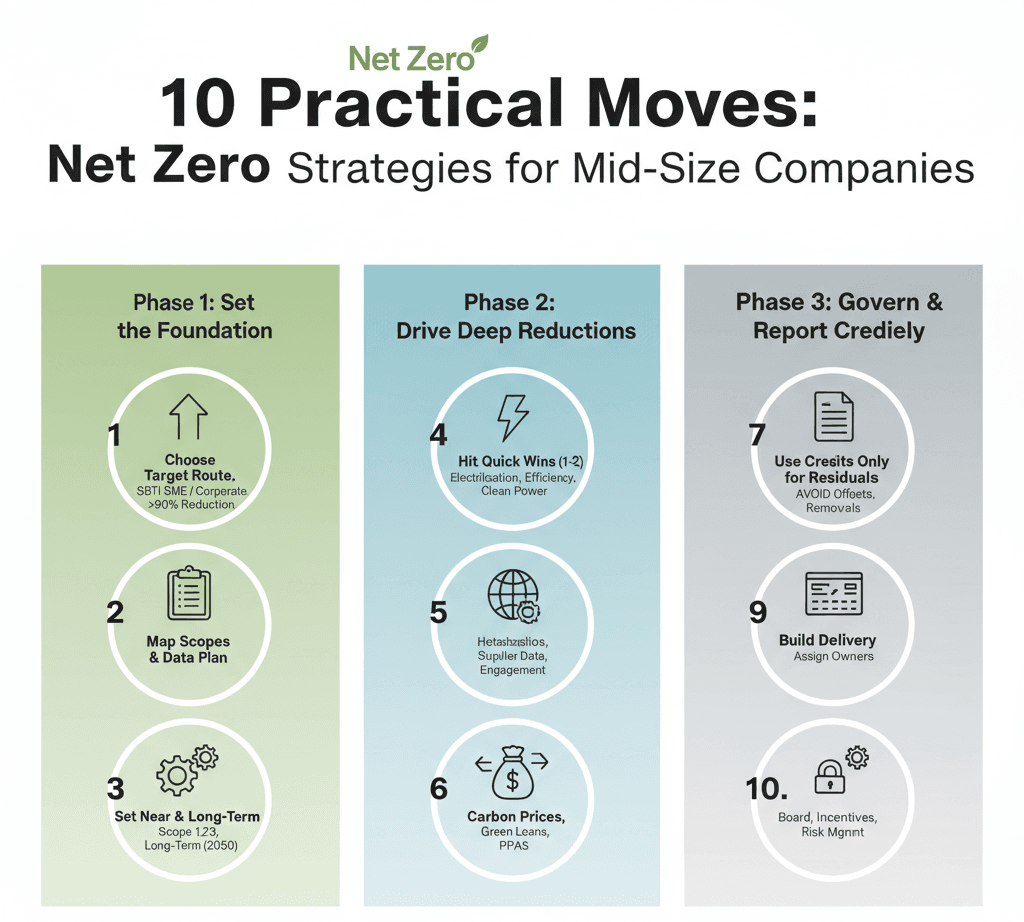
Table of Contents
The Guide
This guide focuses on fast moves an internal team can execute: quantify scopes, set 1.5°C‑aligned targets, implement top decarbonization levers, engage suppliers, and use verified credits only for residuals—while preparing light‑touch reporting that satisfies large customers and banks. On reporting convergence, review the EU’s voluntary SME reporting recommendation and VSME standard updates via the Commission’s recommendation page and legal commentary on the voluntary SME standard (VSME).
Move 1 — Choose the right target route
Pick the SBTi SME route if headcount and resources are limited; it streamlines validation and focuses near‑term on scopes 1–2 while committing to measure and reduce scope 3, with long‑term net‑zero requiring deep cuts across all scopes by 2050 at the latest per the SME FAQ and Net‑Zero Standard. Larger mid‑caps with complex footprints can use the full Corporate Net‑Zero Standard with near‑term and long‑term targets validated against SBTi criteria in the Near‑Term Criteria.
SBTi’s framework requires rapid near‑term cuts (roughly halving by 2030), >90% long‑term reductions, and neutralization of residuals with permanent removals at net‑zero, summarized in the Net‑Zero Standard overview and full standard PDF.
Move 2 — Map scopes and set a 12‑month data plan
Follow GHG Protocol-aligned accounting and assemble a rolling 12‑month plan for activity data and emission factors, ensuring location‑ and market‑based scope 2 totals ahead of target submission, as required by SBTi criteria in the Near‑Term Criteria. SMEs using the SBTi route must quantify scope 3 and commit to reductions, with net‑zero requiring deep scope 3 cuts later, as clarified in the SME FAQ.
Discussion materials in the GHG Protocol update process are flagging scope 3 options for SMEs to keep burden proportionate while still committing to measurement and reduction pathways in a 2025 scope 3 discussion paper.
Move 3 — Set near‑term and long‑term targets together
Combine a 5–10 year near‑term target with a long‑term net‑zero target to lock strategy and capital planning, per SBTi’s structure requiring both target types in the Net‑Zero Standard and full standard PDF. Validation criteria specify coverage and ambition for scopes, timelines, and accounting alignment in the Near‑Term Criteria.
SME routes offer simplified validation and options such as maintenance targets for already‑low scope 1–2 footprints, detailed in the SME FAQ.
Move 4 — Hit quick wins in scopes 1–2
Prioritize electrification of heat and fleets, energy efficiency, and clean power procurement to front‑load reductions that also lower operating costs. SBTi emphasizes rapid near‑term reductions consistent with 1.5°C trajectories before 2030, described in the Net‑Zero overview. For power, use market‑based instruments that meet quality criteria and disclose totals per SBTi’s alignment with GHG Protocol in the Near‑Term Criteria.
SME support programs (e.g., SME Climate Hub) provide playbooks and recognition within Race to Zero to accelerate early moves, per the Hub’s guide to setting 1.5°C‑aligned targets.
Move 5 — Tackle priority scope 3 categories
Screen spend to find hotspots, then switch to supplier‑specific data and contracts for top categories (purchased goods, transport, use of sold products). SBTi requires SMEs to measure and reduce scope 3 and full‑framework companies to include scope 3 when it’s a large share, with criteria summarized in the Near‑Term Criteria and SME expectations in the SME FAQ.
Supplier engagement targets and design changes can be integrated into procurement and product development cycles; the SME Climate Hub guide offers templates and milestones in 1.5°C‑aligned targets for SMEs.
Move 6 — Finance the plan without friction
Use internal carbon prices and green CAPEX screens to steer investments, while tapping green loans and PPAs to fund electrification and clean power. The World Economic Forum outlines capital‑light playbooks and growth linkages for midsize firms in a 2025 roadmap for SMEs and mid‑caps in Sustainability Meets Growth.
Early wins reduce energy costs and credit risk while strengthening access to sustainable finance as banks and customers increasingly request climate data; the EU’s voluntary SME reporting standard aims to reduce burden while improving access to finance, per the Commission’s recommendation and Q&A on the VSME.
Move 7 — Report lightly but credibly
Publish an annual one‑pager with scopes, targets, progress, and key actions that mirrors SBTi disclosures and satisfies value‑chain requests using the VSME template where relevant, per the Commission’s VSME recommendation and legal briefs on the standard. This helps respond to customer questionnaires efficiently while keeping internal focus on delivery.
Large customers subject to CSRD will keep asking for supplier data; aligning to VSME reduces back‑and‑forth and positions the company for future assurance if needed, as noted in the EU’s VSME Q&A.
Move 8 — Use credits only for residuals, with strong guardrails
Avoid using offsets to meet near‑term reduction targets; reserve verified credits for residual emissions and favor durable removals at net‑zero, consistent with SBTi and Oxford‑aligned practice. SBTi’s net‑zero construct specifies neutralization with permanent removals after >90% abatement, per the Net‑Zero overview and the standard PDF.
If purchasing beyond‑value‑chain mitigation now, disclose it as contribution rather than reduction against targets, in line with SBTi guidance and integrity initiatives, and maintain strong due diligence per recognized quality principles (e.g., CCPs).
Move 9 — Build a delivery operating system
Create a quarterly cadence: energy spend review, project pipeline update, supplier engagement check‑ins, and progress reporting that aligns with SBTi milestones in the Near‑Term Criteria. Assign owners for scopes, data, and procurement to avoid stall points and keep a living risk register for energy prices and policy changes.
Leverage ecosystem programs (Race to Zero via SME Climate Hub) for recognition and peer support, per the UN Climate Champions’ hub on climate‑proofing SMEs.
Move 10 — Lock in governance and resilience
Embed climate metrics in board reporting and executive incentives; integrate transition and physical risks into enterprise risk management and supplier contracts. SBTi emphasizes accountability and near‑term action as hallmarks of credible net‑zero, per the Net‑Zero overview. Align procurement, finance, and product teams on gates tied to target trajectories and disclose annually using VSME where applicable, per the EU’s recommendation.
As standards converge, early alignment to SBTi and VSME reduces future rework and improves access to finance and major customers’ preferred supplier lists, as summarized in the Commission’s VSME Q&A.
Opinion
For mid‑size companies, credibility doesn’t require complexity: pair a simple, science‑based target structure with aggressive scope 1–2 action, focused supplier engagement on scope 3, and lightweight reporting that meets customer expectations. Firms that adopt SBTi’s near‑term/long‑term architecture and lean into VSME‑style disclosures will cut costs, win tenders, and avoid future compliance friction, as reflected in SBTi’s Net‑Zero Standard, validation criteria, and the EU’s VSME recommendation.
FAQs — Net Zero Strategies for Mid-Size Companies
What targets should a mid‑size company set first?
Set a 5–10 year near‑term target aligned to 1.5°C, plus a long‑term net‑zero target with >90% reductions by 2050, per SBTi’s Net‑Zero overview and validation criteria.
How does the SME SBTi route differ?
It streamlines validation, focuses near‑term on scopes 1–2 with scope 3 commitments, and offers maintenance options for very low emitters, described in the SME FAQ.
What should be in a minimal annual disclosure?
Scopes 1–3 totals and methods, targets and progress, material levers delivered, and next‑year plan—ideally using the EU’s VSME template where relevant to satisfy customers and banks, per the Commission’s recommendation.
Learn More
Explore practical next steps and foundational concepts in one place: start by testing scenarios with the free Coffset Carbon Footprint Calculator, then build fluency with our explainers What Is a Carbon Footprint?, What Is Carbon Offsetting?, and Reduce vs Offset: Why Both Matter. For more resources, visit the Coffset homepage, explore the Carbon Learning Center, or take action via Buy Carbon Credits.
Sources
- SBTi — Corporate Net‑Zero Standard overview: https://sciencebasedtargets.org/net-zero
- SBTi — Corporate Net‑Zero Standard (full): https://files.sciencebasedtargets.org/production/files/Net-Zero-Standard.pdf
- SBTi — Corporate Near‑Term Criteria: https://files.sciencebasedtargets.org/production/files/SBTi-criteria.pdf
- SBTi — SME FAQs: https://docs.sbtiservices.com/resources/FAQsforSMEs.pdf
- EU Commission — Voluntary SME reporting recommendation (VSME): https://finance.ec.europa.eu/publications/commission-presents-voluntary-sustainability-reporting-standard-ease-burden-smes_en
- EU Commission — VSME Q&A: https://finance.ec.europa.eu/publications/questions-and-answers-recommendation-voluntary-sustainability-reporting-standard-small-and-medium_en
- WEF — Sustainability Meets Growth: A Roadmap for SMEs and Mid‑Caps: https://reports.weforum.org/docs/WEF_Sustainability_Meets_Growth_2025.pdf
- UN Climate Champions — Climate‑Proofing SMEs: https://www.climatechampions.net/campaigns/climate-proofing-smes/