8 Proven Modules: Carbon Literacy for Educators — Teaching Climate Solutions
Carbon Literacy for Educators: Teaching Climate Solutions provides a ready-to-teach, evidence‑based blueprint that turns climate science into classroom action across schools, colleges, and universities. It leverages pre‑accredited Carbon Literacy Toolkits, the latest global climate indicators, and action‑oriented assessment so learners graduate with both knowledge and two significant carbon‑reduction commitments. For toolkit access and delivery formats, see Carbon Literacy for Higher & Further Education and the free, pre‑accredited courses for universities and colleges in Free CL Tools, plus the sector‑specific kit for Schools.
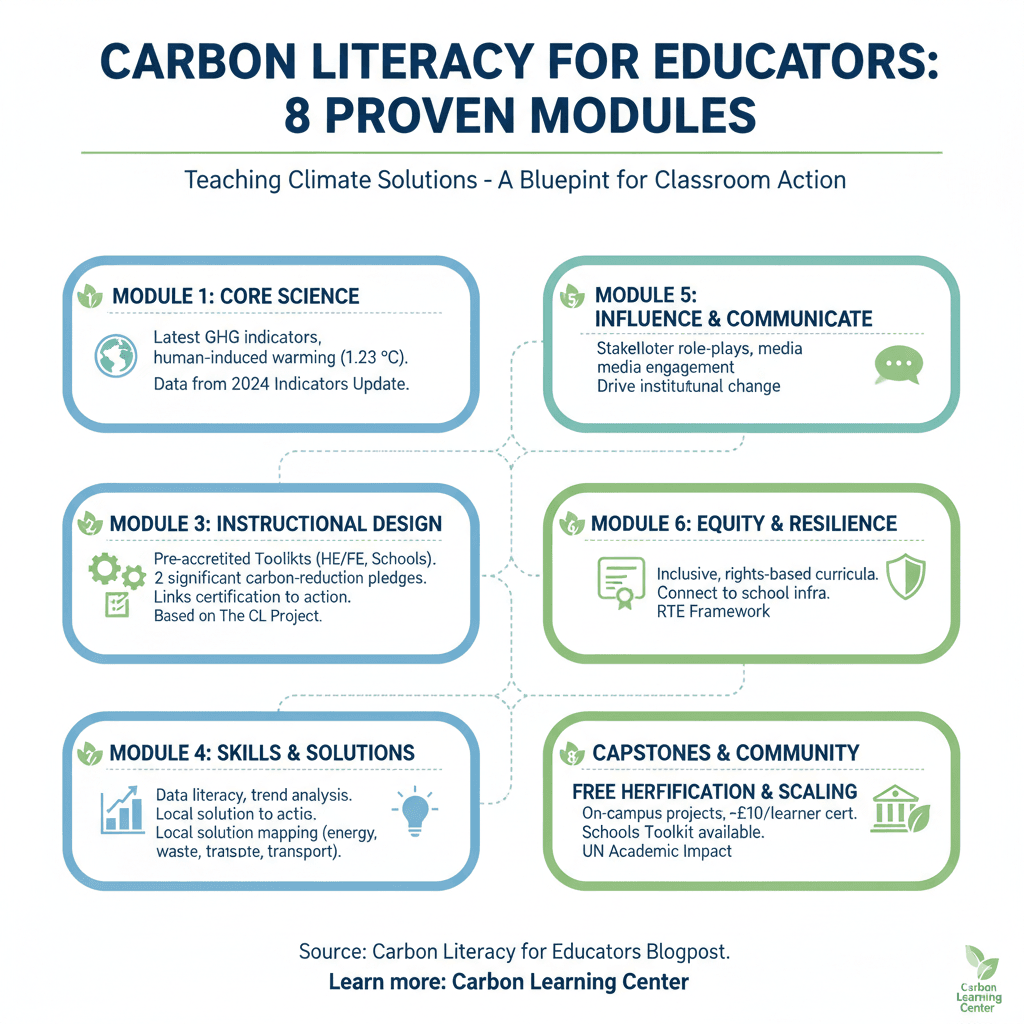
Table of Contents
The Guide
This guide is built for educators and instructional designers who need accredited content, flexible delivery (online, hybrid, in‑person), and defensible learning outcomes aligned to current, authoritative data. For the annual “state of climate” benchmarks that anchor lessons and assignments, use the 2024 update of Indicators of Global Climate Change and the peer‑review thread for methodological transparency in the ESSD review.
Module 1 — Core science with current indicators
Begin with the latest indicators: net GHG emissions, radiative forcing, human‑induced warming, energy imbalance, remaining carbon budget, and sea‑level rise; the 2024 update (published 2025) reports 2015–2024 human‑induced warming of about 1.22–1.23 °C and a decadal warming rate near 0.27 °C per decade, framing urgency for curriculum and action projects, per the 2024 Indicators update and its peer‑reviewed preprint discussion in ESSD. Use these numbers to scaffold quantitative assignments and localize impacts.
Toolkits supply sector‑tailored slides and activities that can be segmented into shorter sessions or delivered in a day, as described for higher and further education in CL for HE/FE and free university/college course kits in Free CL Tools.
Module 2 — Toolkit‑driven instructional design
Adopt pre‑accredited Carbon Literacy Toolkits to cut development time: sector courses from Manchester Metropolitan and Nottingham Trent are customizable for online, hybrid, or in‑person delivery, with peer‑to‑peer cascade models and accreditation workflows, outlined in CL for HE/FE and university/college access via Free CL Tools. Schools can deploy the dedicated CL for Schools Toolkit to bridge policy and action across staff and stakeholders as detailed in CL for Schools.
Toolkit updates improve accessibility and ensure currency, with sector milestone tracking documented in a 2025 note on Toolkit certification milestones.
Module 3 — Action‑based assessment
Carbon Literacy requires each learner to pledge two significant, within‑control actions and links certification to delivery of those commitments; this pedagogy converts knowledge into behavior and institutional change, as summarized by the Carbon Literacy Project overview in The CL Project. For staff development, align actions with institutional targets and create a course‑to‑policy pipeline using a higher‑ed climate action toolkit template in the HE Climate Action Toolkit.
School‑sector toolkits emphasize peer‑to‑peer delivery and a cascade effect to engage the wider community and support national net‑zero policies, per CL for Schools.
Module 4 — Skills: data literacy and solutions mapping
Use the Indicators dataset to teach graph literacy, uncertainty, and trend analysis; learners compute remaining carbon budget scenarios or compare human vs natural variability using the Indicators update and methodological notes in the ESSD review. Pair with sector solution mapping from local facilities (energy, waste, transport) to supply chain and food, and have students tie each proposed action to quantified emissions factors.
Universities and colleges can use ready‑to‑go accredited modules to anchor capstones and service‑learning, per Free CL Tools and toolkit access pathways in CL for HE/FE.
Module 5 — Pedagogy for influence and communication
Layer climate communication practice into the course: role‑plays for stakeholder conversations, prebunking/debunking exercises, and local media engagement. Toolkit courses include influence strategies and case‑based learning for educators and administrators to drive institutional changes, summarized under The CL Project. Embed assignments that align science, policy, and campus operations using the HE Climate Action Toolkit.
Schools’ toolkits support staff in integrating climate education into curricula and culture, creating a ripple effect across communities per CL for Schools.
Module 6 — Equity, rights, and resilience in education
Integrate equity and rights‑based perspectives so programs are inclusive and resilient; international frameworks call for greening curricula, teacher training, system capacity, and community linkages, with assessment to track learning outcomes in climate literacy, per a 2025 international framework on education, climate, and rights in the RTE framework. Connect classroom learning to school infrastructure and operations to build climate‑resilient, low‑carbon education systems.
Museums and cultural institutions can adapt pedagogy with the sector toolkit for museums, encouraging cross‑institution learning, per the CL for Museums Toolkit.
Module 7 — Certification, cost, and scaling
Accredited higher‑ed toolkits are free to download for institutions, with a modest per‑learner certification fee (~£10), enabling scale without large budgets, as noted in Free CL Tools. Toolkits for HE/FE list audience fit and delivery customizations and route educators to request access via CL for HE/FE.
Launch videos and sector briefings support rollout and staff buy‑in; schools have public launch content like the School Staff Course Toolkit Launch.
Module 8 — Capstones and community impact
Finish with capstones that implement on‑campus and community solutions: energy audits, food system interventions, mobility programs, and communications campaigns, all tracked against climate indicators for relevance and timing. UN Academic Impact showcases how embedding CL in programs certifies cohorts and supports employability, per Teaching Carbon Literacy to Combat Climate Change.
Use the latest indicator releases as “news pegs” for public showcases and media engagement, linking projects to current data in the Indicators update and synthesis summaries like the Zero Tracker explainer.
Opinion
Educators don’t need to build climate curricula from scratch: the Carbon Literacy Toolkits deliver accredited content, action‑based assessment, and flexible formats; when coupled with the annual Indicators update, courses stay current and credible. Programs that embed influence skills and equity, and tie learner actions to institutional targets, produce measurable decarbonization and graduates equipped for a net‑zero economy, as reflected across toolkit documentation in CL for HE/FE, Free CL Tools, and sector‑specific kits for Schools.
FAQs — Carbon Literacy for Educators: Teaching Climate Solutions
What makes Carbon Literacy different from a standard climate course?
Accredited toolkits, action‑based assessment (two significant actions per learner), and certification tied to delivery, described in The CL Project and sector kits in CL for HE/FE.
How do institutions keep content up to date?
Use the annual Indicators of Global Climate Change update as the scientific backbone for assignments and briefings, per the 2024 update in ESSD and review thread in ESSD preprint.
What does it cost to certify learners?
HE/FE toolkits are free to download; institutions typically pay a small per‑learner fee for certification (~£10), per Free CL Tools.
How can schools roll this out quickly?
Adopt the pre‑accredited Schools Toolkit and cascade via peer‑to‑peer delivery across staff and stakeholders, as described in CL for Schools.
Learn More
Explore practical next steps and foundational concepts in one place: start by testing scenarios with the free Coffset Carbon Footprint Calculator, then build fluency with our explainers What Is a Carbon Footprint?, What Is Carbon Offsetting?, and Reduce vs Offset: Why Both Matter. For more resources, visit the Coffset homepage, explore the Carbon Learning Center, or take action via Buy Carbon Credits.
Sources
- Carbon Literacy Project — Higher & Further Education: https://carbonliteracy.com/education/
- Carbon Literacy Project — Free tools for Universities & Colleges: https://carbonliteracy.com/free-cl-materials-for-all-universities-and-colleges/
- Carbon Literacy Project — Schools toolkit: https://carbonliteracy.com/schools/
- ESSD — Indicators of Global Climate Change 2024 (published 2025): https://essd.copernicus.org/articles/17/2641/2025/
- ESSD — Indicators of Global Climate Change (peer‑review thread): https://essd.copernicus.org/preprints/essd-2025-250/
- NALC — Carbon Literacy Project overview: https://www.nalc.gov.uk/campaigns/tackling-climate-change/the-carbon-literacy-project.html
- HE Climate Action Toolkit (Scotland): https://sustainablescotlandnetwork.org/uploads/store/mediaupload/1334/file/he_climate_action_toolkit_v2.pdf
- UN Academic Impact — Teaching Carbon Literacy: https://www.un.org/en/academic-impact/teaching-carbon-literacy-combat-climate-change