10 Smart Moves: Energy Storage and Home Carbon Reduction
Energy Storage and Home Carbon Reduction shows how batteries, smart heat pump water heaters, and flexible loads cut household emissions and bills by shifting consumption to cleaner, cheaper hours and soaking up rooftop solar that would otherwise be exported. The key is sequencing: tighten the envelope and electrify first, then size storage to align with time‑of‑use tariffs, grid carbon intensity, and virtual power plant programs for the biggest carbon and cost wins. Recent analyses and guides highlight how residential batteries and controllable loads reduce fossil peaker use, improve self‑consumption, and participate in emerging grid programs across regions. See EU and global perspectives on the role of home storage from Ember’s 2024–2025 assessments and market outlooks.
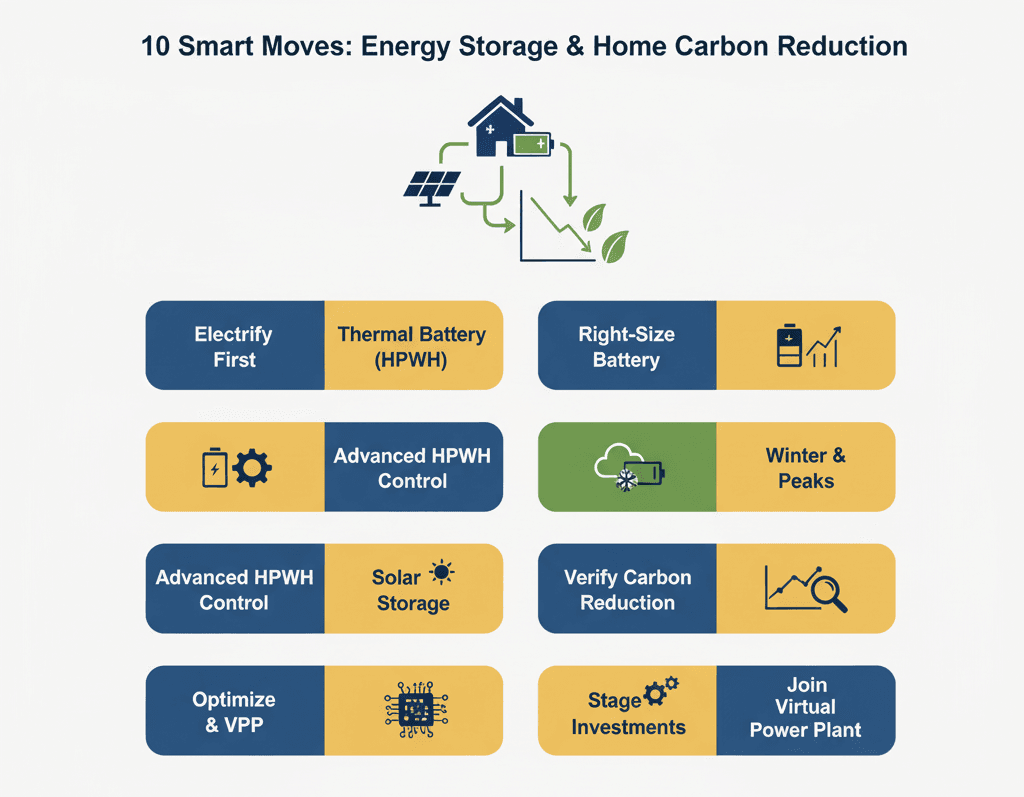
Table of Contents
The Guide
This guide distills ten practical moves—batteries, HPWH load shifting, inverter strategy, and controls—to maximize carbon reduction per euro invested. It cites lab and field results on heat pump water heater (HPWH) demand shifting, residential storage dispatch value, and small‑scale solar plus storage adoption projections that inform sizing and control choices today. Review NREL’s storage duration insights, PNNL and ACEEE HPWH shifting studies, and adoption projections from Australia’s AEMO/CSIRO and market primers.
Move 1 — Electrify first, then add storage
Complete envelope upgrades and electrify hot water and space conditioning so storage can be sized to the real, lower load; batteries then serve genuine peak shaving and solar soaking instead of masking inefficiency. Storage can time‑shift midday solar into evening peaks and support demand response, reducing fossil reliance highlighted in EU analyses of battery storage’s system value.
Projections show accelerating small‑scale PV plus batteries in multiple markets, with adoption trajectories informing pricing and program design; incorporating storage after electrification improves economics and emissions performance in scenario work.
Move 2 — Right‑size the battery to goals and tariffs
Size for the job: backup only (few critical hours), time‑of‑use arbitrage (daily cycling), or deep solar self‑consumption (larger kWh). Dispatch strategies optimized for bill savings often overlap with emissions reduction when peak periods are fossil‑heavy; studies of optimal dispatch and payback emphasize aligning control logic to tariff and carbon signals.
NREL shows most capacity and arbitrage value captured by ~4‑hour batteries in many regions, with diminishing returns beyond 4 hours unless winter peaks or long events dominate; this informs practical residential sizing and expectations.
Move 3 — Use HPWHs as thermal batteries
HPWHs cut water heating energy by 65%+ versus resistance and can pre‑heat (“load up”) when power is clean/cheap, then coast through peaks, acting like a thermal battery; lab studies show peak reductions up to ~0.5 kW per device and added thermal storage with advanced controls (CTA‑2045‑B).
Field and simulation work finds daily load shifting with high setpoints and mixing valves yields meaningful bill and energy savings, with strategies like “load‑up/shed” or “optimal price” delivering ~10–20% cost savings across climates and house sizes when properly configured.
Move 4 — Program advanced HPWH control modes
Advanced Load Up (ALU) raises tank temperature safely to store extra heat for several hours and improves peak‑time performance; evaluations report around 0.20 kW evening peak reduction per unit and average annual emissions reductions on the order of tens of kilograms CO₂e per device under tested conditions.
Key takeaways from recent round‑ups: high‑temp storage and correct mixing valves maximize shift potential; without sufficient pre‑heat, peak shedding risks comfort shortfalls; controller logic and tank volume matter for persistence.
Move 5 — Pair rooftop solar with storage for self‑consumption
A PV‑battery system increases self‑consumption, reduces exports, and improves resilience; contemporary homeowner guides and outlooks explain sizing, battery chemistries, hybrid inverters, and climate adaptations needed for reliable operation. Integrating storage with PV prepares households for evolving net metering and outage risks while enabling VPP participation.
EU analyses emphasize how storage shifts solar beyond sunny hours and reduces fossil peaker needs at dusk; in homes, the same principle boosts on‑site solar utilization and lowers grid carbon exposure during peaks.
Move 6 — Optimize inverter and circuit strategy
Hybrid inverters simplify PV‑battery integration; plan critical loads panels for backup and label circuits for safe operation. Smart meter data and real‑time dashboards help validate control logic and ensure storage is actually charging during low‑carbon hours and discharging during high‑carbon/price peaks. Homeowner and market guides outline integration steps and climate‑specific hardware choices.
Advanced control platforms can follow grid carbon intensity, not just price; combining both signals can further lower emissions in regions where carbon intensity and peak prices diverge.
Move 7 — Join a virtual power plant (VPP)
Enroll batteries and HPWHs in VPPs or demand response to earn payments while supporting the grid during stress events; with the right contracts, program dispatch aligns with high‑emission hours, compounding carbon benefits described in EU and global storage syntheses.
Program terms vary (event length, frequency, minimum state of charge); choose offers that preserve backup needs and household comfort while maximizing grid support revenues.
Move 8 — Plan for winter and longer peaks
In electrified, winter‑peaking regions, 4‑hour batteries may be insufficient for long cold spells; NREL shows extra duration has diminishing returns in many markets but can matter where peaks extend; combine battery storage with envelope upgrades and pre‑heating strategies to ride through longer events.
HPWH and HVAC pre‑heating before peak windows can reduce required battery discharge duration and power, improving overall system effectiveness during multi‑hour peaks.
Move 9 — Use data to verify carbon reductions
Track hourly usage, PV generation, battery state‑of‑charge, and local grid carbon intensity; dashboards confirm that control logic is shifting load to lower‑carbon hours. Studies and projections underscore the importance of data‑driven control to realize modeled benefits at scale.
Review bills and device logs quarterly to retune control schedules, especially after tariff changes or when adding new loads (e.g., EVs, heat pumps).
Move 10 — Stage investments to de‑risk
Start with HPWH controls and basic demand shifting, then add a modest battery and expand once benefits are verified; research on optimal dispatch and payback highlights the value of staged upgrades while markets and tariffs evolve.
Outlook reports indicate accelerating storage markets and expanding homeowner program options, suggesting early adopters can stack benefits (bill savings, grid payments, resilience) while contributing to system‑level fossil reductions.
Opinion
Batteries don’t decarbonize a leaky, gas‑heated home—but as the last step in a sensible sequence, storage multiplies the gains from electrification by moving demand to the cleanest hours and capturing on‑site solar. The best carbon results come from “thermal first, electrons second”: pre‑heat with HPWHs, then let the battery cover long or dirty peaks, and enroll both in grid programs that pay for flexibility, as supported by HPWH studies, storage duration analyses, and EU market outlooks.
FAQs — Energy Storage and Home Carbon Reduction
How much storage do most homes need?
For daily shifting and backup of critical loads, many households find ~4‑hour batteries capture most value; longer duration helps in winter‑peaking regions or multi‑hour events, per NREL’s duration analysis.
Do HPWHs really help with peak load?
Yes—HPWHs can pre‑heat and coast through evening peaks, with lab studies showing up to ~0.5 kW peak reduction per unit and added thermal storage via advanced controls.
Is PV required to benefit from a battery?
No—batteries can arbitrage time‑of‑use and support VPPs even without PV; however, pairing with rooftop solar increases self‑consumption and carbon benefits, as explained in EU storage analyses and homeowner guides.
Learn More
Explore practical next steps and foundational concepts in one place: start by testing scenarios with the free Coffset Carbon Footprint Calculator, then build fluency with our explainers What Is a Carbon Footprint?, What Is Carbon Offsetting?, and Reduce vs Offset: Why Both Matter. For more resources, visit the Coffset homepage, explore the Carbon Learning Center, or take action via Buy Carbon Credits.
Sources
- Ember — EU battery storage is ready for its moment in the sun (2024): https://ember-energy.org/app/uploads/2024/10/Report-EU-battery-storage-is-ready-for-its-moment-in-the-sun.pdf
- SolarPower Europe — European Market Outlook for Battery Storage 2025–2029: https://www.solarpowereurope.org/insights/outlooks/european-market-outlook-for-battery-storage-2025-2029/detail
- Ember — Renewables market has moved; storage outlook: https://ember-energy.org/latest-insights/renewables-market-have-moved-but-governments-have-not/
- NREL — Moving Beyond 4‑Hour Li‑Ion Batteries: https://docs.nrel.gov/docs/fy23osti/85878.pdf
- PNNL — HPWH load shifting potential (lab study): https://www.pnnl.gov/publications/detailed-evaluation-electric-demand-load-shifting-potential-heat-pump-water-heaters
- Ecotope/CEC — HPWH price‑optimized load shifting (simulation): https://efiling.energy.ca.gov/GetDocument.aspx?tn=232168&DocumentContentId=64120
- ACEEE — HPWH Advanced Load Up results: https://www.aceee.org/sites/default/files/proceedings/ssb24/pdfs/Heat%20Pump%20Water%20Heater%20Daily%20Load%20Shifting%20-%20Advanced%20Load%20Up%20and%20Evaluation%20Challenges.pdf
- AEMO/CSIRO — Small‑scale solar PV and battery projections (2024): https://www.aemo.com.au/-/media/files/major-publications/isp/2025/CSIRO-2024-Solar-PV-and-Battery-Projections-Report
- Homeowner market primer — Clean electricity, PV+storage, VPPs: https://www.ecoflow.com/us/blog/clean-electricity-home-guide
- Residential PV+storage integration guide (2025): https://eco-greenenergy.com/residential-solar-ultimate-guide-2025/
SEO assets block
- SEO Title: 10 Smart Moves: Energy Storage
- Home Carbon Reduction
- Slug: energy-storage-and-home-carbon-reduction
- Meta Description: Energy Storage & Home Carbon Reduction: Cut home emissions with batteries and smart heat pump water heaters. Shift to clean hours, soak up solar, and earn VPP payments—without over‑sizing.
- Focus Keyword: Energy Storage and Home Carbon Reduction
- LSI keywords: home battery storage, heat pump water heater, load shifting, time‑of‑use, rooftop solar, self‑consumption, virtual power plant, carbon intensity, hybrid inverter, resilience