Portfolio Playbook: Corporate Carbon Offset Portfolio Management
Corporate Carbon Offset Portfolio Management is about sequencing, screening, and disclosure—cut real emissions first, then use high‑integrity credits for residuals, shift the mix toward durable removals on a time‑bound glidepath, and communicate claims precisely. The revised Oxford Offsetting Principles, ICVCM’s Core Carbon Principles, and VCMI’s Claims and Scope 3 Action Codes together provide a coherent framework to build, manage, and report a portfolio that stands up to scrutiny. See Oxford’s 2024 revision for the trajectory to durable removals, ICVCM’s CCPs for baseline credit quality, and VCMI’s guidance on high‑integrity claims and scope 3 gap financing.
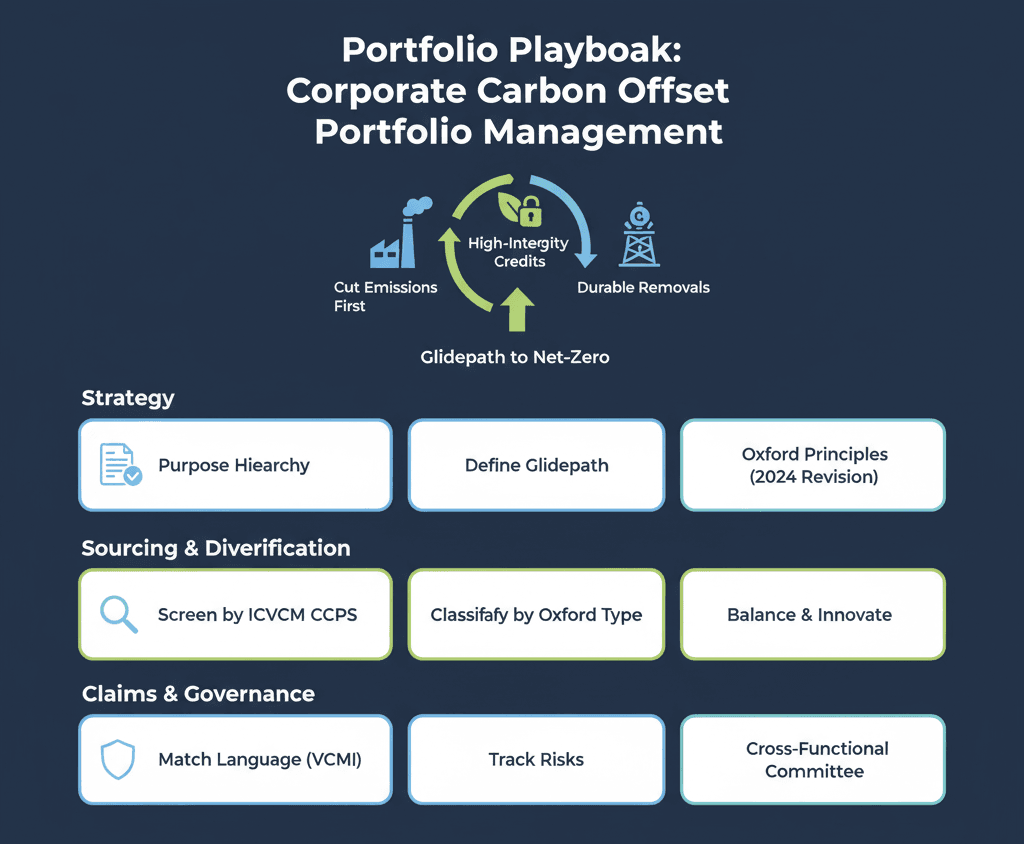
Table of Contents
Strategy
Set a purpose hierarchy: value‑chain decarbonization remains primary; credit use is for residuals or for beyond‑value‑chain contributions without equivalence claims. The revised Oxford principles instruct buyers to ramp from reductions to removals, and from short‑lived to long‑lived storage, aiming for durable removals to neutralize residuals at net‑zero. This provides the backbone for time‑series allocation and pipeline planning.
Define a glidepath with dated milestones to raise the share of removals and storage durability by the target year; document rationale and procurement rules so yearly progress is auditable. Oxford’s 2024 text anchors this glidepath and clarifies durability as a continuum with differentiated risks and governance needs.
Sourcing
Screen first to CCPs, then use ratings: apply ICVCM’s Core Carbon Principles for non‑negotiables—additionality, robust quantification, permanence buffers/liability, no double counting, governance/verification, and transparency—to weed out low‑integrity options before consulting any rating. CCPs are the market’s baseline integrity threshold across credit types.
Classify each candidate by action and storage durability per Oxford: reductions vs removals, and storage risk from short‑ to long‑lived; prioritize Type V‑like durable removals over time while maintaining some high‑integrity reductions in early years. Portfolio construction notes from Oxford explain how buyers should migrate credit mix as supply scales.
Diversification
Balance near‑term, high‑integrity reductions (e.g., jurisdictional nature with strong leakage/accounting) with early offtakes in durable removals (DACCS, mineralization) to grow capacity; Oxford urges supporting innovation alongside reduction of reliance on short‑lived storage. Buyers can reference Oxford‑aligned market explainers for practical procurement steps.
Within removals, diversify across engineered and geochemical pathways while enforcing strict MRV, transport and storage liability, and end‑to‑end verification; use CCP‑aligned program/methodology checks as a minimum bar across providers and registries.
Claims
Match language to durability and target timing: near‑term purchases beyond the value chain can be framed as “contributions,” while net‑zero end‑state claims should be backed predominantly by durable removals, in line with Oxford’s claims guidance. Avoid implying tonne‑for‑tonne equivalence when permanence risks differ materially.
If addressing scope 3 gaps with credits, follow VCMI’s Scope 3 Action Code: disclose the quantified gap to science‑aligned targets, actions and barriers, and retire high‑quality credits up to the defined threshold, while continuing to reduce value‑chain emissions. This creates a structured, transparent pathway to close hard‑to‑abate scope 3 while keeping ambition high.
Risk management
Institutionalize a diligence binder per project: program/method eligibility, additionality/baselines, leakage controls, permanence buffers and reversal remedies, registry status, verifier statements, and monitoring plans, aligned with CCP themes. This standardizes procurement and eases later audits.
Track counterparty and policy risk, especially for novel removals; stagger tenors, stage payments to milestones, and require step‑in rights where feasible. Use Oxford’s durability continuum to score reversal risk and set buffer preferences accordingly.
Pipeline and offtakes
Reserve a portfolio sleeve for early‑stage durable CDR offtakes to accelerate supply consistent with net‑zero timelines; Oxford and market explainers stress the “removals gap” and the need for early demand to scale capacity. Set clear MRV and delivery conditions to protect integrity and learn‑by‑doing.
Blend spot purchases for near‑term coverage with multi‑year contracts to lock future volumes at predictable prices; ensure contracts specify storage liability periods and post‑closure monitoring consistent with permanence goals.
Disclosure
Publish an annual portfolio table: volumes by Oxford type, storage durability, standard/registry/method, geography, and vintage; show year‑over‑year migration toward removals/durability and explain deviations. Oxford’s 2024 revision encourages transparent trajectories and durability‑aware accounting.
Align public claims to VCMI’s Claims Code and Scope 3 Action Code where applicable; disclose methodology for CCP screening and any additional buyer criteria (e.g., co‑benefits, community safeguards) to support stakeholder trust.
Governance
Create a cross‑functional committee (sustainability, legal, finance, procurement) to approve standards, methods, and claims; adopt CCPs as the minimum bar and Oxford as the directional compass. Maintain a policy that offsets cannot substitute for required internal reductions.
Schedule quarterly reviews to refresh screens as CCP assessments evolve and as Oxford‑aligned guidance updates; integrity councils and researchers continue to refine standards and durability expectations—keep the policy living.
Opinion
Treat the offset portfolio like a regulated asset: baseline integrity via CCPs, forward strategy via Oxford’s glidepath to durable removals, and public claims governed by VCMI’s codes. That combination reduces greenwashing risk, builds market capacity where the world needs it most, and gives boards a defensible, time‑bound plan for addressing residual emissions.
FAQs — Corporate Carbon Offset Portfolio Management
What should be the first screen for any credit?
Apply the ICVCM Core Carbon Principles for additionality, quantification, permanence, governance, transparency, and no double counting before using external ratings or co‑benefit criteria.
How should the portfolio evolve toward net‑zero?
Follow Oxford’s trajectory: reduce value‑chain emissions, then increase the share of removals and storage durability over time, aiming for durable removals to neutralize residuals at the target date.
Can credits be used to address scope 3 gaps now?
Yes—with guardrails: disclose the quantified scope 3 gap and barriers, continue value‑chain reductions, and retire high‑quality credits within VCMI’s threshold, following the Scope 3 Action Code.
Learn More
Explore practical next steps and foundational concepts in one place: start by testing scenarios with the free Coffset Carbon Footprint Calculator, then build fluency with our explainers What Is a Carbon Footprint?, What Is Carbon Offsetting?, and Reduce vs Offset: Why Both Matter. For more resources, visit the Coffset homepage, explore the Carbon Learning Center, or take action via Buy Carbon Credits.
Sources
- University of Oxford — Revised Oxford Offsetting Principles (2024): https://www.smithschool.ox.ac.uk/sites/default/files/2024-02/Oxford-Principles-for-Net-Zero-Aligned-Carbon-Offsetting-revised-2024.pdf
- University of Oxford — Offsetting Principles hub: https://www.smithschool.ox.ac.uk/research/oxford-offsetting-principles
- ICVCM — Core Carbon Principles: https://icvcm.org/core-carbon-principles/
- ICVCM — High-integrity carbon markets overview: https://icvcm.org
- VCMI — Scope 3 Action Code of Practice (2025): https://vcmintegrity.org/wp-content/uploads/2025/04/VCMI-Scope-3-Action-Code-of-Practice.pdf
- VCMI — Scope 3 Action hub: https://vcmintegrity.org/scope-3-action/
- CEEZER — Guide to the revised Oxford Offsetting Principles: https://ceez er.earth/insights/oxford-offsetting-principles-guide
- Net Zero Climate — Oxford launches revised Offsetting Principles: https://netzeroclimate.org/oxford-launches-revised-offsetting-principles/
- Calyx Global — What’s the difference between SBTi, VCMI, ICVCM and Oxford?: https://calyxglobal.com/research-hub/commentary/whats-the-difference-between-sbti-vcmi-icvcm-and-the-oxford-principles