Frontier Technologies in Carbon Removal: Case Studies

Frontier technologies in carbon removal are moving from prototypes to purchase orders, with direct air capture (DAC), ocean-based CDR, and mineralization each advancing through first‑of‑a‑kind projects, new definitions, and growing public funding. The case studies below focus on what’s deployable, what’s still in research mode, and how buyers and policymakers can back the right milestones with clear MRV and liability terms, drawing on the U.S. Department of Energy’s 2025 definition of DAC, updated cost syntheses, EU perspectives on DAC’s role, and national research strategies for marine CDR.
For foundational scope and technology mapping, start with the DOE’s 2025 report Direct Air Capture: Definition and Company Analysis, an IEAGHG cost review in Global Assessment of Direct Air Capture Costs, and the National Academies’ ocean CDR blueprint in A Research Strategy for Ocean‑based Carbon Dioxide Removal and Sequestration.
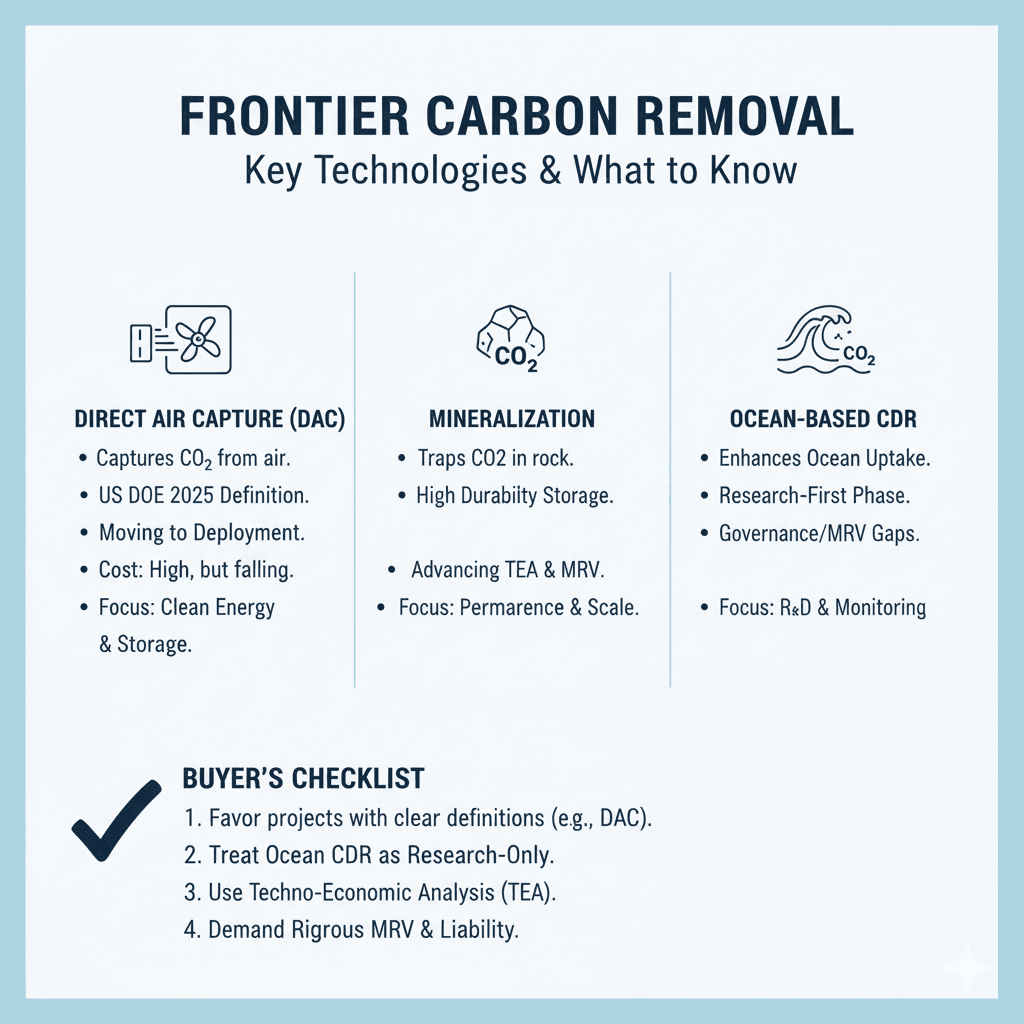
Table of Contents
Case 1 — Direct air capture: definition, landscape, and costs
In 2025 the U.S. DOE published a precise operational definition of DAC that clarifies what counts and what does not, distinguishing DAC from point‑source capture and biological uptake, and categorizing approaches (CO₂‑concentrating DAC, reactive DAC, direct‑storage DAC) by capture medium and air contactor design—critical for eligibility, MRV, and funding programs; see the DOE’s scope and company analysis in Direct Air Capture: Definition and Company Analysis and the companion listing via OurEnergyPolicy. Cost and performance evidence has tightened, with IEAGHG’s multi‑source synthesis and developer data providing removal cost ranges and drivers across sorbent/solvent systems and energy integration, summarized in Global Assessment of Direct Air Capture Costs and earlier technical report detail in the 2021 IEAGHG study Global Assessment of Direct Air Capture Costs.
Techno‑economic updates in 2025 compare novel DAC configurations and project learning curves, while policy briefs track market signals and procurement models emerging post‑Inflation Reduction Act and early offtakes, as surveyed in WRI’s explainer 6 Things to Know About Direct Air Capture and an EU perspective on deployment pathways in The role of Direct Air Capture technologies in the EU’s climate strategy.
Case 2 — DAC siting and integration: energy, storage, and policy
DAC’s energy intensity makes siting with clean, firm power and access to CO₂ transport and storage decisive; DOE’s definition report emphasizes closed‑loop media regeneration and atmospheric capture, which guides cluster development near low‑carbon energy and Class VI storage, in Direct Air Capture: Definition and Company Analysis. EU analysis explores DAC’s role relative to industrial decarbonization, storage capacity, and cross‑border CO₂ networks, offering scenarios for European hubs in The role of Direct Air Capture technologies in the EU’s climate strategy.
As public support expands, federal newsletters and grant announcements show increased funding for FOAK pilots and MRV tooling to reduce unit costs and standardize verification, with program snapshots in DOE communications like the FECM update embedded in the Carbon Capture Newsletter.
Case 3 — Mineralization and enhanced weathering: permanence and TEA
Mineralization reacts CO₂ into stable carbonates, offering high‑durability storage across in‑situ (basalts, peridotites) and ex‑situ (industrial residues) approaches; recent comparative techno‑economic assessments evaluate process routes, feedstocks, and energy needs for scalable operations, as outlined in 2025 journal analyses such as A comparative techno‑economic assessment of CO₂ mineralization pathways. IEAGHG reviews also cover accelerated mineralization and conversion options as part of the broader DACCS cost and pathway landscape, summarized in Global Assessment of Direct Air Capture Costs and detailed in the 2021 technical report Global Assessment of Direct Air Capture Costs.
Key diligence points include feedstock logistics, reaction kinetics, co‑product markets, and MRV that quantifies net removal after energy and processing emissions, themes reflected across cost syntheses and WRI primers like 6 Things to Know About Direct Air Capture.
Case 4 — Ocean‑based CDR: research first, procurement later
Marine CDR methods—ocean alkalinity enhancement, electrochemical removal, and biomass sinking—are in a research‑first phase with substantial governance and MRV gaps; the National Academies’ research agenda lays out pilot priorities, environmental monitoring, and decision frameworks to determine which approaches merit scale, in A Research Strategy for Ocean‑based Carbon Dioxide Removal and Sequestration and its open‑access book version via NCBI Bookshelf. U.S. federal strategy for marine CDR emphasizes building a knowledge base by 2030 to inform policy choices, with program coordination and community engagement outlined in the National Marine Carbon Dioxide Removal Research Strategy.
For non‑U.S. buyers and researchers, WRI’s overview of U.S. ocean CDR momentum provides a succinct context for governance and funding trends in 5 Things to Know About Ocean Carbon Removal in the US.
Case 5 — Procurement models: from pilots to portfolios
Corporate buyers shifting from reductions to removals are testing multi‑year DAC and mineralization offtakes with milestone‑based payments and rigorous MRV, a pattern consistent with DOE’s definition and IEAGHG cost evidence that favors high‑durability storage as net‑zero approaches, in Direct Air Capture: Definition and Company Analysis and Global Assessment of Direct Air Capture Costs. EU policy studies argue for integrating DAC into industrial clusters and transport/storage networks to leverage scale and reduce delivered removal costs, guiding public‑private portfolio design in The role of Direct Air Capture technologies in the EU’s climate strategy.
TEA studies of novel DAC configurations help buyers set price expectations and structure contract risk, with 2025 analyses discussing cost trajectories toward the low hundreds per ton by mid‑century under favorable learning and energy scenarios, as reviewed in Techno‑economic analysis of two novel direct air capture configurations and plain‑language market status in Direct Air Capture in 2025: The End of Hype, the Start of Delivery.
Case 6 — MRV and liability: making tonnes defendable
High‑durability removals require end‑to‑end MRV: capture energy and mass balance, transport metering, storage verification, and post‑closure monitoring tied to liability terms; DOE’s definition clarifies DAC system boundaries, strengthening MRV design for both project registries and corporate accounting, as set out in Direct Air Capture: Definition and Company Analysis. For ocean CDR, the National Academies stress environmental baselines, tracer studies, and ecosystem impact monitoring before procurement, guiding grantmaking and claims integrity in A Research Strategy for Ocean‑based Carbon Dioxide Removal and Sequestration.
Public agencies continue to publish accessible primers that compare pathways, permanence, and resource constraints across the CDR portfolio, anchoring buyer education in vetted science; see DOE’s high‑level portal Carbon Dioxide Removal and WRI’s DAC overview 6 Things to Know About Direct Air Capture.
What to fund next: a buyer’s checklist
- Favor projects consistent with DOE’s DAC definition or with peer‑reviewed mineralization MRV, and treat marine CDR as research‑only until governance and MRV mature; see Direct Air Capture: Definition and Company Analysis and A Research Strategy for Ocean‑based Carbon Dioxide Removal and Sequestration.
- Co‑locate DAC with low‑carbon energy and storage networks to reduce delivered removal cost; align with EU cluster insights in The role of Direct Air Capture technologies in the EU’s climate strategy.
- Use TEA benchmarks and IEAGHG syntheses to size offtake sleeves and stage payments to verified milestones, referencing Global Assessment of Direct Air Capture Costs and Techno‑economic analysis of DAC configurations.
Opinion
Frontier CDR is past the concept stage: DAC definitions are firming, mineralization routes are quantifying permanence at scale, and ocean CDR has a clear research agenda before procurement.
The advantage now lies with portfolios that buy learning—multi‑year offtakes with tight MRV and storage liability—while funding the science that will tell us which ocean approaches, if any, deserve a ticket to deployment; that balance is visible across DOE’s 2025 DAC definition, IEAGHG cost syntheses, EU cluster studies, and the National Academies’ marine CDR roadmap in Direct Air Capture: Definition and Company Analysis, Global Assessment of Direct Air Capture Costs, The role of Direct Air Capture technologies in the EU’s climate strategy, and A Research Strategy for Ocean‑based Carbon Dioxide Removal and Sequestration.
FAQs — Frontier Technologies in Carbon Removal: Case Studies
What makes DAC “DAC” under current U.S. definitions?
DAC must regenerate a capture medium in a closed loop and/or use a mechanical air contactor to separate CO₂ directly from ambient air; it excludes point‑source capture and purely biological uptake, per DOE’s 2025 definition in Direct Air Capture: Definition and Company Analysis.
Are durable removals affordable yet?
Costs are high but narrowing; multi‑source syntheses and developer data show pathways for cost decline with clean energy, heat integration, and learning, summarized in IEAGHG’s Global Assessment of Direct Air Capture Costs and 2025 TEAs such as Techno‑economic analysis of DAC configurations.
Should ocean CDR be purchased today?
Not for large‑scale procurement; research and environmental monitoring must mature first under frameworks like the National Academies’ roadmap in A Research Strategy for Ocean‑based Carbon Dioxide Removal and Sequestration and the federal strategy in National Marine Carbon Dioxide Removal Research Strategy.
Learn More
Explore practical next steps and foundational concepts in one place: start by testing scenarios with the free Coffset Carbon Footprint Calculator, then build fluency with our explainers What Is a Carbon Footprint?, What Is Carbon Offsetting?, and Reduce vs Offset: Why Both Matter. For more resources, visit the Coffset homepage, explore the Carbon Learning Center, or take action via Buy Carbon Credits.
Sources
- U.S. DOE — Direct Air Capture: Definition and Company Analysis (2025): https://www.energy.gov/sites/default/files/2025-01/Direct%20Air%20Capture%20Definition%20and%20Company%20Analysis%20Report.pdf
- IEAGHG — Global Assessment of Direct Air Capture Costs (2024 hub): https://ieaghg.org/publications/global-assessment-of-direct-air-capture-costs/
- IEAGHG — Global Assessment of Direct Air Capture Costs (2021 technical report): https://publications.ieaghg.org/technicalreports/2021-05%20Global%20Assessment%20of%20Direct%20Air%20Capture%20Costs.pdf
- European Parliament — The role of Direct Air Capture technologies in the EU’s climate strategy (2025): https://www.europarl.europa.eu/RegData/etudes/STUD/2025/772474/ECTI_STU(2025)772474_EN.pdf
- National Academies — A Research Strategy for Ocean‑based Carbon Dioxide Removal and Sequestration: https://www.nationalacademies.org/our-work/a-research-strategy-for-ocean-carbon-dioxide-removal-and-sequestration
- NCBI Bookshelf — Ocean‑based CDR research strategy (open access): https://www.ncbi.nlm.nih.gov/books/NBK580048/
- U.S. DOE FECM — Carbon Dioxide Removal overview: https://www.energy.gov/fecm/carbon-dioxide-removal-0
- WRI — 6 Things to Know About Direct Air Capture: https://www.wri.org/insights/direct-air-capture-resource-considerations-and-costs-carbon-removal