7 Advanced Moves: Advanced Carbon Literacy for Professionals and Activists

Advanced Carbon Literacy for Professionals and Activists equips teams to move beyond basics—mastering up‑to‑date climate indicators, claims integrity, misinformation defense, and program design—so campaigns and corporate initiatives deliver verifiable impact. This guide blends the Carbon Literacy Project’s toolkit approach with current science on emissions and warming indicators and evidence‑backed strategies for prebunking and debunking climate misinformation. For structured training resources, see the Carbon Literacy Project’s Toolkits and sector implementations such as the Carbon literacy action toolkit, alongside annual climate indicators in the 2024 and 2025 updates of Indicators of Global Climate Change and its 2025 update.
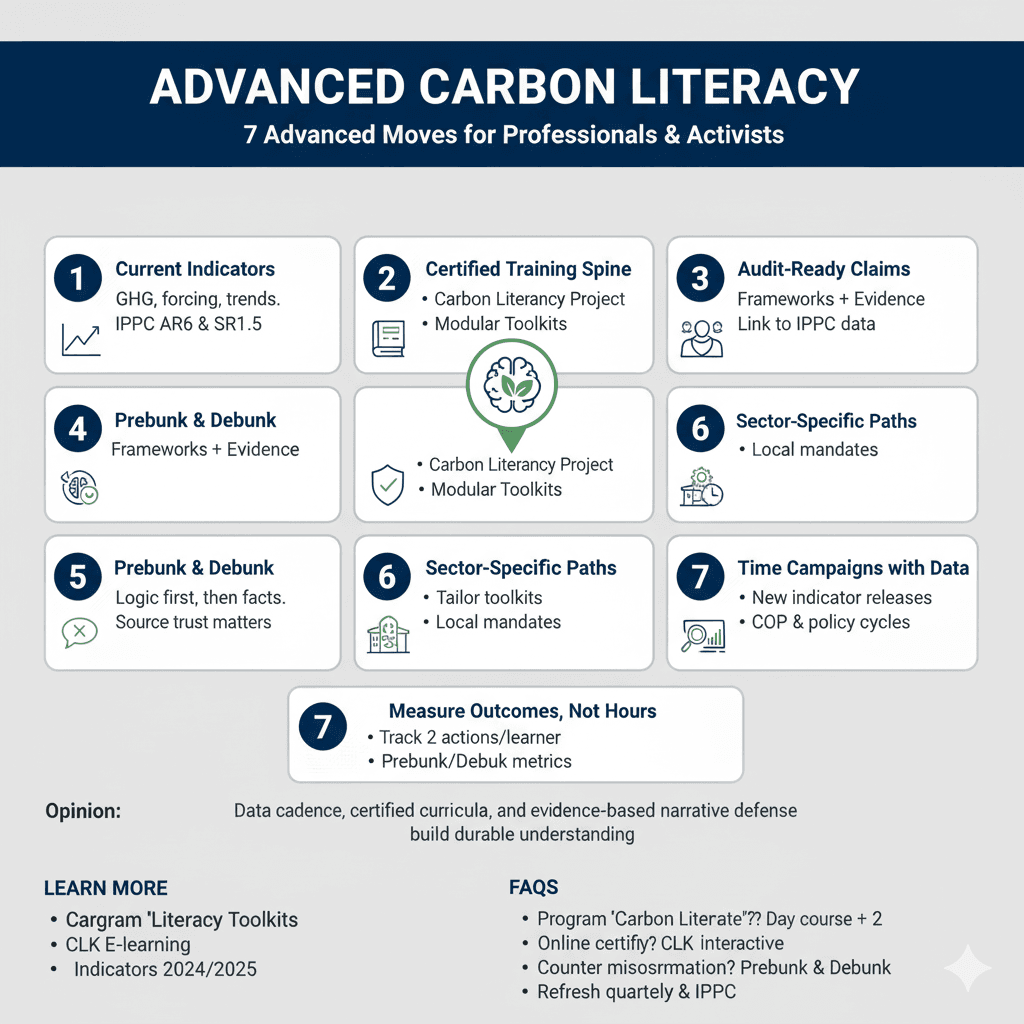
Table of Contents
Introduction
This article is designed for practitioners who need to brief decision‑makers, shape narratives, and build programs that stand up to scrutiny. It also summarizes advanced training formats and e‑learning scaffolds like the Carbon Literacy CLK e‑learning framework, while emphasizing that full certification requires interactive, action‑oriented work.
Move 1 — Anchor actions in current indicators
Open with the latest global indicators: total GHG emissions, effective radiative forcing, and drivers of year‑to‑year variation, so strategies and messaging reflect current conditions; see the 2023 update of Indicators of Global Climate Change and the 2024 dataset update with 2023–2024 emissions and aerosol notes in the 2025 update. Use these figures to frame budgets, timelines, and sector priorities in briefings.
The IPCC’s AR6 Synthesis and SR1.5 remain core references for pathways and risk framing—keep them in the “source pack” for executives and media engagements via the AR6 Synthesis Report and Global Warming of 1.5°C.
Move 2 — Adopt a certified training spine
Use the Carbon Literacy Project’s modular toolkits to scale delivery across teams and sectors, customizing case studies and local data while preserving standards; browse available Toolkits and sector rollouts like the Carbon literacy action toolkit. For blended learning, scaffold with the Carbon Literacy e‑learning framework (CLK), noting it contributes knowledge toward certification but still requires interactive components.
Sector examples (councils, museums, universities) show how to align a one‑day course with local decision contexts and action plans; see the higher‑ed and cultural implementations via the Universities/Colleges toolkit and the Museums toolkit.
Move 3 — Make claims audit‑ready
Ground public and corporate claims in recognized frameworks and keep an evidence binder with sources and calculations. The IPCC AR6 synthesis remains the “why,” while the annual indicators offer the “now,” so pair the AR6 Synthesis Report with current Indicators 2024 and Indicators 2025.
For trainings, align outcomes to Carbon Literacy’s action commitments and tracking conventions to maintain credibility and comparability, following the design philosophy embedded in the Carbon Literacy Toolkits and action‑oriented templates like the MMU action toolkit.
Move 4 — Prebunk and debunk effectively
Equip spokespeople with short prebunks (logic‑focused) for common myths and robust debunks (fact‑ and logic‑focused) that cite primary sources. A 2024 comparative study finds debunking generally outperforms prebunking overall, while logic‑focused prebunks are effective when used before exposure, summarized in a research comparison on debunking vs prebunking and EU analysis that both strategies work with debunk slightly stronger in a JRC brief.
Related experimental work shows source trust and messaging type shape corrections’ effectiveness, reinforcing the need to match tactics to audiences; see a 2024 study on source trust and (pre)debunking.
Move 5 — Build sector‑specific pathways
Professionals and activists need sector lenses (health, education, local government, culture) to move from generic advice to specific mandates and budgets. The Carbon Literacy Project curates sector toolkits to speed adoption without “reinventing the wheel,” as described in the general Toolkits and exemplified for municipalities in a local government overview of the Carbon Literacy Project’s course.
Higher education institutions can leverage turnkey materials and business cases via the Universities and Colleges toolkit and local action scaffolds in the MMU action toolkit.
Move 6 — Use indicators to time campaigns
Tie messaging to new data drops to stay relevant and newsworthy: annual climate indicator releases provide fresh hooks for media, internal town halls, and board updates; see Indicators 2024 and the expanded 2025 update. Align calls to action with emissions milestones and sector‑specific signals in the IPCC AR6 Synthesis.
Campaign calendars should anticipate COP cycles and national policy updates, weaving them into training and mobilization tracks.
Move 7 — Train facilitators and scale delivery
Adopt a train‑the‑trainer model using certified curricula to scale rapidly while maintaining quality. The Carbon Literacy e‑learning CLK framework provides a knowledge spine, but completion requires interactive sessions to meet the Standard.
Sector teams can adapt slide decks, trainer manuals, and activities from the Museums toolkit and the Universities/Colleges toolkit, while municipal partners can build local action plans through the MMU action toolkit.
Move 8 — Measure outcomes, not hours
Define success by actions taken and emissions influenced, not seat time; Carbon Literacy emphasizes two meaningful actions per learner and follow‑up tracking, a design principle across the Toolkits. Use indicators and sector KPIs to quantify change and report quarterly, tying program effects to the broader climate context using Indicators 2024 and Indicators 2025.
For narrative control, integrate prebunk/debunk metrics (reach, correction retention) based on evidence syntheses comparing strategies like the debunking vs prebunking study and the EU’s JRC brief.
Move 9 — Keep the canon fresh
Update reading lists and slides every six months with the newest indicators and landmark papers; the “Ten New Insights” series and annual indicator updates make this straightforward, with a 2024/2025 installment at Ten new insights in climate science 2024 and the latest Indicators 2025. Retain the IPCC AR6 Synthesis and SR1.5 as anchor references.
For toolkit updates and new modules, monitor the Carbon Literacy site for new sector packs and e‑learning updates via Toolkits and E‑Learning (CLK).
Opinion
Advanced carbon literacy is less about memorizing facts and more about building a repeatable operating system: credible indicators to frame urgency, certified toolkits to scale training, and evidence‑based narrative defense to keep the public square reality‑based. Programs that combine these three threads—data cadence, action‑certified curricula, and effective (pre)debunking—deliver the durable understanding and motivation that Carbon Literacy aims to instill at scale. See how toolkits and e‑learning frameworks enable this in the Toolkits and CLK framework, and keep strategy synced to the latest science via Indicators 2024 and Indicators 2025.
FAQs — Carbon Literacy for Professionals and Activists
What makes a program “Carbon Literate”?
Certification requires a day’s worth of learning plus two meaningful action commitments, delivered through accredited materials such as the Carbon Literacy Toolkits and sector packs like the MMU action toolkit.
Can learners certify fully online?
The CLK e‑learning framework covers the knowledge component and issues an interim certificate, but full certification requires interactive components per the Carbon Literacy E‑Learning (CLK) page.
How should messaging counter misinformation?
Use short prebunks for logic and robust debunks with facts and logic after exposure; comparative studies and EU briefs show both work, with debunking slightly stronger overall—see the debunking vs prebunking study and the JRC’s analysis.
Which references should be refreshed each quarter?
Update with the annual indicators in Indicators 2024 and Indicators 2025, plus anchor reports from the IPCC AR6 Synthesis and SR1.5.
Learn More
Explore practical next steps and foundational concepts in one place: start by testing scenarios with the free Coffset Carbon Footprint Calculator, then build fluency with our explainers What Is a Carbon Footprint?, What Is Carbon Offsetting?, and Reduce vs Offset: Why Both Matter. For more resources, visit the Coffset homepage, explore the Carbon Learning Center, or take action via Buy Carbon Credits.
Sources
- Carbon Literacy Project — Toolkits: https://carbonliteracy.com/toolkits/
- MMU — Carbon literacy action toolkit: https://www.mmu.ac.uk/carbon-literacy-action-toolkit
- Carbon Literacy Project — E‑Learning (CLK): https://carbonliteracy.com/organisation/e-learning/
- ESSD — Indicators of Global Climate Change 2023: https://essd.copernicus.org/articles/16/2625/2024/
- ESSD — Indicators of Global Climate Change 2024: https://essd.copernicus.org/articles/17/2641/2025/
- IPCC — AR6 Synthesis Report: https://www.ipcc.ch/report/ar6/syr/downloads/report/IPCC_AR6_SYR_LongerReport.pdf
- IPCC — SR1.5: https://www.ipcc.ch/sr15/
- Journal of Risk Research — Debunking vs Prebunking comparison: https://www.tandfonline.com/doi/full/10.1080/17524032.2024.2316757
- EU JRC — Both prebunking and debunking work: https://joint-research-centre.ec.europa.eu/jrc-news-and-updates/misinformation-and-disinformation-both-prebunking-and-debunking-work-fighting-it-2024-10-25_en
- Nature Scientific Reports — Source trust and (pre)debunking: https://www.nature.com/articles/s41598-024-71599-6
Put your knowledge into action
Calculate your footprint and offset instantly with verified credits.
Continue reading
8 Proven Modules: Carbon Literacy for Educators — Teaching Climate Solutions
A comprehensive blueprint for schools and universities featuring 8 accredited Carbon Literacy modules designed specifically for educators. Includes ready-to-teach toolkits, action-based assessments, and current climate indicators.
Advanced Net Zero Frameworks: Global Standards & Implementation
Explore how global net zero standards are converging through SBTi targets, IFRS S2 disclosures, and ISO-GHG Protocol accounting. Learn to implement credible, auditable decarbonization strategies for your organization.
10 Practical Moves: Net Zero Strategies for Mid-Size Companies
A comprehensive guide to implementing credible net zero strategies for mid-size companies. Learn how to set science-based targets, reduce emissions across scopes 1-2, engage suppliers, and establish effective reporting systems.