Behavioral Interventions for Household Carbon Reduction: 9 Proven Steps

Behavioral Interventions for Household Carbon Reduction focuses on simple, evidence-backed actions that cut energy, transport, and food emissions using feedback, social norms, defaults, and incentives. Decades of randomized trials show that well‑designed home energy reports and feedback tools reduce electricity use by roughly 1–3% on average, with larger and more persistent savings when messages are timely and repeated, as seen in evaluations of Opower‑style programs and recent meta-analyses. See a randomized impact summary of Home Energy Reports and a utility meta‑analysis on behavioral savings patterns.
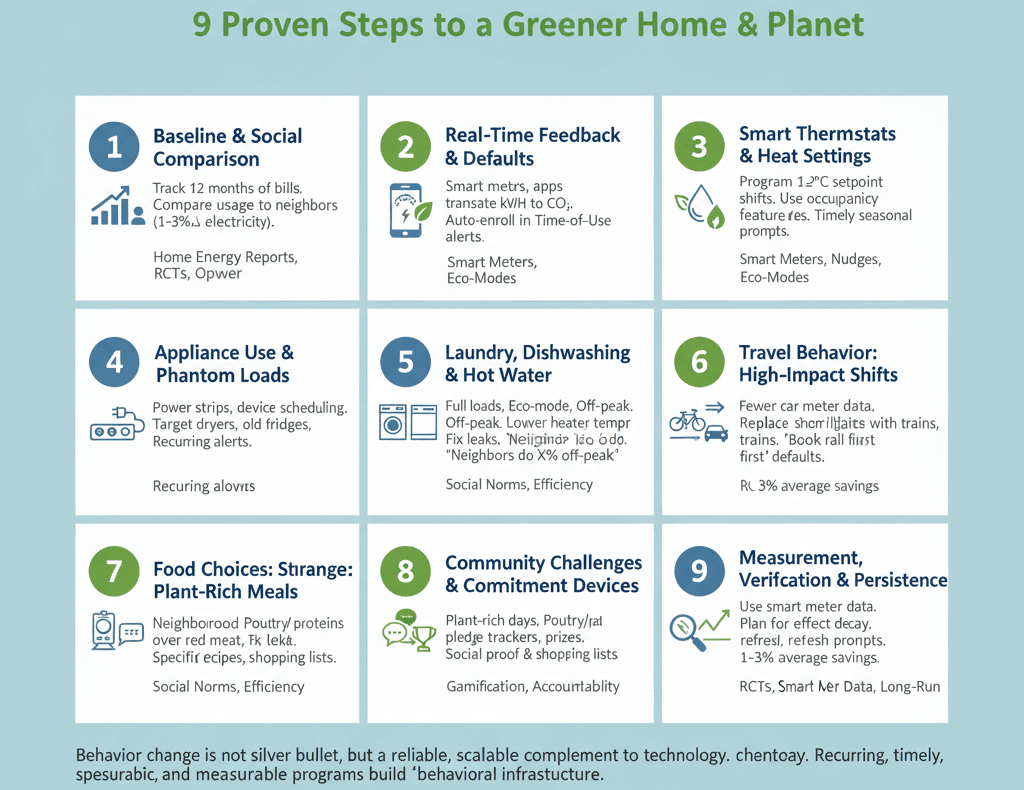
Table of Contents
Introduction
This guide simplifies the behavioral science—what to do, when to do it, and how to track it—drawing from scoping reviews and trial evidence that highlight feedback, social norms, and targeted information as consistently effective tools. For broad reviews and protocols, see a 2024 scoping review of nudge-based electricity interventions, an experimental study of feedback-driven electricity savings, and a living protocol for a meta‑analysis of behavioral, information, and monetary interventions.
Step 1 — Baseline and social comparison
Start with a baseline: gather 12 months of bills and generate a monthly profile, then activate social comparison feedback to show how usage compares to similar homes—an approach central to Opower‑style Home Energy Reports, which cut electricity use by about 1.4–3.3% in RCTs per J‑PAL’s evaluation of Opower HERs. Savings persist with ongoing reports and tend to be larger for high‑use households, with program performance tracked in a recent meta‑review of behavioral programs.
Timely reminders matter: savings spike when reports arrive and decay between mailings, suggesting the value of cadence and nudges that reconnect intent to action, as observed in the Opower RCT summary. Utilities and evaluators regard randomized designs as the “gold standard,” as noted in a cross‑cutting evaluation of HER methods and results.
Step 2 — Real-time feedback and defaults
Add real‑time or near‑real‑time feedback through smart meters, in‑home displays, or apps that translate kWh into euros and CO₂ to anchor decisions; feedback consistently reduces consumption in trials from Vietnam and other regions, as shown in a 2024 experiment on electricity feedback. Defaults and reminders—like auto‑enrolling time‑of‑use alerts—help, and literature mapping finds feedback, incentives, and social norms among the most effective tools in a 2024 scoping review of green nudges.
Where feasible, set appliance defaults to efficient modes (eco cycles, lower water temps) and automate schedules for heating, cooling, and EV charging; behavioral protocols emphasize reducing friction and surfacing timely cues, per the meta‑analysis protocol on behavioral/information/monetary interventions.
Step 3 — Smart thermostats and heat settings
Program heating setpoints down by 1–2°C and cooling up by 1–2°C, pair with smart thermostats for consistent schedules, and use occupancy features to avoid conditioning empty rooms. Persistence depends on timely prompts, which is why recurring feedback cycles sustain effects over time, as shown in longitudinal HER evaluations summarized in behavioral program meta‑reviews.
Combine thermostat changes with room‑by‑room zoning where possible and with simple prompts at seasonal transitions, mirroring evidence that reminder timing influences results in HER program RCTs.
Step 4 — Appliance use and phantom loads
Use power strips and device scheduling to cut standby loads; prompt households to target the biggest consumers (dryers, old fridges, entertainment systems) where behavior changes compound. Evidence syntheses indicate that targeted information and feedback drive measurable reductions, especially when paired with specific device guidance, as seen across interventions in the nudge scoping review.
Persistent savings often require recurring prompts; reports and alerts act as periodic cues that counter “behavioral decay,” a pattern documented in the HER RCT analysis. Meta‑analyses reiterate the utility of feedback and social norms in sustaining attention on high‑impact devices, per the behavioral/information protocol.
Step 5 — Laundry, dishwashing, and hot water
Run laundry and dishwashers full, in eco modes, and off‑peak; drop water heater setpoints to safe‑efficient levels and fix leaks fast. Behavioral savings in these end uses are supported by general evidence on feedback and prompts, and utility meta‑studies track durable yet modest savings when households receive consistent, readable reports, per the behavioral programs meta‑review.
Social norm messaging (“neighbors do X% off‑peak”) strengthens adoption rates, as shown by trials where social comparisons amplified engagement and savings in HER RCTs. A methods comparison paper further validates RCTs for estimating HER savings reliably, in a large, multi‑year analysis of methods for HER savings.
Step 6 — Travel behavior: high‑impact shifts
Behavior change potential is largest in transport choices—fewer car trips, modal shifts to transit and cycling, and replacing short‑haul flights with trains—identified as top‑priority shifts in a 2025 working paper synthesizing potential and real‑world effect sizes in behavioral shifts across sectors. An ESRI study finds feasibility perceptions drive willingness to change travel and diet, highlighting barriers and supports to action in transport and food behavior.
Defaults and cues (e.g., “book rail first” in corporate portals) align with evidence that well‑timed, low‑friction interventions outperform generic appeals, a theme across feedback trials and the systematic protocol.
Step 7 — Food choices: plant‑rich meals
Shift to plant‑rich meals several days a week; prioritize poultry or plant proteins over ruminant meat where substitution is easiest. Cross‑sector syntheses rank plant‑rich diets among the top household shifts when considering both impact and adoption, per the working paper on effective behavioral shifts. Perceived feasibility and social norms also shape adoption, consistent with survey findings in ESRI’s national study.
Messaging should be specific and contextual (recipes, shopping lists), which aligns with broader findings that actionable, timely information beats generic advice in energy and diet behavior literature, reflected in the behavioral protocol.
Step 8 — Community challenges and commitment devices
Neighborhood challenges, pledge trackers, and prize draws increase engagement and follow‑through for modest, persistent savings, as utilities observed with HER add‑ons and gamified prompts in evaluations summarized by ILLUME’s analyses. RCTs show that monthly cadence outperforms quarterly mailings, emphasizing the value of frequent touchpoints in HER findings.
Commitment devices—simple contracts to hold setpoints or travel targets—work best when tied to social proof and reminders, which multiple reviews flag as effective elements, per the nudge scoping review and behavioral meta‑protocol.
Step 9 — Measurement, verification, and persistence
Use smart meter data, app logs, or utility bills to measure changes; plan for effect decay and refresh prompts seasonally. Methods papers and program evaluations recommend randomized cohorts or strong quasi‑experimental designs for credible estimates, per cross‑cutting analyses of HER methods and long‑run performance in behavioral programs meta‑reviews.
Expect typical electricity savings around 1–3% with well‑designed behavioral programs, based on RCTs in the U.S. utilities and international experiments like feedback in Vietnam. Scale comes from reach and persistence, not just effect size, as documented in Opower’s multi‑utility RCT summary.
Opinion
Behavior change is not a silver bullet—but it’s a reliable, scalable complement to technology upgrades when built on reminders, comparisons, and defaults that reduce friction at the moment of choice. The best programs act like “behavioral infrastructure”: recurring, timely, specific, and measurable—qualities seen in successful HER deployments and the broader literature on feedback, social norms, and feasibility cues in energy, transport, and food decisions. See recurring savings patterns in HER meta‑reviews and the evidence‑based prioritization of shifts in WRI’s synthesis.
FAQs — Behavioral Interventions for Household Carbon Reduction
How much can behavioral programs save on home energy?
RCTs of Home Energy Reports show average electricity savings of about 1–3%, with larger impacts among high‑use households and with monthly cadence, as summarized by J‑PAL and ILLUME’s reviews.
Do reminders and social comparisons actually work?
Yes—savings spike when reports arrive and decay between mailings, and neighbor comparisons increase engagement, according to the Opower RCT synthesis and a methods comparison.
Which household shifts have the biggest climate impact?
Transport changes dominate (car‑free days, public transit, cycling), followed by flight substitution, home solar/efficiency, and plant‑rich diets, per a multi‑sector synthesis of effective behavioral shifts.
Learn More
Explore practical next steps and foundational concepts in one place: start by testing scenarios with the free Coffset Carbon Footprint Calculator, then build fluency with our explainers What Is a Carbon Footprint?, What Is Carbon Offsetting?, and Reduce vs Offset: Why Both Matter. For more resources, visit the Coffset homepage, explore the Carbon Learning Center, or take action via Buy Carbon Credits.
Sources
- J‑PAL — Opower: Evaluating the Impact of Home Energy Reports: https://www.povertyactionlab.org/evaluation/opower-evaluating-impact-home-energy-reports-energy-conservation-united-states
- ILLUME — Behavioral Programs Come of Age (meta‑analysis): https://illumeadvising.com/files/Behavioral-Programs-Come-of-Age.pdf
- ILLUME — Analyzing Savings from Recent HER Programs: https://illumeadvising.com/files/Home-Energy-Report-Analysis_Final-Report_ILLUME-1.pdf
- RSD Journal — Scoping Review of Green Nudges for Electricity: https://rsdjournal.org/rsd/article/view/46419
- Energy Policy — Nudging Households with Feedback (Vietnam): https://www.sciencedirect.com/science/article/abs/pii/S0301421524003987
- PLOS One — Protocol for Meta‑analysis of Behavioral/Information/Monetary Interventions: https://pmc.ncbi.nlm.nih.gov/articles/PMC11237337/
- ESRI — Perceived Feasibility of Transport and Diet Shifts: https://www.esri.ie/pubs/RS186.pdf
- CALMAC — Methods Comparison for Estimating HER Savings: https://www.calmac.org/publications/Comparison_of_Methods_for_Estimating_HER_Energy_Savings_11032015.pdf
Put your knowledge into action
Calculate your footprint and offset instantly with verified credits.
Continue reading
Behavioral Economics for Carbon Reduction
Discover how behavioral science transforms carbon reduction efforts through social comparisons, feedback systems, and goal setting strategies that work at scale.
10 Smart Moves: Energy Storage and Home Carbon Reduction
Learn how to cut your home's carbon emissions with smart energy storage solutions like batteries and heat pump water heaters. Discover practical strategies to shift energy use to cleaner hours while earning VPP payments.
9 Proven Steps: Guide to Renewable Energy Adoption at Home
Learn 9 proven steps to successfully adopt renewable energy at home, including solar power installation, energy storage solutions, and effective strategies to reduce your carbon footprint while saving money.