Carbon Offsetting vs Carbon Removal: 5 Key Differences (and 1 Smart Strategy)

Carbon offsetting vs carbon removal describes two different ways credits can balance emissions: offsets reduce or avoid future emissions elsewhere, while removals pull existing CO₂ from the air and store it durably to create negative emissions. Net‑zero guidance recommends cutting emissions first, then using credits sparingly—shifting over time from avoidance/reduction toward removals with long‑lived storage as the supply matures and costs fall, in line with the revised Oxford Offsetting Principles.
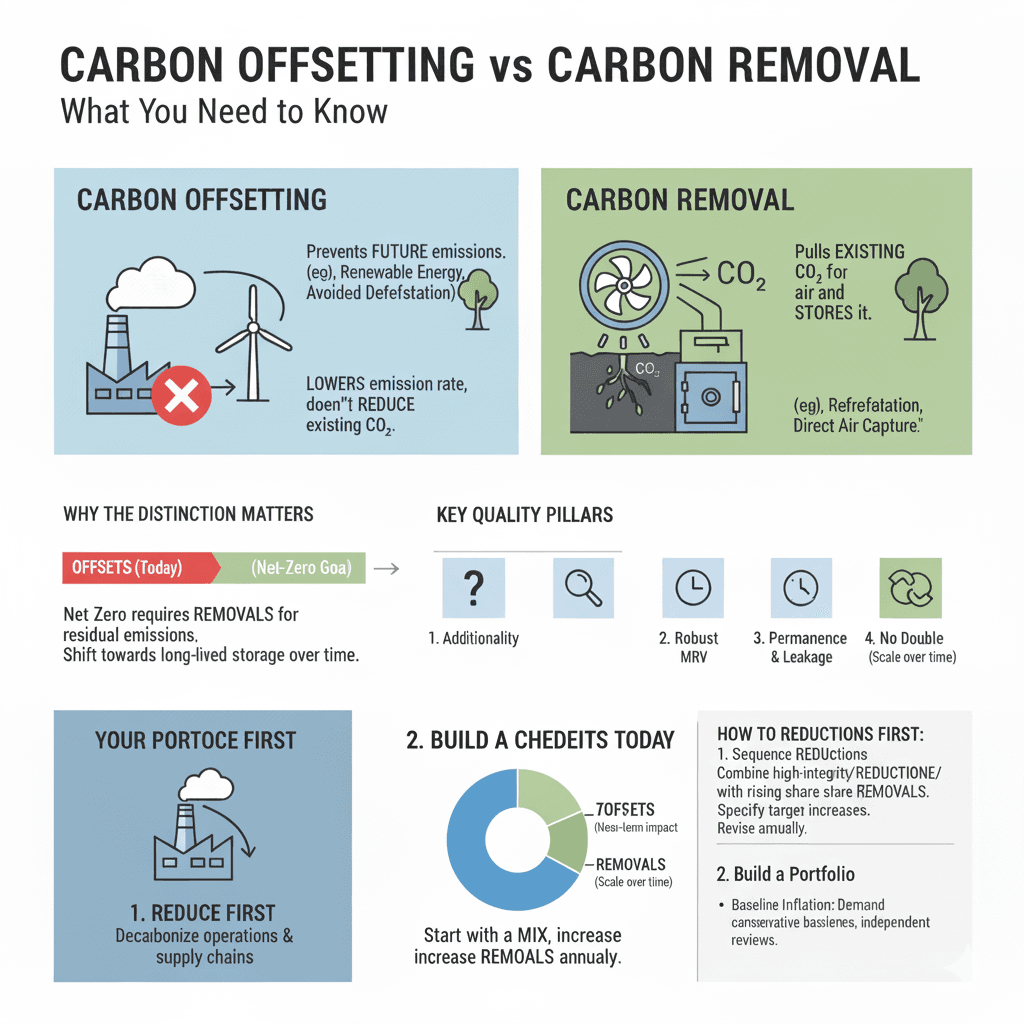
Table of Contents
Key definitions
- Offsetting (avoidance/reduction): Credits from activities that prevent emissions that would otherwise occur (e.g., clean cookstoves, renewable energy, avoided deforestation). These lower the rate at which CO₂ accumulates but do not reduce today’s atmospheric load.
- Removal: Credits from activities that take CO₂ out of the atmosphere and store it in biomass, products, or geologic reservoirs (e.g., reforestation, enhanced mineralization, direct air capture with storage). These create negative emissions when storage is durable and additional.
Why the distinction matters
Reaching net zero requires that any remaining emissions are balanced by removals, and—over time—shift toward removals with durable storage to reduce reversal risk. Guidance emphasizes reduction‑first strategies, early support for scaling removals, and careful portfolio transitions to higher‑durability options by the net‑zero date.
Quality pillars for both
- Additionality: Would the project exist without carbon revenue or legal mandates? If not additional, the credit does not represent real extra impact.
- Robust MRV: Measured, reported, verified with conservative baselines and transparent methods; weak baselines risk over‑crediting.
- Permanence and leakage: Address reversal risk (buffers, long‑lived storage) and avoid shifting emissions elsewhere; leakage is a known challenge in some land‑use projects and must be credibly deducted.
- No double counting: Unique serials and public retirements in reputable registries to ensure one use per tonne.
Examples
- Avoidance/reduction projects: clean cookstoves, grid‑connected renewables, landfill methane capture, industrial N₂O abatement; strong when outcomes are directly metered and baselines are conservative.
- Removal projects: afforestation and reforestation, soil carbon projects, biochar, enhanced rock weathering, BECCS, and DAC with geologic storage; durability varies by pathway, with geologic storage typically highest.
How to choose credits today
- Sequence reductions first: Decarbonize operations, energy procurement, and supply chains before turning to credits; revise annually as best practice evolves.
- Build a portfolio: Combine high‑integrity reductions/avoidance (especially metered methane or industrial projects) with a rising share of removals; specify target increases in durable removals as supply scales.
- Document claims precisely: Boundary + tonnes + timeframe + programme/methodology + serials/retirements; keep any corresponding adjustment claims clear and separate where relevant to Article 6.
Risks and how to manage them
- Baseline inflation: Demand conservative, jurisdictionally aligned baselines, particularly for land‑use; look for independent reviews and jurisdictional nesting to reduce inflation risk.
- Reversal risk: Prefer durable storage (mineralization, geologic) for long‑term balances; if using nature‑based removals, require strong buffers, monitoring, and contingencies.
- Policy and reputational risk: Align with net‑zero guidance that phases toward removals, and avoid messaging that suggests credits replace decarbonization.
Opinion: A practical split that works
A pragmatic approach is 70–80% high‑integrity, metered reductions/avoidance plus 20–30% removals now, with a published glidepath that increases removals and their storage durability each year. That mix keeps near‑term climate outcomes strong, funds early removal supply, and positions claims to stay credible as standards tighten in line with the revised Oxford Offsetting Principles.
Learn More
For planning and transparent tracking, baseline residuals and reductions progress with the Coffset Carbon Footprint Calculator, then build a credit portfolio that prioritizes quality today and steadily increases removals with durable storage. For background on portfolio shifts and net‑zero‑aligned claims, see the updated Oxford Offsetting Principles and summary explainers from Oxford/Net Zero Climate.
FAQs: Carbon Offsetting vs Carbon Removal
- What’s the core difference between carbon offsetting vs carbon removal?
Offsetting reduces or avoids future emissions; removal extracts CO₂ already in the air and stores it, creating negative emissions when storage is durable. - Why do net‑zero plans shift toward removals?
Net‑zero balance requires removals for residual emissions; guidance calls for increasing the share and durability of removals by the net‑zero date while continuing to cut operational emissions. - Are all removal credits equally “permanent”?
No. Durability varies: geologic storage and mineralization are typically longer‑lived than most biogenic pools; diligence should match storage risk and monitoring provisions. - What makes any credit “high quality,” whether offsetting or removal?
Clear additionality, conservative baselines, strong MRV, permanence/leakage safeguards, and public registry retirements—plus precise claims and separation from core reduction efforts.
Sources
- Oxford Offsetting Principles (revised 2024): https://www.smithschool.ox.ac.uk/sites/default/files/2024-02/Oxford-Principles-for-Net-Zero-Aligned-Carbon-Offsetting-revised-2024.pdf and overview: https://netzeroclimate.org/oxford-launches-revised-offsetting-principles/
- DOE – Carbon Dioxide Removal FAQs (definitions, storage durability): https://www.energy.gov/sites/default/files/2021-11/Carbon-Dioxide-Removal-FAQs.pdf
- Klimate – Avoidance vs removal explainer: https://www.klimate.co/insight/avoidance-versus-removal-differences
- Persefoni – Offset quality criteria (additionality, permanence, leakage, verification): https://www.persefoni.com/blog/what-are-carbon-offsets
- Carbon Market Watch/Cambridge – Leakage, additionality, permanence in land‑use: https://www.somo.nl/myth-carbon-offsets-reduce-emissions/ and https://4c.cst.cam.ac.uk/about/additionality-leakage-and-permanence
- Technology pathways for durable CDR (DAC/BECCS): https://www.sciencedirect.com/science/article/pii/S0196890423010336 and https://www.iata.org/globalassets/iata/publications/sustainability/carbon-dioxide-removal-cdr-technologies-facts.pdf
Put your knowledge into action
Calculate your footprint and offset instantly with verified credits.
Continue reading
Frontier Technologies in Carbon Removal: Case Studies
Discover frontier carbon removal technologies through detailed case studies covering DAC, ocean-based CDR, costs, and procurement models. Learn from real-world applications backed by authoritative research and guidance.
Frontier Carbon Removal Technologies — An Expert Guide: 9 Proven Steps
Discover the complete guide to frontier carbon removal technologies including DACCS, enhanced weathering, and marine CDR. Learn about durability, monitoring, costs, and how to build a future-proof carbon removal portfolio.
Portfolio Playbook: Corporate Carbon Offset Portfolio Management
Learn how to build a high-integrity carbon offset portfolio using CCP screening, Oxford-aligned durability standards, and VCMI-compliant claims with a strategic glidepath to durable removals.