9 Proven Steps: Community-Led Carbon Reduction — Local Projects That Work

Community-Led Carbon Reduction: Local Projects That Work highlights practical, high-impact initiatives that neighborhoods, cities, and cooperatives can launch and scale—from community solar and heat‑pump bulk buys to bike networks and food‑waste prevention—grounded in evidence on what reliably cuts emissions. Community programs work best when they blend trusted local institutions, recurring engagement, and measurement tools to turn one-off actions into durable, compounding results, as seen in randomized evaluations of energy feedback programs and multi-city mobility pilots. See the randomized evaluation of Home Energy Reports and a meta‑review of behavioral program savings in Behavioral Programs Come of Age.
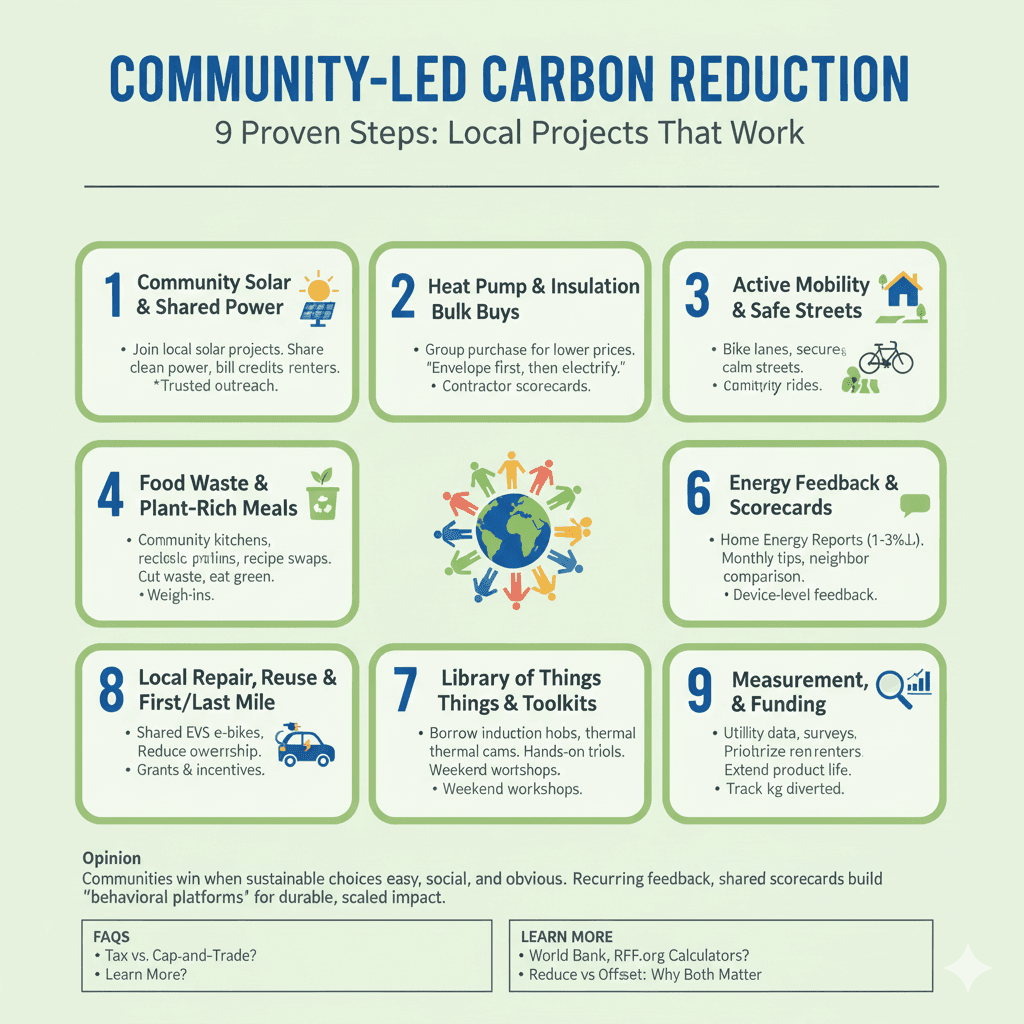
Table of Contents
The Guide
This guide curates nine replicable models with setup tips, equity considerations, and tracking methods so local leaders can start fast and iterate. Where relevant, it ties household‑level nudges to community infrastructure—co‑ops, transit, makerspaces—so individual choices add up to measurable, city‑scale emissions cuts documented across scoping reviews and program evaluations like the HER analysis and experimental studies on electricity feedback.
Step 1 — Community solar and shared clean power
Form or join a community solar program to deliver bill credits and emissions cuts without rooftop constraints; shared arrays help renters and shaded homes participate while building local ownership and resilience. Community uptake improves with clear contracts, bill credit transparency, and trusted outreach, mirroring engagement lessons from feedback‑based programs like the Home Energy Reports RCTs. Sustained communications cadence supports persistence, a pattern observed across meta‑analyses of behavioral savings.
Pair projects with neighborhood load‑shifting campaigns that teach off‑peak habits and smart device scheduling; timely feedback and reminders amplify savings, consistent with electricity feedback trials in Energy Policy. Community groups can host monthly “bill clinics” to help residents read credits and optimize usage.
Step 2 — Heat pump and insulation bulk buys
Neighborhood bulk procurement for heat pumps and weatherization unlocks lower prices, better contractor performance, and faster timelines; sequencing “envelope first, then electrify” maximizes comfort and right‑sizes systems. Persistence in usage-phase savings correlates with regular prompts and seasonal checklists, echoing durability patterns in HER program evaluations.
Add smart thermostat programming workshops and follow‑up texts; recurring cues maintain gains over time, aligning with evidence that savings from nudges are largest right after reminders in HER RCTs. Publish an open contractor scorecard to raise quality across vendors.
Step 3 — Active mobility networks and safe streets
Small, connected bike lanes, secure parking at transit, and traffic‑calmed streets yield outsized mode shifts when paired with wayfinding and community rides. Feasibility perceptions strongly shape behavior change; national research shows perceived feasibility boosts willingness to shift transport habits in an ESRI study on transport and diet shifts.
Layer in social proof—leaderboards, challenges, workplace rewards—to lock in new routines; behavioral syntheses emphasize social norms and timely feedback in sustaining action, reflecting cross‑sector findings in the behavioral meta‑protocol. Monthly “bike bus” events build skills and confidence for new riders.
Step 4 — Food waste prevention and plant‑rich meal challenges
Community kitchens, storage workshops, and neighborhood fridges cut waste, while plant‑rich meal challenges nudge toward high‑impact dietary shifts. Cross‑sector evidence ranks plant‑rich diets among top household levers, with feasibility and norms as key drivers highlighted in WRI’s synthesis of effective behavioral shifts and ESRI’s feasibility study on diet and transport.
Success depends on specific, actionable prompts—meal plans, shopping lists, neighborhood recipe swaps—consistent with findings that targeted, timely information beats generic messaging, per the behavioral interventions protocol. Publish waste‑weight “weigh‑ins” to visualize collective progress.
Step 5 — Energy feedback and neighborhood scorecards
Home Energy Reports and app‑based comparisons reduce electricity use by ~1–3% on average in randomized trials, especially with monthly cadence and actionable tips, as demonstrated in J‑PAL’s review of HERs. Utility meta‑reviews corroborate persistent, modest savings that add up at scale in Behavioral Programs Come of Age.
Neighborhood scorecards transform private actions into public momentum; savings spikes after each mailing show why recurring communications matter, a pattern documented in the HER analysis. Add device‑level feedback to target high‑impact loads like dryers and HVAC, echoing feedback trials in Energy Policy.
Step 6 — Library of things: efficiency kits and tools
Set up a municipal or NGO‑run lending library for induction hobs, infrared cameras, smart plugs, and clotheslines to lower friction and spark trials. Behavioral mapping studies indicate that reducing hassle and offering hands‑on trials boosts adoption, a theme across scoping reviews of green nudges.
Combine with weekend workshops to interpret thermal images and set smart schedules; recurring prompts and social learning reinforce action, paralleling persistence dynamics seen in HER programs. Track checkouts and follow‑up surveys to estimate emissions impacts.
Step 7 — EV car‑share and first‑/last‑mile transit
Neighborhood EV car‑shares and e‑bike fleets reduce car ownership pressure and make transit more viable, especially when paired with secure parking and on‑street charging. Feasibility and convenience drive behavior adoption, consistent with transport findings in the ESRI study on behavioral feasibility.
Onboarding should include route planning and cost calculators; timely prompts and visible social proof (usage stats, testimonials) align with general evidence that feedback and norms sustain participation documented in the behavioral meta‑protocol. Publish monthly utilization dashboards to iterate siting.
Step 8 — Local repair, reuse, and material swaps
Makerspaces and regular repair cafés keep goods in use longer, cutting embodied emissions; pairing events with “right‑to‑repair” education removes confidence barriers. Engagement grows when events are regular and social, echoing cadence‑driven impact seen in HER communications patterns.
Measure success in items repaired, kg diverted, and household spend saved; periodic reporting keeps momentum high, much like the persistence benefits tracked in behavioral program reviews. Offer tool checkouts via the Library of Things to extend impact.
Step 9 — Measurement, equity, and funding
Use utility data, app telemetry, and short surveys to quantify change; where possible, randomize outreach cohorts to attribute impact credibly, following methods guidance in HER evaluations like the methods comparison paper. Plan for effect decay and design monthly touchpoints to maintain gains, reflecting savings‑cadence dynamics in HER RCTs.
Center equity by prioritizing rental buildings, low‑income neighborhoods, and non‑owners with access‑first programs (community solar, efficiency kits, car‑share credits); perceived feasibility and convenience are decisive, per transport and diet research from ESRI. Seed funding can come from utilities, municipal climate budgets, and philanthropic grants, with persistence supported by small, recurring incentives—consistent with the evidence base summarized in the behavioral meta‑protocol.
Opinion
Communities win when they make sustainable choices the easy, social, and obvious default—clear feedback every month, shared tools that lower friction, and public scorecards that celebrate progress. The most durable programs behave like platforms: they standardize outreach cadence, measurement, and participation pathways, echoing what long‑running energy report programs taught us about persistence and scale in HER meta‑reviews and RCT syntheses from J‑PAL.
FAQs – Local Projects That Work
Do community energy feedback programs really save energy?
Yes—randomized trials of Home Energy Reports show average electricity savings of ~1–3%, with larger effects for high‑use homes and with monthly cadence, per J‑PAL and ILLUME reviews.
What are the highest‑impact local projects to start?
Community solar or subscriptions, heat‑pump/weatherization bulk buys, and safe cycling networks are high‑impact, especially when combined with recurring feedback and social proof, reflecting evidence on cadence and norms in HER RCTs and behavioral meta‑reviews.
How should communities measure progress credibly?
Use utility data and randomized cohorts or strong comparison groups; methods papers show how to estimate savings consistently in the HER methods comparison and multi‑program analyses like ILLUME’s report.
Learn More
Explore practical next steps and foundational concepts in one place: start by testing scenarios with the free Coffset Carbon Footprint Calculator, then build fluency with our explainers What Is a Carbon Footprint?, What Is Carbon Offsetting?, and Reduce vs Offset: Why Both Matter. For more resources, visit the Coffset homepage, explore the Carbon Learning Center, or take action via Buy Carbon Credits.
Sources
- J‑PAL — Opower: Evaluating the Impact of Home Energy Reports: https://www.povertyactionlab.org/evaluation/opower-evaluating-impact-home-energy-reports-energy-conservation-united-states
- ILLUME — Behavioral Programs Come of Age (meta‑analysis): https://illumeadvising.com/files/Behavioral-Programs-Come-of-Age.pdf
- ILLUME — Analyzing Savings from Recent HER Programs: https://illumeadvising.com/files/Home-Energy-Report-Analysis_Final-Report_ILLUME-1.pdf
- Energy Policy — Nudging Households with Electricity Feedback (experimental): https://www.sciencedirect.com/science/article/abs/pii/S0301421524003987
- PLOS One — Protocol for Meta‑analysis of Behavioral/Information/Monetary Interventions: https://pmc.ncbi.nlm.nih.gov/articles/PMC11237337/
- WRI — The Effective Impact of Behavioral Shifts (cross‑sector synthesis): https://www.wri.org/research/effective-impact-behavioral-shifts
- ESRI — Perceived Feasibility and Willingness to Act (transport and diet): https://www.esri.ie/pubs/RS186.pdf
- CALMAC — Methods Comparison for Estimating HER Savings: https://www.calmac.org/publications/Comparison_of_Methods_for_Estimating_HER_Energy_Savings_11032015.pdf
Put your knowledge into action
Calculate your footprint and offset instantly with verified credits.
Continue reading
9 Proven Steps: Intermediate Corporate Carbon Accounting — Reporting & Verification
Master intermediate corporate carbon accounting with practical steps for reporting, scope 2 dual totals, scope 3 hotspots, and ISO 14064-1 verification. This comprehensive guide provides actionable insights for companies advancing their carbon management practices.
8 Proven Modules: Carbon Literacy for Educators — Teaching Climate Solutions
A comprehensive blueprint for schools and universities featuring 8 accredited Carbon Literacy modules designed specifically for educators. Includes ready-to-teach toolkits, action-based assessments, and current climate indicators.
7 Advanced Moves: Advanced Carbon Literacy for Professionals and Activists
Go beyond carbon basics with advanced toolkits, indicators, and misinformation defense strategies. Deliver certified, action-driven climate literacy across your teams and campaigns.