9 Proven Steps: Intermediate Corporate Carbon Accounting — Reporting & Verification

Intermediate Corporate Carbon Accounting: Reporting & Verification bridges foundational GHG inventory skills with the real-world requirements of audit-ready reporting, limited/reasonable assurance, and alignment to evolving disclosure rules like ESRS/CSRD and IFRS S2. This guide explains how to structure scope boundaries, dual-report scope 2, prioritize high‑leverage scope 3 categories, and prepare for third‑party verification under ISO 14064‑1, while staying interoperable with the GHG Protocol Corporate Standard and its ongoing update plans documented in the Corporate Standard development plan.
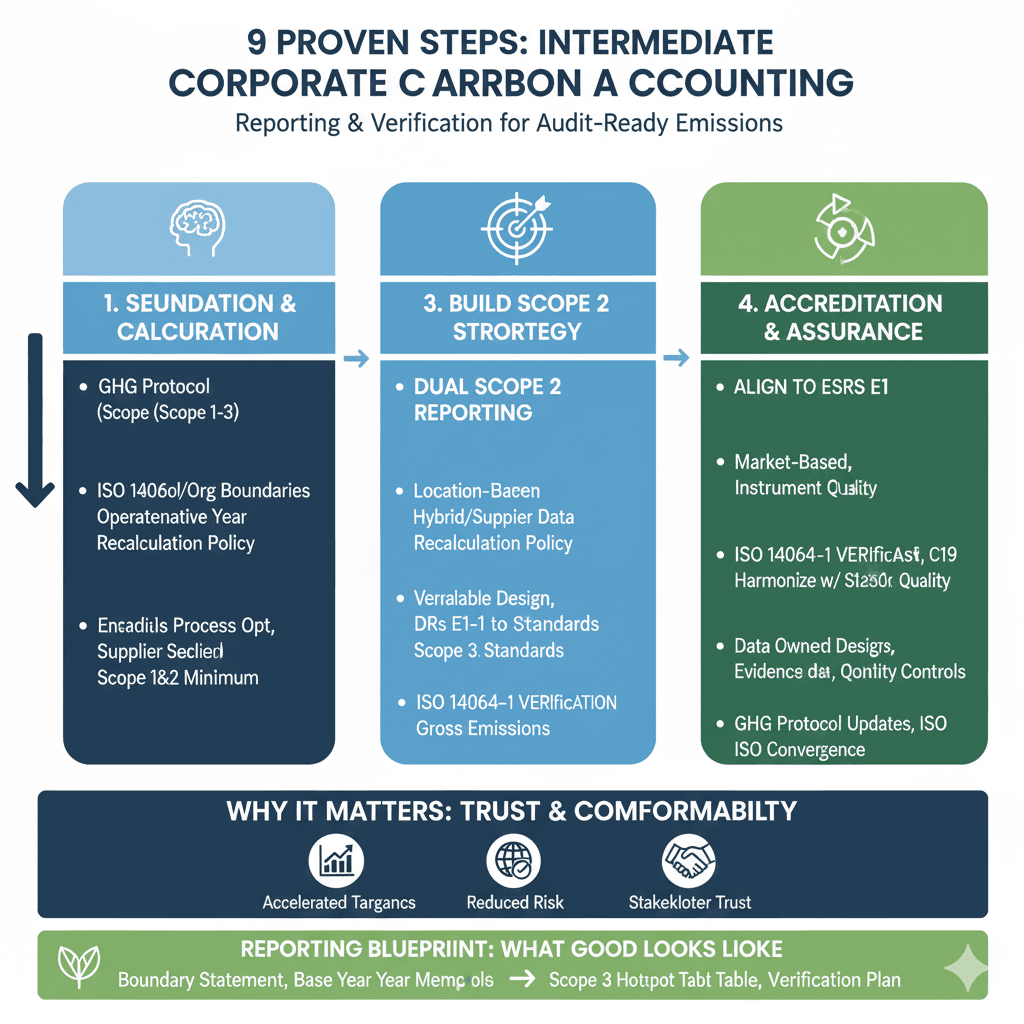
Table of Contents
The Focus
The focus is practical execution: build a defensible base year, select correct activity data and emission factors, document methods and materiality thresholds, implement a controls library for data owners, and pre‑empt reviewer questions with a verification file set. For scope 2 and scope 3 decisions, follow emerging guidance from the Scope 2 revision plan and survey feedback captured in the Corporate Standard survey summary.
Step 1 — Set organizational and operational boundaries correctly
Choose and document the organizational boundary (equity share or control) and define operational boundaries across scopes 1, 2, and 3 consistent with the GHG Protocol Corporate Standard. Make scope choices explicit in the inventory methodology and ensure reporting at minimum includes scopes 1 and 2 as required per the Protocol text and summaries.
When material, scope 3 should be quantified per the Corporate Value Chain Standard even as the Corporate Standard treats it differently; consolidation issues and materiality expectations are highlighted in the 2024 survey summary. Because revisions are underway, track alignment and optionality changes using the Corporate Standard development plan.
Step 2 — Build a defensible base year and change log
Select a representative base year with adequate data coverage and disclose any recalculations due to structural changes, mergers, divestitures, or significant methodology updates as outlined in the Corporate Standard. Keep a change log that ties each recalculation to scope categories, factors, and data substitutions consistent with the Protocol’s reporting expectations.
If scope 3 baselines are later expanded, document the rationale and the quantitative effect on totals following materiality guidance trends captured in the survey summary. This reduces assurance friction during limited or reasonable assurance.
Step 3 — Quantify scopes 1 and 2 with dual reporting
For scope 1, pair activity data (e.g., fuel volumes) with appropriate emission factors and document calculation hierarchies per the Corporate Standard. For scope 2, prepare both location‑based and market‑based totals and meet quality criteria for instruments, alignment that is being refined in the Scope 2 revision plan.
Ensure the final public report satisfies minimum content requirements (scopes 1 and 2 at least) as reiterated in the Protocol’s summaries and handbooks, such as the Protocol reference PDF. Maintain evidence packets for electricity data, residual mixes, and certificates to streamline assurance fieldwork.
Step 4 — Prioritize scope 3 categories that move the needle
Triage scope 3 using spend‑based screening to rank hotspots, then shift to hybrid or supplier‑specific methods for the largest categories in line with best practices reflected in the Corporate Standard survey summary. Harmonize definitions and boundaries with broader disclosure programs referenced by respondents (SBTi, GRI, CSRD), using the Protocol as the baseline per the Corporate Standard development plan.
Document exclusions, data limitations, and improvement plans transparently so auditors can track progress year over year, mirroring the completeness and transparency themes in the Protocol overview. This positions the inventory for efficient verification.
Step 5 — Align to ESRS E1 for CSRD readiness
For entities in scope of CSRD, map disclosures to ESRS E1, including transition plan, targets, energy mix, gross scopes 1–3, GHG removals and credits, internal carbon pricing, and financial effects, as summarized in accessible explainers like ESRS E1 requirements overviews and ESRS E1 guides. Cross‑reference the Commission’s CSRD page for scope and ESRS applicability in Corporate sustainability reporting.
Because ESRS expects gross reporting and decision‑useful detail, ensure inventory tables, policies, actions, and targets align structurally with ESRS E1’s nine disclosure requirements using those guides and the EU’s summary page as orientation aids. This makes limited assurance under CSRD smoother in early years.
Step 6 — Prepare for ISO 14064‑1 verification and assurance
Design the inventory to be verifiable under ISO 14064‑1 by defining boundaries, methods, data sources, controls, and uncertainties in line with practical checklists from accredited verifiers such as NQA’s ISO 14064‑1 verification overview and SGS ISO 14064‑1 service notes. Familiarize teams with ISO concepts and organizational-level requirements using primers like ISO 14064‑1 summaries and official references for ISO 14064‑1.
Aligning GHG Protocol and ISO is getting easier, with recent announcements of a collaboration to harmonize frameworks; track these developments to streamline dual compliance via news like GHG Protocol–ISO partnership updates. This reduces duplication across regulatory and voluntary assurance.
Step 7 — Build a controls library and audit trail
Assign data owners, define evidence folders, and list control checks (completeness, accuracy, cutoff) for each source system, reflecting the Protocol’s emphasis on transparency and accuracy in the Corporate Standard. For scope 2, include instrument quality checks consistent with objectives in the Scope 2 revision plan.
Maintain a verification file set: methodology statement, base year memo, factor library, supplier questionnaires, sampling frames, and reconciliation workpapers mirroring reporting requirements summarized in Protocol references. This anticipates assurance requests and speeds up reviews.
Step 8 — Disclose methods, materiality, and uncertainties clearly
Public reporting should describe boundaries, calculation methods, assumptions, limitations, and material exclusions to meet user needs, consistent with the Corporate Standard survey themes. Where dual reporting or restatements occur, point to the base year memo and change log for clarity per the Protocol.
For CSRD filers, map these disclosures directly to ESRS E1 DRs using practical explainers such as ESRS E1 requirement breakdowns and official EU context on CSRD. This alignment reduces rework when assurance providers test compliance.
Step 9 — Plan for revisions and interoperability
The GHG Protocol is revising Corporate, Scope 2, and other guidance to improve comparability and alignment with mandatory rules (e.g., ESRS, IFRS S2), so track the revision process via the Corporate Standard development plan, Scope 2 plan, and update overviews. Many stakeholders favor limiting optionality and clarifying materiality, highlighted in the 2024 survey summary.
Parallel moves to harmonize with ISO should simplify verification and regulatory filings over time; keep an eye on announcements like the GHG Protocol–ISO partnership. This future‑proofs the inventory and disclosure package.
Reporting blueprint — What good looks like
- Boundary statement: organizational approach (equity vs control) and operational scopes, citing the Corporate Standard.
- Base year memo: selection rationale, data coverage, and recalculation policy per Protocol references.
- Scope 2 dual totals: location‑based and market‑based with instrument quality notes aligned to the Scope 2 revision plan.
- Scope 3 hotspot table: method tiers by category and improvement roadmap guided by the survey summary.
- ESRS E1 mapping: DRs E1‑1 through E1‑9 with references to inventory tables using ESRS explainers and the EU’s CSRD page.
- Verification plan: ISO 14064‑1 scope, sampling, and evidence list referencing NQA and SGS guides.
Opinion
Carbon accounting is entering its “controls and comparability” era: the winners will be those who treat inventories like financial statements—documented boundaries, stable factor governance, auditable change logs, and clear ESRS mappings—while staying nimble as the GHG Protocol and ISO converge. Teams that operationalize dual scope 2 reporting, lift scope 3 method quality in hotspots, and pre‑build verification file sets will move fastest toward limited and reasonable assurance without disruption, as encouraged by the Protocol plans and Scope 2 objectives.
FAQs — Intermediate Corporate Carbon Accounting: Reporting & Verification
What minimums must corporate reporters meet?
At minimum, report scopes 1 and 2 in accordance with the GHG Protocol Corporate Standard and disclose boundaries, methods, and any recalculations as outlined in Protocol references.
How should scope 2 be presented?
Provide both location‑based and market‑based totals and disclose instrument quality; monitor evolving guidance in the Scope 2 revision plan and objectives in update overviews like the October 2024 integration note.
What helps scope 3 verification?
Prioritize hotspots with hybrid/supplier data, document exclusions and uncertainty, and map to ESRS E1 if in scope of CSRD, using practical explainers such as ESRS E1 requirements and the EU’s CSRD page.
How to get audit‑ready for ISO 14064‑1?
Define boundaries, methods, evidence, and controls; align with verifier checklists from NQA and SGS, and use ISO primers like ISO 14064‑1 summaries.
Are standards converging?
Yes—Protocol updates emphasize interoperability with mandatory regimes and ISO, and recent announcements flag a joint path forward; monitor the Corporate Standard development plan and the Protocol–ISO partnership update.
Learn More
Explore practical next steps and foundational concepts in one place: start by testing scenarios with the free Coffset Carbon Footprint Calculator, then build fluency with our explainers What Is a Carbon Footprint?, What Is Carbon Offsetting?, and Reduce vs Offset: Why Both Matter. For more resources, visit the Coffset homepage, explore the Carbon Learning Center, or take action via Buy Carbon Credits.
Sources
- GHG Protocol — Corporate Standard: https://ghgprotocol.org/corporate-standard
- GHG Protocol — Corporate Standard development plan (2024–2026): https://ghgprotocol.org/sites/default/files/2025-01/CS-SDP-20241220.pdf
- GHG Protocol — Scope 2 revision plan: https://ghgprotocol.org/sites/default/files/2025-01/S2-SDP-20241220.pdf
- GHG Protocol — Corporate Standard survey summary (Mar 2024): https://ghgprotocol.org/sites/default/files/2024-03/Corporate-Standard-Survey-Summary-Final.pdf
- GHG Protocol — Update overview and integration with disclosure rules (Oct 2024): https://ghgprotocol.org/sites/default/files/2024-11/Update-Overview-Integration-Disclosure-Rules.pdf
- EU Commission — Corporate sustainability reporting (CSRD/ESRS): https://finance.ec.europa.eu/capital-markets-union-and-financial-markets/company-reporting-and-auditing/company-reporting/corporate-sustainability-reporting_en
- ESRS E1 explainers — Coolset guide: https://www.coolset.com/academy/esrs-e1-requirements-climate-change
- ISO 14064‑1 — Organizational GHG inventories (overview): https://www.iso.org/standard/38381.html
- ISO 14064‑1 verification — NQA: https://www.nqa.com/en-gb/certification/standards/ghg-inventory
- ISO 14064‑1 verification — SGS: https://www.sgs.com/en/services/iso-14064-1-verification-quantify-and-report-greenhouse-gas-ghg-emissions-and-removals
- ISO/Protocol convergence — Partnership update: https://www.bdlaw.com/publications/ghg-protocol-announces-iso-partnership-to-develop-unified-carbon-accounting-standards/
Put your knowledge into action
Calculate your footprint and offset instantly with verified credits.
Continue reading
9 Proven Steps: Community-Led Carbon Reduction — Local Projects That Work
Learn 9 evidence-based community carbon reduction strategies that deliver real results. From community solar to heat pump bulk purchases, discover local projects that make a measurable climate impact.
8 Proven Modules: Carbon Literacy for Educators — Teaching Climate Solutions
A comprehensive blueprint for schools and universities featuring 8 accredited Carbon Literacy modules designed specifically for educators. Includes ready-to-teach toolkits, action-based assessments, and current climate indicators.
9 Proven Moves: Corporate Offsetting Programs — Case Studies of Success
Learn from Microsoft, Swiss Re, and Frontier's successful corporate carbon offsetting programs. Discover 9 proven strategies to scale durable carbon removals with credibility and impact.