Frontier Carbon Removal Technologies — An Expert Guide: 9 Proven Steps

Frontier Carbon Removal Technologies: An Expert Guide surveys the leading engineered and geochemical pathways for durable carbon removal, with practical checkpoints on performance, permanence, MRV, cost trajectories, and governance. It draws on current synthesis reports for direct air capture, enhanced weathering and mineralization, and emerging marine CDR governance to clarify where to deploy capital today and how to derisk offtakes for the next decade. See clear primers on direct air capture as a net‑zero enabler, detailed cost evidence for DAC costs, and ongoing governance updates for marine CDR.
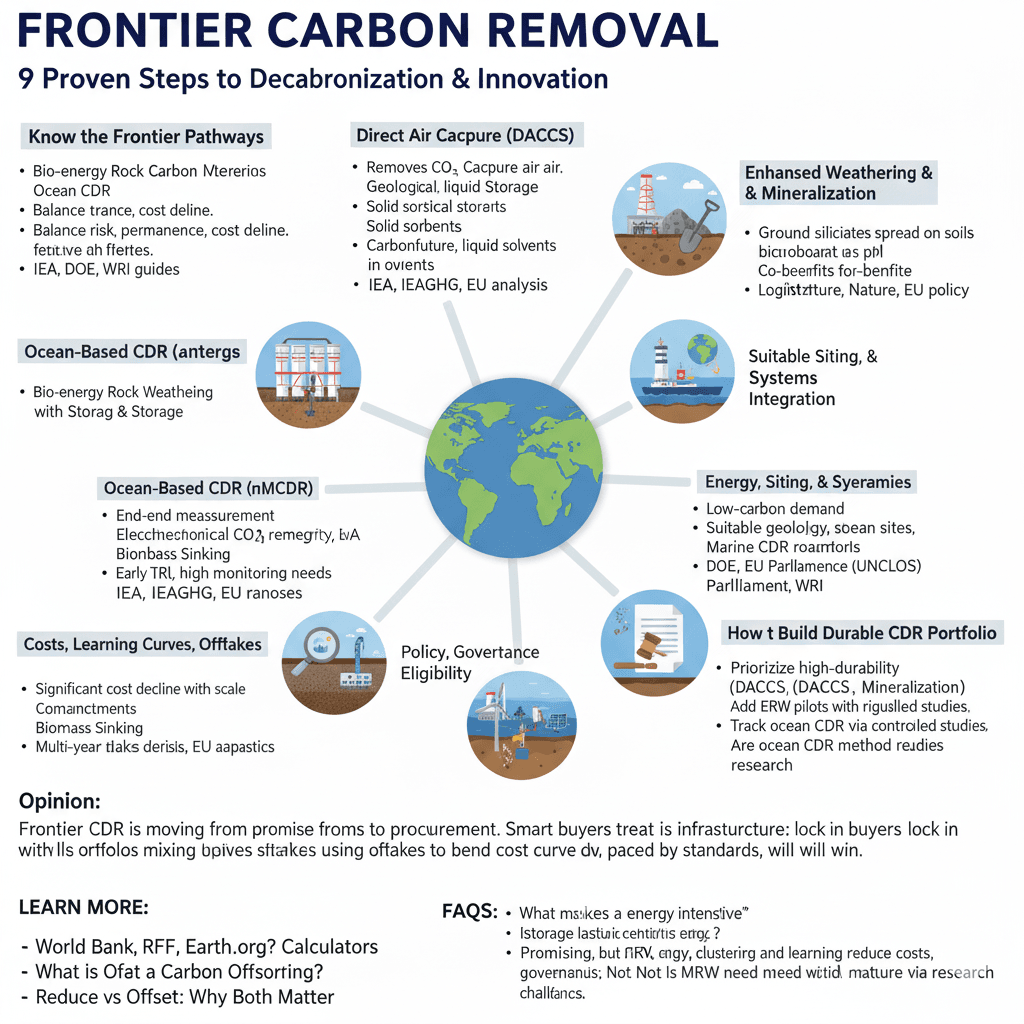
Table of Contents
The Guide
This expert guide translates technical literature into nine actionable steps: define removal pathways, assess storage durability, validate energy and land constraints, align MRV with standards, and structure contracts that encourage cost decline. For near‑term market context, review DOE’s 2025 DAC definition and company analysis, EU perspectives on the role of DAC, and market surveys of the durable CDR landscape.
Step 1 — Know the frontier pathways
Frontier CDR spans engineered and geochemical options: direct air capture with geological storage (DACCS), bio‑based with capture and storage (BECCS), mineralization and enhanced weathering (ERW), and ocean‑based approaches like alkalinity enhancement and biomass sinking, each with distinct energy, land, and MRV profiles; see IEA’s DAC overview, IEAGHG’s DAC cost synthesis, and WRI’s primer on marine CDR governance. DOE’s 2025 report clarifies the formal scope of DAC and maps active firms in a DAC definition & company analysis.
Portfolio design should balance technical risk, permanence, and cost decline potential while ensuring projects meet evolving regulatory and accounting guidance, which the European Parliament highlights in a 2025 study on the EU role for DAC.
Step 2 — Direct air capture (DACCS)
DACCS removes CO₂ from ambient air and stores it in geologic formations or mineralizes it, offering high‑durability storage when paired with robust MRV and site stewardship; core technology lines include solid sorbents and liquid solvents at varying temperatures and regeneration energies, surveyed in IEA’s DAC report. Cost and performance ranges remain wide by design and scale, with meta‑assessments summarised by IEAGHG’s DAC cost assessment.
The policy and market case for DAC in Europe is expanding under fit‑for‑55 and industrial decarbonization, described in the Parliament’s study on the role of DAC in the EU. U.S. definitions and typologies in DOE’s 2025 report clarify boundary conditions for eligible DAC projects, in the DAC definition & company analysis.
Step 3 — Enhanced weathering and mineralization
Enhanced rock weathering (ERW) accelerates natural reactions by applying ground silicates to soils, converting atmospheric CO₂ to dissolved bicarbonate that eventually stores in oceans, with co‑benefits for pH and yields in some contexts; for practical overviews, see Carbonfuture’s technology explainer on enhanced weathering and a 2024 policy roadmap summarized by the Carbon Business Council via a roadmap for ERW. Scientific assessments discuss scalability, logistics, and MRV challenges, including the need for isotopic tracing and leachate monitoring, reviewed in Nature’s 2025 look at scaling enhanced weathering.
European analysis notes deployment constraints and governance gaps for geochemical CDR across in‑situ mineralization and surficial ERW, with country case studies illustrating logistics and cost bands, as summarised in a 2025 policy perspective on the EU’s preparedness for geochemical CDR.
Step 4 — Ocean‑based CDR (mCDR)
Marine CDR approaches include ocean alkalinity enhancement, electrochemical CO₂ removal from seawater, and biomass sinking, all at early TRLs with significant monitoring and governance needs, discussed in WRI’s guide to high‑seas MCDR governance. The National Academies set research priorities for controlled pilots and environmental monitoring in a research strategy for ocean CDR and sequestration.
Funding calls are building monitoring infrastructure for safe, verifiable marine removal, including programs to track mesopelagic sequestration and ecosystem impacts outlined in an EU synopsis for marine CDR monitoring.
Step 5 — MRV, accounting, and permanence
Durable storage requires end‑to‑end MRV: quantifying net removal at system boundaries, verifying storage integrity, and attributing permanence across reservoirs; IEA’s DAC report frames MRV elements for engineered removals in its DAC overview. For DACCS, MRV spans air capture, regeneration energy, transport, injection, and post‑closure monitoring; IEAGHG’s synthesis links cost drivers with MRV and energy inputs in its DAC costs assessment.
Marine CDR MRV must address ocean chemistry, biological responses, and sequestration depth and duration; governance pathways to standardize MRV are reviewed in WRI’s analysis of marine CDR governance.
Step 6 — Energy, siting, and systems integration
Frontier CDR demands low‑carbon energy, suitable geology or ocean settings, and logistics networks for minerals or sorbents; IEA outlines DAC energy needs and siting trade‑offs in its DAC report. EU studies map DAC’s potential role relative to energy and storage infrastructures as summarized in the Parliament’s review of the EU role for DAC.
For ERW, supply chains for quarrying, grinding, and field application dominate costs and emissions, with roadmaps highlighting policy and logistics enablers in the ERW roadmap. Ocean CDR integration hinges on monitoring networks and risk frameworks described in the EU’s synopsis for marine CDR monitoring.
Step 7 — Costs, learning curves, and offtakes
Modeled learning suggests significant cost decline as deployment scales; buyers can accelerate this through advance market commitments and multi‑year offtakes that derisk capacity, with supplier and purchaser sentiment captured in the 2025 CDR market survey by CDR.fyi. IEAGHG’s 2024 synthesis compiles reported ranges and drivers for DAC, a central reference for offtake pricing in the DAC cost assessment.
European analysis points to industrial clustering and CO₂ transport/storage networks as key to scale in the EU, positioned in the Parliament’s study of the EU role for DAC. For ERW, logistics standardization and farmer engagement underpin scalable cost reductions, per the ERW roadmap.
Step 8 — Policy, governance, and eligibility
Eligibility and definitions shape which projects qualify for credits or compliance counting; DOE’s 2025 report clarifies DAC’s definition for U.S. policy contexts in the DAC definition & company analysis. The EU’s evolving stance on engineered removals, MRV, and infrastructure is outlined in the Parliament’s study of the EU role for DAC.
Marine CDR governance is rapidly developing across UNCLOS forums and London Convention/Protocol processes; WRI compiles current signals and near‑term expectations in its analysis of how marine CDR is governed.
Step 9 — How to build a durable CDR portfolio
- Prioritize high‑durability storage (DACCS, mineralization) where MRV is strongest, leveraging IEA and IEAGHG evidence in the DAC overview and DAC cost review.
- Add ERW pilots with rigorous MRV and supply‑chain guardrails, aligned with guidance in the ERW roadmap and scientific reviews like Nature’s scaling assessment.
- Track ocean CDR via controlled studies and governance milestones before committing to large volumes, following WRI’s marine CDR governance and the National Academies’ research strategy.
Opinion
Frontier CDR is moving from promise to procurement, and the smartest buyers now treat it like infrastructure: lock in clean energy, storage sites, MRV, and logistics while using offtakes to bend cost curves down. The next decade belongs to portfolios that mix proven durability (DACCS, mineralization) with disciplined pilots (ERW, mCDR), paced by standards and governance—an approach grounded in IEA’s DAC synthesis, IEAGHG’s cost review, and WRI’s marine governance guide.
FAQs — Frontier Carbon Removal Technologies: An Expert Guide
What makes a carbon removal “durable”?
Storage that lasts centuries to millennia with low reversal risk, typically in geologic reservoirs or mineralized forms, as emphasized in IEA’s DAC overview and IEAGHG’s cost and performance synthesis.
Is DAC too energy intensive to scale?
DAC requires significant low‑carbon energy, but clustering and learning can reduce costs; siting with clean power and storage networks is central in IEA’s DAC report and EU analyses of the role of DAC.
How credible is enhanced weathering today?
ERW is promising but MRV, logistics, and agronomic variability are active challenges; roadmaps and reviews outline pathways to credible scale in the ERW roadmap and Nature’s scaling review.
Are ocean CDR methods ready?
Not yet for large‑scale procurement; governance and MRV must mature through targeted research and standards setting, per WRI’s marine CDR governance and the National Academies’ research strategy.
Learn More
Explore practical next steps and foundational concepts in one place: start by testing scenarios with the free Coffset Carbon Footprint Calculator, then build fluency with our explainers What Is a Carbon Footprint?, What Is Carbon Offsetting?, and Reduce vs Offset: Why Both Matter. For more resources, visit the Coffset homepage, explore the Carbon Learning Center, or take action via Buy Carbon Credits.
Sources
- IEA — Direct Air Capture: https://www.iea.org/reports/direct-air-capture
- DOE — Direct Air Capture: Definition & Company Analysis (2025): https://www.energy.gov/sites/default/files/2025-01/Direct%20Air%20Capture%20Definition%20and%20Company%20Analysis%20Report.pdf
- IEAGHG — Global Assessment of Direct Air Capture Costs (2024): https://ieaghg.org/publications/global-assessment-of-direct-air-capture-costs/
- European Parliament — The Role of DAC in the EU (2025): https://www.europarl.europa.eu/RegData/etudes/STUD/2025/772474/ECTI_STU(2025)772474_EN.pdf
- WRI — How Marine Carbon Removal Is Governed in the High Seas (2025): https://www.wri.org/technical-perspective/ocean-carbon-removal-governance
- National Academies — Research Strategy for Ocean CDR: https://www.nationalacademies.org/our-work/a-research-strategy-for-ocean-carbon-dioxide-removal-and-sequestration
- Carbonfuture — Enhanced Weathering technology explainer: https://www.carbonfuture.earth/cdr-technology/enhanced-weathering
- Carbon Business Council — Roadmap for Enhanced Rock Weathering (2024): https://www.remineralize.org/2025/05/carbon-business-councils-roadmap-for-enhanced-rock-weathering/
- Nature Reviews Earth & Environment — Scaling Enhanced Weathering (2025): https://www.nature.com/articles/s43017-025-00713-7
- CDR.fyi — 2025 CDR Market Survey: https://www.cdr.fyi/blog/2025-cdr-market-survey-report
Put your knowledge into action
Calculate your footprint and offset instantly with verified credits.
Continue reading
Frontier Technologies in Carbon Removal: Case Studies
Discover frontier carbon removal technologies through detailed case studies covering DAC, ocean-based CDR, costs, and procurement models. Learn from real-world applications backed by authoritative research and guidance.
10 Pro Moves: Advanced Guide to Verified Carbon Offset Markets
Build a high-integrity carbon offset portfolio with verified strategies including CCP screening, Oxford-aligned durability protocols, and rigorous MRV systems.
Carbon Offsetting vs Carbon Removal: 5 Key Differences (and 1 Smart Strategy)
Understand the 5 key differences between carbon offsetting and carbon removal, including when to use each approach and why climate portfolios should prioritize durable carbon removal strategies.