Green Purchasing Power: 9 Good Moves (and 5 Bad Habits) That Impact Carbon

Green purchasing power translates everyday buying into climate impact—small choices add up when they prioritize durability, repairability, recycled content, efficient use, and smarter logistics, while avoiding wasteful “fast” purchases and split shipments that inflate emissions across supply chains. To see how green purchasing power shifts a monthly footprint, log categories and deliveries in the Coffset Carbon Footprint Calculator, then focus effort where reductions are largest.
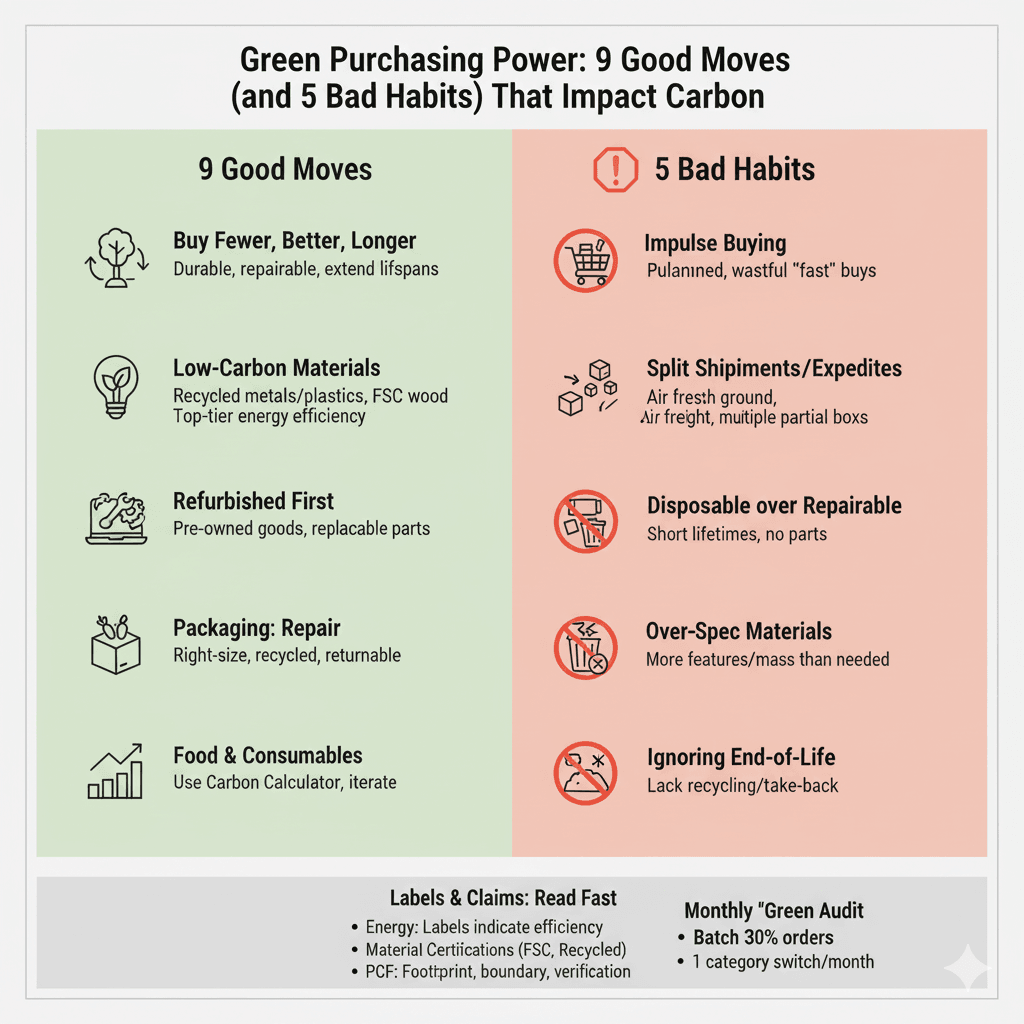
Table of Contents
Why buying choices matter
Household emissions include a large “indirect” portion from goods and services—materials, manufacturing energy, and logistics embedded in purchases—which varies widely by material intensity, energy sources, and product lifetime; choosing durable, repairable, and efficient items often beats incremental tweaks like minor packaging shifts EU climate policy explained. Production method usually dominates over “food miles” or shipping distance for many categories, but consolidating shipments and avoiding air freight still cuts avoidable last‑mile and expedited transport emissions, especially for frequent online orders UN climate basics.
9 good moves for greener purchasing
- Buy fewer, better, longer
Choose durable, repairable products and extend lifespans; the greenest product is often the one not bought, and repairability keeps material and energy “embodied” in use instead of landfills EU climate policy explained. - Prefer low‑carbon materials
Select recycled aluminum/steel, FSC wood, and verified recycled plastics where performance allows; these choices typically lower embodied emissions compared to virgin alternatives when supported by credible declarations UN climate basics. - Choose efficiency where use dominates
For energy‑using products, lifetime electricity often outweighs production, so top‑tier efficiency and eco‑mode defaults deliver the largest cut in operational emissions, particularly as grids decarbonize EU climate policy explained. - Refurbished and re‑commerce first
Refurbished electronics and quality pre‑owned goods avoid new manufacturing impacts; re‑commerce platforms and certified refurbishers extend device life with warranties that reduce risk for buyers UN climate basics. - Design for repair and parts
Favor modular designs with replaceable batteries and standard fasteners; ready access to parts and manuals extends service life and prevents premature replacement, improving lifetime carbon intensity per use EU climate policy explained. - Smarter shipping and consolidation
Choose no‑rush ground shipping and fewer, consolidated deliveries; split shipments and air freight raise last‑mile emissions, so batching orders avoids avoidable transport and packaging waste UN climate basics. - Packaging: right‑size and reuse
Right‑sized packaging with recycled content reduces material intensity; where reuse systems exist, select returnable packaging to reduce single‑use impacts across multiple cycles EU climate policy explained. - Food and household consumables
Production method often outweighs distance; seasonal and efficiently produced items plus frozen staples can cut waste and emissions when storage is managed well to avoid spoilage UN climate basics. - Track, learn, optimize
Use the Coffset Carbon Footprint Calculator monthly to identify high‑impact categories, then iterate toward durable/refurbished and efficient alternatives with consolidated deliveries.
5 bad habits that raise emissions
- Impulse buying non‑essentials
Unplanned purchases often become underused waste; a 30‑day waitlist filters wants from needs and avoids “one‑use” items that lock in embodied emissions with little utility UN climate basics. - Split shipments and expedites
Multiple partial boxes and air freight drive up transport emissions; batch orders and accept slower ground shipping to keep logistics lighter where timing allows EU climate policy explained. - Disposable over repairable
Single‑use and non‑repairable items guarantee short lifetimes; choosing repairable designs, parts availability, and local repair services keeps carbon “in service” longer EU climate policy explained. - Over‑spec materials and features
Buying more material or features than needed adds mass and manufacturing energy without proportional benefit; spec to function, not marketing claims UN climate basics. - Ignoring end‑of‑life
Lack of recycling or take‑back programs can turn materials into waste; choose brands with clear EPR/take‑back to retain material value and reduce landfill emissions EU climate policy explained.
Labels and claims: how to read them fast
- Energy labels
Regional labels and ENERGY STAR‑style marks indicate operational efficiency, but always check test conditions and standby assumptions to ensure real‑world relevance EU climate policy explained. - Material certifications
FSC/PEFC for wood and recycled content declarations help, but verify scope and chain‑of‑custody to avoid misleading claims and partial coverage UN climate basics. - Product carbon footprints (PCF)
Credible PCFs state functional unit, boundaries (cradle‑to‑gate/‑grave), reference year, and verification; use them to compare similar products within a category thoughtfully, not across wildly different functions EU climate policy explained.
A monthly “green purchasing power” audit
- Week 1: Identify top spend categories and five impulse buys; add a 30‑day waitlist for non‑essentials and a “repair first” rule. Log baseline in the Coffset Carbon Footprint Calculator.
- Week 2: Switch one repeating purchase to durable/refillable/refurbished with parts availability.
- Week 3: Consolidate online orders to a single no‑rush ground shipment; avoid split shipments.
- Week 4: Replace one energy‑using device with a top‑tier efficient model and set eco‑modes by default.
SME procurement: green purchasing power at work
- Supplier standards and PCF asks
Request recycled content, renewable energy usage, and PCF/EPD disclosures for major inputs to shift supply toward lower‑carbon materials and processes EU climate policy explained. - Refurb‑first IT and furniture
Adopt “refurb‑first” procurement and extend refresh cycles; buy modular, repairable equipment with spare‑parts commitments and clear service pathways UN climate basics. - Logistics policy
Set ground‑first, no‑rush defaults and block split shipments; design reorder points to avoid emergency air freight and its higher carbon intensity EU climate policy explained.
Opinion: The 30/30/1 rule wins
Most of the benefit from green purchasing power comes from one simple cadence: a 30‑day waitlist for non‑essentials, 30% of orders batched into one weekly ground shipment, and one major category switch per month (durable/refurbished/efficient). It’s unglamorous—but this trio cuts the biggest waste first and keeps the savings compounding without micromanagement.
Learn More
Explore practical next steps and foundational concepts in one place: start by testing scenarios with the free Coffset Carbon Footprint Calculator, then build fluency with our explainers What Is a Carbon Footprint?, What Is Carbon Offsetting?, and Reduce vs Offset: Why Both Matter. For more resources, visit the Coffset homepage, explore the Carbon Learning Center, or take action via Buy Carbon Credits.
Sources
- European Commission – EU Climate Policy Explained (production vs. use, labeling, policy tools): https://climate.ec.europa.eu/system/files/2017-02/eu_climate_policy_explained_en.pdf
- United Nations – What Is Climate Change? (high‑level drivers and sector basics): https://www.un.org/en/climatechange/what-is-climate-change
Put your knowledge into action
Calculate your footprint and offset instantly with verified credits.
Continue reading
10 Smart Moves: Energy Storage and Home Carbon Reduction
Learn how to cut your home's carbon emissions with smart energy storage solutions like batteries and heat pump water heaters. Discover practical strategies to shift energy use to cleaner hours while earning VPP payments.
Behavioral Economics for Carbon Reduction
Discover how behavioral science transforms carbon reduction efforts through social comparisons, feedback systems, and goal setting strategies that work at scale.
Low Carbon Tech in Daily Life: Smart Devices & Apps That Actually Reduce Emissions
Cut your daily emissions with smart devices, heat pump water heaters, and carbon-aware EV charging coordinated by an open home hub. Learn practical low carbon tech solutions that make a real environmental impact.