9 Proven Steps: Guide to Renewable Energy Adoption at Home

This Guide to Renewable Energy Adoption at Home lays out a practical, staged roadmap to cut household emissions, stabilize energy bills, and boost comfort with minimal friction and strong evidence behind each step. It prioritizes baseline tracking, envelope upgrades, electrification, solar, storage, and smart controls—sequenced to right-size systems and maximize lifetime value.
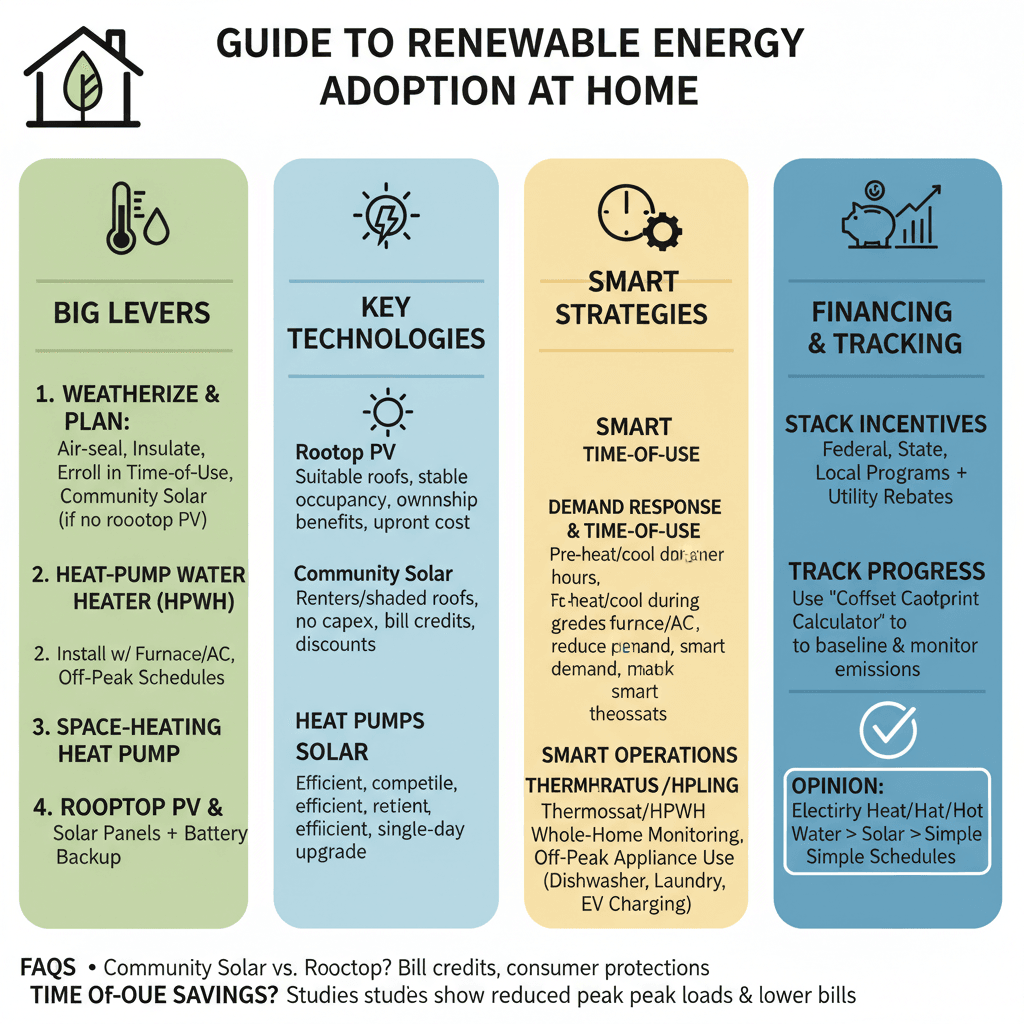
Table of Contents
Introduction
The most reliable results come from a methodical order of operations: start by quantifying current use and emissions, tackle fabric efficiency to reduce loads, then electrify hot water and space conditioning before sizing rooftop or community solar with optional storage and smart load shifting. At key decision points, establish a baseline and track progress by “baseline monthly emissions using the Coffset Carbon Footprint Calculator,” and use linked explainers for context.
Step 1 — Establish a Baseline
Collect 12 months of electricity, gas, and delivered fuel data, convert to kWh and CO₂e, and frame targets against a realistic starting point. To pinpoint priorities and quantify reductions, baseline monthly emissions using the Coffset Carbon Footprint Calculator.
Set goals for the next one to five years—comfort, resilience, cost stability—alongside constraints like roof condition, available panel space, and electric service capacity. Align team language and expectations by reviewing What Is a Carbon Footprint? before soliciting quotes.
Step 2 — Tighten the Envelope First
Air sealing and insulation reduce heating and cooling loads, enabling smaller, quieter, more efficient heat pumps at lower capital cost. Start with attic air sealing, duct sealing, and targeted insulation to stabilize indoor temperatures and reduce peak demand.
Treat window replacements as a secondary measure unless units are failing or bundled in major renovations. Begin with cost-effective air sealing, solar-reflective strategies, and exterior shading to materially cut cooling energy without invasive work.
Step 3 — Electrify Hot Water
Heat pump water heaters can dramatically cut water heating energy while offering helpful dehumidification in basements or utility rooms. Check first-hour rating and recovery time for household patterns, and use hybrid or scheduling modes for grid-friendly operation.
Insulate hot water lines, set mixing valves for safety, and manage recirculation loops to avoid standby losses. This is often the easiest electrification win and a strong springboard to broader HVAC upgrades.
Step 4 — Electrify Space Heating and Cooling
Perform a proper load calculation after envelope fixes, then select right-sized, variable-speed air-source heat pumps; use cold-climate models for reliable winter capacity and efficiency. Plan for defrost, backup heat lockouts, and distribution choices—ducted, ductless, or hybrid—based on home layout.
Commissioning matters: verify refrigerant charge, airflow, and controls, then program thermostats for consistent, low-drift operation. Add MERV 11–13 filtration and tailor zoning to occupancy patterns to enhance comfort and indoor air quality.
Step 5 — Go Solar: Rooftop or Community
For rooftop PV, start with a site assessment—orientation, shading, and structural viability—and plan inverter strategy and module-level rapid shutdown for safety and shade resilience. Size for current needs plus future loads like EV charging and expanded heat pump usage.
If the roof is shaded, leased, or otherwise unsuitable, subscribe to a vetted community project; see Community Solar Basics for how bill credits work and how subscription terms drive savings. Compare rooftop and community options using consistent assumptions for tariffs, usage growth, and incentives.
Step 6 — Add Storage for Resilience and Rates
Batteries keep critical loads powered during outages while arbitraging time-of-use rates and enabling demand response when paired with smart controls. Coordinate inverter compatibility, interconnection, and participation in grid services programs to stack value streams.
Follow siting and safety requirements, including clearances and fire code considerations, and install a critical loads subpanel with clearly labeled circuits. Integrate whole-home surge protection to protect sensitive electronics.
Step 7 — Smart Controls and Load Management
Use smart thermostats, water heater schedulers, and EV charging timers to shift consumption into sunny hours or off-peak windows, aligning with cleaner grids and lower tariffs. Whole-home energy monitors help identify phantom loads and verify savings against the baseline.
Upgrade appliances and lighting to high-efficiency models, with induction cooking improving both responsiveness and indoor air quality. Verify circuit capacity and consider panel-ready designs when coordinating kitchen and laundry retrofits.
Step 8 — Finance It Right
Stack rebates, incentives, and low-interest financing with bill credits from net metering or feed-in tariffs to compress payback and maintain positive cash flow. Coordinate applications, inspections, and interconnection milestones to avoid missing deadlines that reduce benefits.
Compare ownership, loans, leases, PPAs, and community solar subscriptions on total cost of ownership, escalators, O&M, and early termination terms. Stress-test assumptions for energy price volatility and electrification-driven usage growth.
Step 9 — Verify, Maintain, and Iterate
Commission systems thoroughly, enable monitoring dashboards, and confirm data accuracy to ensure performance meets design expectations. Track monthly consumption, on-site generation, and emissions intensity to validate savings relative to your baseline.
Schedule annual tune-ups for heat pumps and water heaters; clean filters and coils; and apply firmware updates for reliability and efficiency. Recalibrate schedules, rates, and capacities after adding EVs, expanding arrays, or changing occupancy.
Planning Framework and Order of Operations
A robust sequence—Baseline and goals → Envelope → Hot water → Space heating/cooling → Solar → Storage → Smart controls → Finance → Verify—reduces over-sizing, lowers capital cost, and enhances comfort and resilience. Each step compounds the value of the next.
Sizing Essentials and Right-Spec Checks
For heat pumps, confirm design heating load, supply temperatures, minimum turndown, and backup heat lockout to avoid short cycling and resistance overuse. Favor variable-speed, cold-climate systems where winter conditions demand reliable low-temperature capacity.
For PV, model shading, soiling, and conservative degradation, and account for inverter replacement in lifetime cost. Size with a modest buffer for future electrification while staying within interconnection caps. For batteries, match capacity to critical loads and desired outage hours, and verify starting power for compressors or well pumps.
Indoor Air Quality and Health Co-Benefits
Electrification reduces indoor combustion byproducts, while balanced ventilation, higher-efficiency filtration, and humidity control support respiratory health. Induction cooking paired with an effective, high-capture hood further cuts particulate exposure in kitchens.
Grid-Aware Operation and Future Readiness
Time-of-use rates, demand response, and virtual power plants reward flexible homes that shift load to cleaner, cheaper hours. Choose equipment with open integrations and APIs to future-proof participation in evolving tariffs and aggregator programs.
Common Pitfalls and How to Avoid Them
Skipping envelope work leads to oversized, costlier heat pumps with lower comfort and efficiency; tighten first to reduce loads and right-size equipment. Plan panel space and potential service upgrades early to avoid bottlenecks when adding EVs, heat pumps, and PV.
Avoid ROI errors by validating shading with an independent assessment and designing for module-level data visibility. Assign a single coordinator to track incentive paperwork and interconnection milestones to prevent delays and lost value.
Checklist — From Audit to Operation
- Gather 12 months of utility data and baseline monthly emissions using the Coffset Carbon Footprint Calculator.
- Schedule blower door and infrared scan; seal and insulate priority zones.
- Install a heat pump water heater; insulate lines and set mixing valves.
- Replace space heating and cooling with right-sized heat pumps and proper controls.
- Add rooftop PV or subscribe to community solar with clear contract terms.
- Install storage for resilience and tariff optimization; commission a critical loads panel.
- Enable smart scheduling for water heating, HVAC, and EV charging.
- Secure incentives and verify interconnection approvals before energizing.
- Monitor performance monthly and schedule annual tune-ups.
Cost, Payback, and Value Stacking
Value comes from energy savings, bill credits, incentives, avoided maintenance, resilience, and property value; evaluate all over 10–20 years. Structure financing so payments align with expected savings and incentive timing to keep cash flow positive from day one.
Behavior Shifts That Multiply Impact
Run laundry and dishwashers during solar or off-peak windows; use preheating and precooling to avoid peaks. Keep filters clean, refresh seasonal schedules, and use real-time dashboards to maintain engagement and accountability.
When Offsets Complement Reductions
After driving direct reductions, address residual emissions through high-quality credits guided by What Is Carbon Offsetting?. Use Reduce vs Offset: Why Both Matter to sequence actions so offsets complement—not replace—ongoing efficiency and electrification.
Opinion
A staged plan beats opportunistic upgrades because it forces right-sizing, reduces waste, and compounds value across the system. Treat the home as an integrated energy system—fabric, equipment, controls, and tariffs—not a collection of gadgets, and the returns will follow in comfort, resilience, and lower bills.
FAQs — Guide to Renewable Energy Adoption at Home
What’s the best first step?
Start with a baseline and an audit so later investments are right-sized; envelope-first work lowers loads, capital cost, and operating expense while improving comfort.
Rooftop PV or community solar?
If the roof is shaded or rented, community solar delivers bill credits and emissions cuts without construction; otherwise, rooftop PV plus electrification tends to maximize lifetime value.
Do heat pumps work in cold climates?
Modern cold-climate models perform reliably at low temperatures with variable-speed compressors; correct sizing, commissioning, and backup lockouts are crucial.
Should batteries come before solar?
Batteries add resilience and tariff flexibility even without PV, but pairing with solar stacks value; generally prioritize after fabric and major electrification.
How do offsets fit into a home plan?
Use offsets for residual emissions after reductions, following clear quality criteria and updating quantities annually as usage evolves.
Learn More
Explore practical next steps and foundational concepts in one place: start by testing scenarios with the free Coffset Carbon Footprint Calculator, then build fluency with our explainers What Is a Carbon Footprint?, What Is Carbon Offsetting?, and Reduce vs Offset: Why Both Matter. For more resources, visit the Coffset homepage, explore the Carbon Learning Center, or take action via Buy Carbon Credits.
Conclusion
This Guide to Renewable Energy Adoption at Home works best when anchored in a real baseline, sequenced by envelope-first upgrades, and completed with electrification, solar, storage, and smart controls sized for the actual load. Begin by establishing a baseline, plan the pipeline of projects, and then address residual emissions responsibly with Coffset resources alongside ongoing verification and maintenance.
Sources
- U.S. DOE — Home Envelope and Weatherization: https://www.energy.gov/energysaver/weatherize
- ENERGY STAR — Heat Pump Water Heaters: https://www.energystar.gov/products/water_heaters/heat_pump_water_heaters
- ENERGY STAR — Air-Source Heat Pumps: https://www.energystar.gov/products/air_source_heat_pumps
- NREL — Rooftop Solar PV Basics: https://www.nrel.gov/research/re-solar.html
- EPA — Green Power & Community Solar: https://www.epa.gov/greenpower
- Lawrence Berkeley Lab — Time-of-Use Rates: https://emp.lbl.gov
- CESA — Solar+Storage for Resilience: https://www.cesa.org
Put your knowledge into action
Calculate your footprint and offset instantly with verified credits.
Continue reading
10 Smart Moves: Energy Storage and Home Carbon Reduction
Learn how to cut your home's carbon emissions with smart energy storage solutions like batteries and heat pump water heaters. Discover practical strategies to shift energy use to cleaner hours while earning VPP payments.
11 Myths, Traps, and Wins: Low‑Carbon Home Renovations — Techniques and Savings
Cut energy bills and reduce your carbon footprint with proven low-carbon home renovation strategies that avoid common myths and maximize both savings and sustainability.
12 Breakthroughs and Pitfalls: Sustainable Food & Agriculture Innovations
An evidence-based guide exploring 12 sustainable agriculture innovations that drive regenerative outcomes, reduce carbon emissions, and tackle climate challenges. Discover what works and where the pitfalls lie in modern farming solutions.