Understanding the Oxford Offsetting Principles: 7 Proven Moves

Understanding the Oxford Offsetting Principles helps teams distinguish reductions from removals and evaluate storage durability so portfolios can transition toward long‑lived removals by net‑zero dates, as laid out in the revised Oxford Offsetting Principles (2024) and the original Oxford Principles for Net Zero Aligned Carbon Offsetting. For an accessible overview, see the Oxford Principles hub and a market guide to the revised Oxford Offsetting Principles.
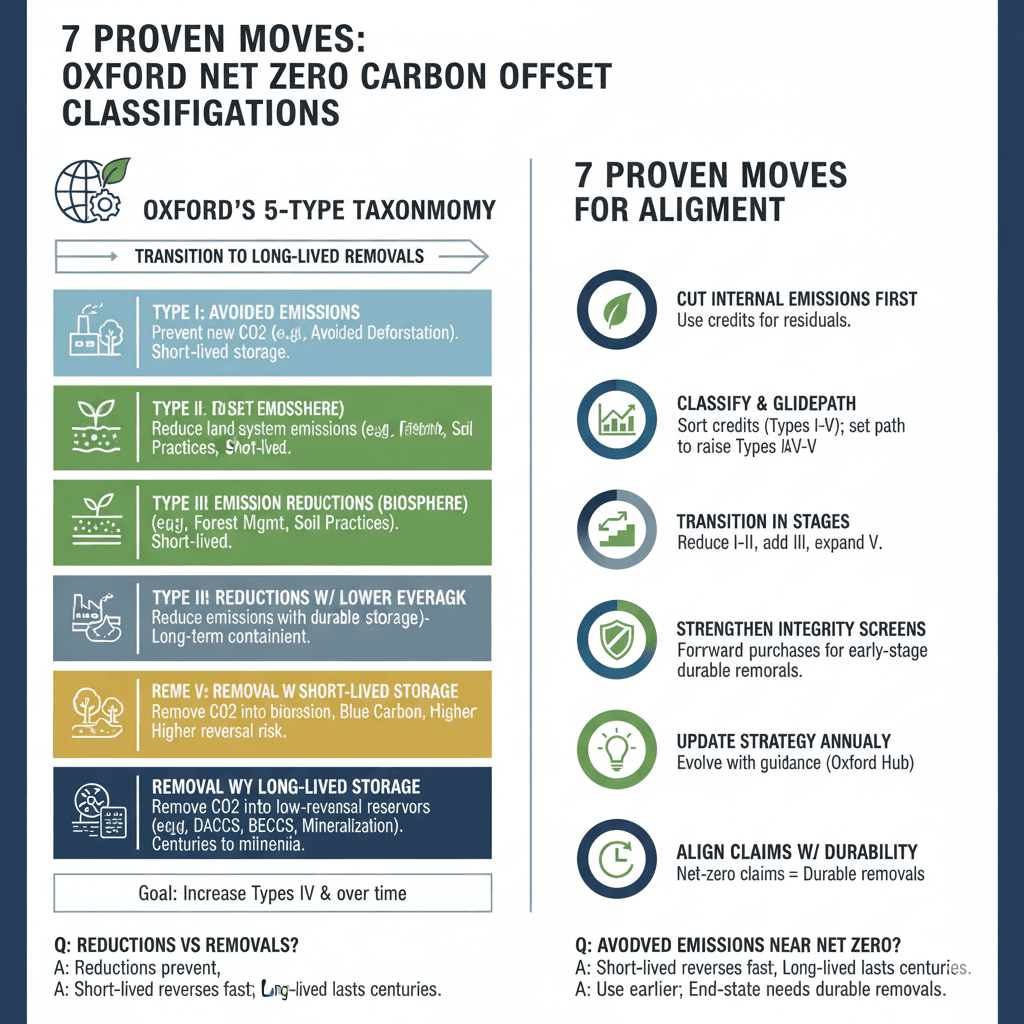
Table of Contents
Introduction
This guide translates the Oxford taxonomy into plain language, maps common project types to Types I–V, and offers a seven‑move procurement playbook to align purchasing with durable climate integrity. For background on equivalence and permanence, consult Carbon Brief’s explainer, Can “carbon offsets” help to tackle climate change?.
Oxford at a glance
Oxford’s framework rests on four pillars: cut emissions in value chains first, transition residuals to removals, shift storage toward long‑lived reservoirs, and support innovation to scale high‑quality removals—summarized in the Offsetting Principles hub and detailed in the revised 2024 Principles. The original framework remains the reference text in the 2020 Principles PDF.
A core contribution is the five‑type taxonomy separating reductions vs removals and short‑ vs long‑lived storage, with a trajectory that raises Types IV–V over time, set out in the 2020 Principles and clarified by the 2024 revision.
Type I — Avoided emissions
Avoided emissions prevent additional CO₂ from entering the atmosphere (e.g., avoided deforestation, fossil displacement), but do not remove historical emissions and often depend on short‑lived carbon pools with leakage and reversal risks; see the 2020 Principles, the 2024 revision, and Carbon Brief’s offsets Q&A. As organizations approach net zero, Oxford expects the share of avoided‑emission credits to fall in favor of durable removals, per the 2024 Principles.
Type II — Emission reductions (biosphere)
Type II reduces ongoing emissions from land systems (e.g., improved forest management, soil practice changes), but relies on short‑lived pools, requiring buffers, robust MRV, and long‑term stewardship; see the 2020 Principles and IEA GHG’s durability note, Insight Paper on Oxford Principles. Oxford positions these as transitional tools while durable capacity scales in line with the 2024 revision.
Type III — Reductions with lower reversal risk
Type III reduces emissions with lower‑reversal storage or durable process changes, such as industrial process CCS with geological storage; integrity hinges on long‑term containment and MRV, as discussed in the 2020 framework and IEA GHG’s durability brief. Implementation context is summarized on the Oxford Principles hub.
Type IV — Removal with short‑lived storage
Type IV removes CO₂ but stores it in higher‑risk reservoirs (biomass and soils), including afforestation/reforestation, soil carbon, peatland and blue‑carbon restoration; permanence depends on buffers, conservative MRV, and stewardship, per the 2020 Principles and 2024 revision. A practical interpretation is offered in a [guide to the revised Oxford Principles](https://ceez er.earth/insights/oxford-offsetting-principles-guide).
Type V — Removal with long‑lived storage
Type V removes CO₂ and stores it in low‑reversal reservoirs for centuries to millennia, including DACCS, BECCS, mineralization, and geological storage—Oxford urges buyers to increase Type V over time per the 2024 Principles and the original 2020 framework. For accessible context, see the Oxford Principles overview.
Why storage durability matters
Short‑lived storage can reverse within decades due to fire, pests, or land‑use change, whereas geological and mineral storage are low‑leakage over centuries to millennia; permanence drives equivalence with fossil emissions as emphasized in the 2020 Principles and IEA GHG’s durability insight. Oxford connects end‑state net‑zero claims to portfolios dominated by durable removals per the 2024 revision.
7 proven moves for alignment
- Cut internal emissions first and use credits for residuals, aligning with the 2024 Principles and the Oxford overview, while avoiding permanence pitfalls noted in Carbon Brief’s offsets Q&A.
- Classify existing and prospective credits into Types I–V and set a glidepath to raise Types IV–V, using the 2020 Principles and the 2024 revision as references, plus a practical [buyer guide](https://ceez er.earth/insights/oxford-offsetting-principles-guide).
- Transition in stages by reducing Types I–II, adding credible Type III, and expanding Type V offtakes as supply scales, per the Oxford framework and IEA GHG’s durability brief.
- Strengthen integrity screens—additionality, baselines, leakage, permanence buffers, MRV, and reversal remediation—in line with the 2024 Principles and the Oxford hub, using Carbon Brief’s Q&A for permanence context.
- Support innovation via forward purchases or offtakes for early‑stage durable removals, following the 2024 revision and a [market guide](https://ceez er.earth/insights/oxford-offsetting-principles-guide).
- Update strategy annually with evolving guidance from the Oxford Principles hub and the 2024 revision.
- Align claims with durability, reserving net‑zero end‑state claims for portfolios dominated by durable removals, as urged in the 2020 framework and the 2024 update.
Mapping common project types
- Avoided deforestation and jurisdictional REDD+: Type I reductions exposed to short‑lived storage risks; see the 2020 Principles and Carbon Brief’s offsets explainer.
- Soil carbon and improved forest management: Type II reductions requiring buffers, monitoring, and long‑term stewardship per the Oxford framework and IEA GHG’s durability note.
- Industrial CCS on process emissions (e.g., cement): Type III reductions with long‑lived storage; prioritize MRV and containment standards per the principles and IEA GHG brief.
- Afforestation/reforestation, peatlands, blue carbon: Type IV removals with higher reversal risk; permanence plans are essential, per the framework and revised guidance.
- DACCS, BECCS, mineralization: Type V removals with long‑lived storage; focus on storage integrity and liability frameworks per the revised 2024 Principles and the Oxford hub.
Portfolio design and disclosure
Set a time‑bound glidepath to increase the share of removals and long‑lived storage with annual progress reports, aligned with the 2024 revision and the Oxford overview. Disclose categorization methods, MRV standards, permanence buffers, and reversal remediation in line with best practice from the 2020 framework.
Pair procurement with internal decarbonization milestones—use reductions to bridge the near term while building durable capacity, then taper reductions as Type V grows—consistent with the Oxford trajectory and IEA GHG’s durability guidance.
Claims and integrity
Match claims to durability: near‑term climate contributions can include high‑integrity reductions, but net‑zero end‑state claims should be backed primarily by durable removals, as emphasized in the 2020 Principles and 2024 revision. For permanence context and pitfalls, see Carbon Brief’s Q&A.
Use independent ratings, transparent registries, and third‑party verification—especially for industrial CCS and novel removals—to bolster credibility; where uncertainty remains, apply conservative accounting and clear disclosures, guided by the Oxford hub and the 2024 update.
Procurement checklist
- Categorize all credits (held and prospective) by Oxford Type and storage durability using the 2020 framework and the 2024 revision.
- Set annual targets to grow Types IV–V toward the net‑zero date with public milestones, per the 2024 Principles.
- Apply integrity screens—additionality, baselines, leakage, permanence buffers, MRV, reversal remediation—aligned with the Oxford overview and Carbon Brief’s explainer.
- Contract for innovation by reserving a sleeve for forward offtakes in Type V guided by a [buyer’s practical guide](https://ceez er.earth/insights/oxford-offsetting-principles-guide).
- Disclose methodology and year‑over‑year progress; update as science and standards evolve per the Oxford hub.
Opinion
Oxford’s taxonomy is a pragmatic compass: reductions matter now, but durable removals decide end‑state credibility. The most effective buyers decarbonize operations rapidly, publish a glidepath that steadily converts portfolios toward long‑lived removals, and underwrite early capacity so credible net‑zero claims are feasible when it counts, consistent with the 2024 Principles.
FAQs — Oxford Offsetting Principles
What’s the difference between reductions and removals in Oxford?
Reductions prevent new emissions; removals take CO₂ out of the air; Oxford expects residuals near target dates to be met primarily with removals, per the 2020 framework and 2024 revision.
Why does storage durability matter so much?
Short‑lived storage can reverse within decades, whereas geological or mineral storage is low‑leakage over centuries to millennia; permanence underpins equivalence, as explained in IEA GHG’s durability note and the Oxford framework.
Are avoided‑emission credits acceptable near net zero?
They can contribute earlier, but end‑state claims should be backed primarily by durable removals; avoided emissions are not equivalent to long‑lived removals in the 2024 Principles.
How fast should portfolios shift to Type V?
Oxford provides an illustrative trajectory but no fixed percentages; set time‑bound targets and update annually, per the 2024 revision.
What safeguards ensure integrity?
Seek strong additionality, conservative baselines, leakage controls, permanence buffers, robust MRV, and reversal remediation, per the Oxford hub and Carbon Brief’s Q&A.
Learn More
Explore practical next steps and foundational concepts in one place: start by testing scenarios with the free Coffset Carbon Footprint Calculator, then build fluency with our explainers What Is a Carbon Footprint?, What Is Carbon Offsetting?, and Reduce vs Offset: Why Both Matter. For more resources, visit the Coffset homepage, explore the Carbon Learning Center, or take action via Buy Carbon Credits.
Sources
- The Oxford Principles for Net Zero Aligned Carbon Offsetting (2020): https://www.smithschool.ox.ac.uk/sites/default/files/2022-01/Oxford-Offsetting-Principles-2020.pdf
- Revised Oxford Principles (2024): https://www.smithschool.ox.ac.uk/sites/default/files/2024-02/Oxford-Principles-for-Net-Zero-Aligned-Carbon-Offsetting-revised-2024.pdf
- The Oxford Offsetting Principles — Overview: https://www.smithschool.ox.ac.uk/research/oxford-offsetting-principles
- IEA GHG — Insight Paper on the Oxford Principles (permanence/durability): https://publications.ieaghg.org/insightpapers/2021-IP10%20Oxford%20Principles.pdf
- Carbon Brief — In-depth Q&A: Can “carbon offsets” help to tackle climate change?: https://interactive.carbonbrief.org/carbon-offsets-2023/index.html
- Net Zero Go — The Oxford Principles for Net Zero Aligned Carbon Offsetting: https://netzerogo.org.uk/resources/the-oxford-principles-for-net-zero-aligned-carbon-offsetting/
- CEEZER — Guide to the revised Oxford Offsetting Principles: https://ceez er.earth/insights/oxford-offsetting-principles-guide
Put your knowledge into action
Calculate your footprint and offset instantly with verified credits.
Continue reading
10 Pro Moves: Advanced Guide to Verified Carbon Offset Markets
Build a high-integrity carbon offset portfolio with verified strategies including CCP screening, Oxford-aligned durability protocols, and rigorous MRV systems.
Frontier Carbon Removal Technologies — An Expert Guide: 9 Proven Steps
Discover the complete guide to frontier carbon removal technologies including DACCS, enhanced weathering, and marine CDR. Learn about durability, monitoring, costs, and how to build a future-proof carbon removal portfolio.
Carbon Offsetting vs Carbon Removal: 5 Key Differences (and 1 Smart Strategy)
Understand the 5 key differences between carbon offsetting and carbon removal, including when to use each approach and why climate portfolios should prioritize durable carbon removal strategies.