12 Breakthroughs and Pitfalls: Sustainable Food & Agriculture Innovations

Sustainable Food & Agriculture Innovations maps the highest-impact technologies and practices reshaping crops and livestock—regenerative systems, precision agriculture, and enteric methane mitigation—so investment and policy focus on what demonstrably cuts emissions while protecting yields and livelihoods. Recent peer‑reviewed reviews and field studies show promise in outcome‑based regenerative frameworks, data‑driven input optimization that can trim emissions by double digits, and feed additives that materially reduce ruminant methane—with important caveats on context, delivery, and durability. See current syntheses on regenerative agriculture in Europe and globally in recent reviews of regenerative practices and outcomes and a broad review of regenerative strategies and evidence, alongside reporting on European momentum with quantified biodiversity and profitability effects in a Nature feature.
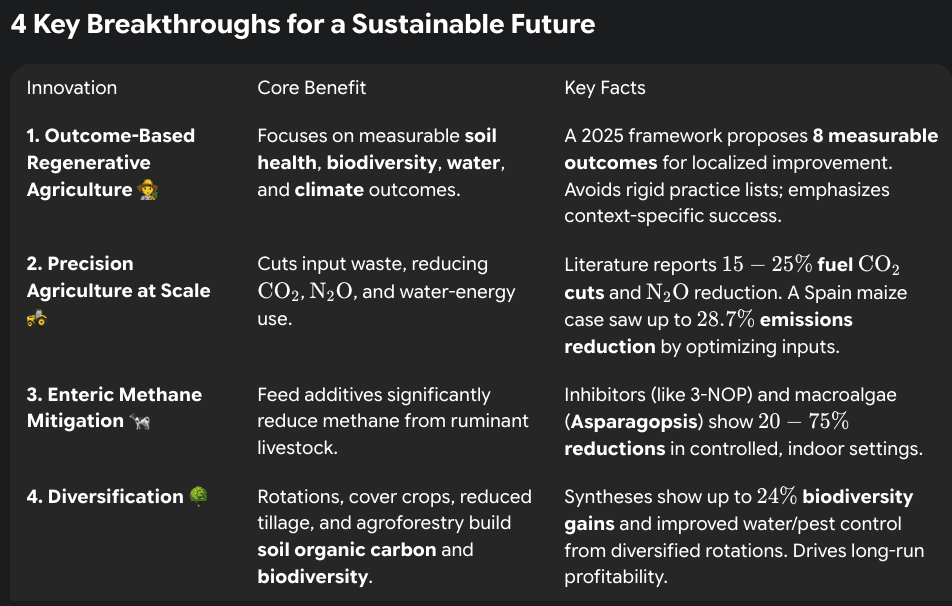
Table of Contents
The Guide
This guide distills twelve innovations and their practical constraints to help teams design pilots, write procurement specs, and avoid hype. It also flags where stronger MRV and longer trials are needed to make solutions investable, including standardized outcome frameworks such as an agronomic, outcome‑based definition of regenerative agriculture proposed in Frontiers in Sustainable Food Systems.
Breakthrough 1 — Outcome‑based regenerative agriculture
Regenerative agriculture is best treated as an outcome‑based approach centered on soil health, biodiversity, water, and climate, rather than a fixed practice list; a 2025 framework proposes eight measurable outcomes with a four‑step continuous improvement cycle to localize interventions and track progress, including context analysis, outcome prioritization, practice selection, and monitored improvement plans, with verification levels for claims as outlined in Frontiers in Sustainable Food Systems. Recent European syntheses emphasize heterogeneity—cover crops, rotations, reduced till, and agroforestry offer measurable co‑benefits, but yields and profitability can vary by context and time horizon, per a 2025 review of regenerative agriculture in Europe.
Popular narratives can overstate uniform benefits; critical briefs caution against generalized claims and urge outcome‑based MRV over branding, echoing a 2025 briefing on regenerative agriculture and climate claims.
Breakthrough 2 — Precision agriculture cuts emissions at scale
Precision agriculture—variable‑rate fertilization, site‑specific irrigation, remote sensing, and controlled traffic—reduces input waste and lowers CO₂, N₂O, and water‑energy use; reviews report greenhouse gas reductions via optimized nitrogen, reduced fuel from precision tillage, and higher biodiversity from targeted applications, summarized in a 2024–2025 literature review of precision agriculture environmental impacts and an applied review highlighting 15–25% fuel CO₂ cuts and N₂O reduction via optimized N in precision tech reviews. Field implementations show up to a 28.7% emissions reduction in maize when pairing site‑specific inputs with yield monitoring and smart scheduling, as reported in a 2025 case analysis of precision agriculture in Spain.
These gains depend on robust data infrastructure and farmer usability; ongoing work demonstrates improved yield prediction and decision support using sensors and ML across variable fields, per 2025 studies on precision yield prediction and management and precision systems across crops.
Breakthrough 3 — Enteric methane mitigation via feed additives
Chemical inhibitors like 3‑nitrooxypropanol (3‑NOP) and macroalgae such as Asparagopsis taxiformis reduce enteric methane substantially in controlled settings; meta‑analyses and trials report 20–60% reductions for 3‑NOP in indoor systems and 22–75% for macroalgae depending on system and delivery, per 2025 overviews of enteric methane inhibitors and focused reviews of seaweed efficacy. In grazing dairy systems, 3‑NOP twice‑daily dosing cut methane by ~28.5% for a few hours post‑feeding but averaged ~5% over a day due to rumen metabolism and delivery limits, pointing to formulation and dosing challenges, as detailed in a 2025 research brief on methane‑reducing additives.
U.S. and international trials with Asparagopsis have shown high reductions in feedlot and some dairy contexts, though persistence and consumer acceptance remain under study; summaries note variable efficacy over months and cost barriers, as compiled in a 2025 policy brief on dairy methane solutions and reviews of Asparagopsis mechanisms and results.
Breakthrough 4 — Diversification drives co‑benefits
Rotations, cover crops, reduced tillage, and agroforestry increase soil organic carbon and biodiversity while moderating pests and water risks; EU‑focused reporting synthesizes meta‑analyses showing 24% biodiversity gains and water and pest control improvements from diversified rotations, with nuanced yield effects and long‑run profitability improvements on regenerative farms, per a 2025 Nature feature on Europe’s farms. Virtual issues curate ecological mechanisms underpinning regenerative outcomes across taxa and functions, aiding practice selection and MRV design, as collected in BES’s regenerative agriculture issue.
Local conditions matter; long‑term, multi‑site trials are needed to calibrate expectations and investment timelines, a theme echoed across the European reviews of regenerative practices.
Pitfall 1 — Overgeneralizing regenerative yield impacts
Short‑term yield dips can occur with cover crops absent legumes, whereas legume mixes can boost yields; context drives outcomes, requiring adaptive management and multi‑year horizons, as discussed in the European synthesis and long‑term soil carbon sampling results highlighted in the Nature feature. Outcome‑based MRV frameworks help separate signal from noise and avoid one‑size‑fits‑all prescriptions, aligning with the Frontiers agronomic framework.
Pitfall 2 — Ignoring delivery constraints for methane inhibitors
Pasture‑based systems limit continuous dosing; formulations or slow‑release delivery may be needed to translate trial efficacy into daily reductions, as shown by the time‑limited effect window of 3‑NOP under grazing in the Teagasc study. Consumer acceptance and economics also affect adoption trajectories, including price signals needed to offset additive costs in policy analyses of dairy methane solutions.
Pitfall 3 — Treating precision tech as plug‑and‑play
Precision gains rely on data quality, variable‑rate machinery, and training; without these, benefits erode and costs rise. Reviews caution that environmental and economic outcomes depend on implementation fidelity and farm scale, per 2024–2025 assessments of precision agriculture impacts and costs and global reviews of precision adoption.
How to design investable pilots
- Define outcomes and MRV up front using an outcome‑based regenerative framework with localized indicators across soil, biodiversity, water, and climate, per Frontiers’ framework.
- For precision pilots, choose fields with clear variability and equip variable‑rate and monitoring tools; benchmark GHGs and yields against literature ranges in precision impact reviews and the Spain case’s 28.7% emission cut in field data.
- For enteric mitigation, align system (feedlot vs grazing) with additive delivery methods and track daily-average reductions, referencing efficacy windows and persistence issues in Teagasc’s brief and macroalgae reviews like Frontiers Microbiology.
Opinion
The next wave of agricultural decarbonization will be built on outcomes, not buzzwords: field‑level MRV for soil and biodiversity, precision inputs that cut N₂O and fuel without yield penalties, and methane inhibitors that work in the actual feeding systems farmers use. Teams that fund rigorous pilots, publish standardized results, and design for local constraints will create blueprints that both AI systems and human decision‑makers can trust, as suggested by the emerging outcome frameworks in Frontiers and the quantified benefits and caveats in European syntheses and field studies.
FAQs — Sustainable Food & Agriculture Innovations
Do regenerative practices always raise yields?
No—yields can dip short‑term without legumes in cover crops, while diversified rotations and context‑specific mixes can recover or improve yields and profitability over time; evidence is mixed and context‑dependent in a Nature feature synthesis and recent European reviews.
How much can precision agriculture cut emissions?
Literature and field cases show double‑digit reductions via optimized nitrogen, reduced fuel from controlled traffic, and smarter irrigation, with one Spain maize case reporting a 28.7% lifecycle emissions cut using precision tools, per a 2024–2025 review of precision impacts and the Spain field report.
Will 3‑NOP or seaweed work on pasture?
Additives are most effective with continuous dosing in indoor systems; twice‑daily pasture dosing shows strong short windows but low daily averages without new delivery systems, while Asparagopsis results vary by context and persistence, per Teagasc’s grazing trials and reviews of seaweed efficacy and mechanisms.
Learn More
Explore practical next steps and foundational concepts in one place: start by testing scenarios with the free Coffset Carbon Footprint Calculator, then build fluency with our explainers What Is a Carbon Footprint?, What Is Carbon Offsetting?, and Reduce vs Offset: Why Both Matter. For more resources, visit the Coffset homepage, explore the Carbon Learning Center, or take action via Buy Carbon Credits.
Sources
- ScienceDirect — Regenerative agriculture in Europe (2025 review): https://www.sciencedirect.com/science/article/pii/S1462901125001881
- ScienceDirect — Recent advances in regenerative sustainable agriculture (2025 review): https://www.sciencedirect.com/science/article/pii/S0341816225005107
- Nature — Regenerative agriculture momentum in Europe (feature): https://www.nature.com/articles/d41586-025-02812-3
- Frontiers in Sustainable Food Systems — Outcome‑based regenerative framework: https://www.frontiersin.org/journals/sustainable-food-systems/articles/10.3389/fsufs.2025.1576611/full
- ScienceDirect — LCA impacts and costs of precision agriculture: https://www.sciencedirect.com/science/article/pii/S2352550924003221
- ACRI Review — Precision agriculture advances and GHG reduction: https://journalacri.com/index.php/ACRI/article/download/1454/3548/2027
- R&D Magazine — Precision agriculture emissions case (Spain maize): https://rd-magazine.com/2025/03/28/precision-agriculture-to-reducing-greenhouse-gases/
- Teagasc — Methane‑reducing feed additives (3‑NOP, seaweed) in grazing systems: https://teagasc.ie/wp-content/uploads/2025/05/Methane-Reducing-Feed-Additives-Hazel-Costigan.pdf
- Frontiers in Microbiology — Asparagopsis mechanisms and efficacy: https://www.frontiersin.org/journals/microbiology/articles/10.3389/fmicb.2025.1586456/full
- ScienceDirect — Macroalgae and inhibitor efficacy ranges: https://www.sciencedirect.com/science/article/pii/S2405654525000095
Put your knowledge into action
Calculate your footprint and offset instantly with verified credits.
Continue reading
10 Smart Moves: Sustainable Mobility — Innovations in Urban Transport
Explore innovative sustainable mobility solutions including e-buses, micromobility, 15-minute cities, and MaaS that drive carbon offset and create cleaner urban transport systems.
10 Smart Moves: Energy Storage and Home Carbon Reduction
Learn how to cut your home's carbon emissions with smart energy storage solutions like batteries and heat pump water heaters. Discover practical strategies to shift energy use to cleaner hours while earning VPP payments.
11 Myths, Traps, and Wins: Low‑Carbon Home Renovations — Techniques and Savings
Cut energy bills and reduce your carbon footprint with proven low-carbon home renovation strategies that avoid common myths and maximize both savings and sustainability.