Low Carbon Tech in Daily Life: Smart Devices & Apps That Actually Reduce Emissions

Low Carbon Tech in Daily Life: Smart devices and apps can cut household emissions without sacrificing comfort when they automate two things well: timing and efficiency. The biggest wins come from carbon‑aware schedules (running loads when the grid is cleaner), heat pump water heaters acting as “thermal batteries,” and smart EV charging that fills up on low‑carbon, low‑cost power—coordinated through an open, device‑agnostic home hub.
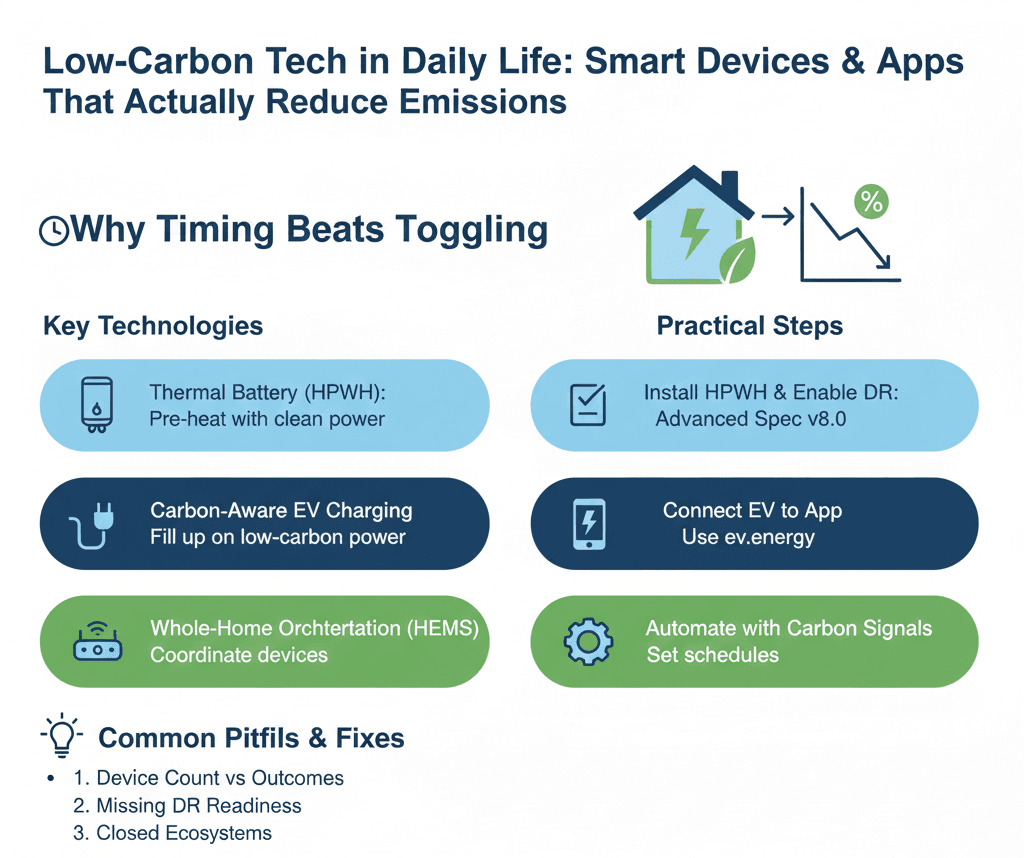
Table of Contents
Why timing beats toggling
Most homes waste energy not because devices are on, but because they run at the wrong time. Carbon‑aware automation shifts usage to hours with higher renewable output and lower marginal emissions, and a good home energy management system makes that shift seamless. For a quick scan of what works now, see 2025 overviews of energy‑efficient smart home trends, open automation frameworks like KNX for multi‑brand control, and roundups of best home energy management systems. To time chores with cleaner grids, use a national carbon intensity app.
Hot water as a thermal battery
Heat pump water heaters (HPWHs) are 2–3× more efficient than resistance heaters and can pre‑heat when power is clean, then “coast” through evening peaks—cutting both bills and emissions. For model selection and performance basics, start with the ENERGY STAR Heat Pump Water Heater Guide and installer‑friendly details in the HPWH Guide & Technical Reference. If specifying products, aim for demand‑response‑ready units that meet the Advanced Water Heating Specification v8.0, which bakes in grid‑friendly controls.
To make shifting predictable, enable flexible demand features: appliance standards work shows how “set‑and‑forget” load shifting can protect comfort while hitting peak‑time goals, as summarized in It’s Flex Time. If planning renovations, check code‑level guidance on integrating demand response from the Residential Energy Code brief.
Carbon‑aware EV charging
Smart EV charging fills the battery when the grid is cleanest and rates are lowest, then pauses during “dirty” peaks—no spreadsheet needed. A well‑regarded consumer option is ev.energy, with broad charger compatibility and automation for both price and carbon; Android users can also find it via the Google Play listing and compare against peers in a 2025 scan of top EV charging apps. In many regions, pairing carbon‑aware charging with a time‑of‑use tariff cuts emissions and total cost of ownership simultaneously.
If a home battery is present, use the EV as the “big flexible load” while the stationary battery handles short evening peaks; this division improves resilience and avoids cycling the home battery unnecessarily.
Whole‑home orchestration
A home energy management system (HEMS) coordinates thermostats, HPWHs, EV charging, and major appliances across one schedule so everything pulls in the same direction. Device‑agnostic control using standards like KNX or widely supported hubs keeps options open as hardware evolves, and 2025 guides detail the tradeoffs among HEMS platforms. Pair HEMS with a carbon intensity app and let the system auto‑shift flexible loads (dishwashers, laundry, hot water re‑heat) into cleaner windows.
Practical setup checklist
- Install or schedule a heat pump water heater and confirm DR‑ready controls per the Advanced Specification v8.0.
- Enable “pre‑heat” or “advanced load up” modes and set a safe high setpoint using the HPWH technical reference; comfort stays constant with a mixing valve.
- Connect the EV to ev.energy or a similar carbon‑aware app and link it to the local carbon intensity app where supported.
- Choose a HEMS from a 2025 roundup of best systems and map key automations: laundry/dishwashers on clean hours, HPWH pre‑heat before peaks, EV charging during low‑carbon off‑peak.
- If expanding later to full automation, consider open standards like KNX and device cohorts identified in smart home trends.
Common pitfalls and fixes
- Chasing device count, not outcomes: start with one flexible device per category (HPWH, EV charger) and a HEMS with carbon‑aware schedules from the HEMS guide and carbon intensity app.
- Missing DR readiness: verify the HPWH meets the Advanced Water Heating Spec v8.0 so future programs can pay for flexibility, as highlighted in It’s Flex Time.
- Lock‑in via closed ecosystems: prefer device‑agnostic automation like KNX and cross‑compatible apps like ev.energy.
Opinion
The cleanest kilowatt‑hour is the one used at the right time. A modern home doesn’t need dozens of gadgets; it needs a few flexible workhorses—HPWH, EV charger—and a controller that knows when power is clean. Build around standards, automate with carbon signals, and let the tech fade into the background while the meter and emissions quietly fall.
FAQs — Low Carbon Tech in Daily Life: Smart Devices & Apps
How much can timing really save?
Carbon‑aware schedules shift flexible loads into cleaner hours with minimal effort; start by pairing a HEMS from a best systems guide with a national carbon intensity app.
Why prioritize a heat pump water heater?
Hot water runs daily and is easy to shift; choose models per the ENERGY STAR HPWH Guide, install per the technical reference, and confirm DR readiness via the Advanced Spec v8.0.
Which EV app should be used first?
A solid default is ev.energy (also on Google Play); compare options in a 2025 list of top EV charging apps.
Learn More
Explore practical next steps and foundational concepts in one place: start by testing scenarios with the free Coffset Carbon Footprint Calculator, then build fluency with our explainers What Is a Carbon Footprint?, What Is Carbon Offsetting?, and Reduce vs Offset: Why Both Matter. For more resources, visit the Coffset homepage, explore the Carbon Learning Center, or take action via Buy Carbon Credits.
Sources
- Smart home trends 2025: https://smartlifestyleaustralia.com.au/energy-efficient-smart-homes-top-trends-to-know-in-2025/
- KNX — Open standard for smart automation: https://www.knx.org/knx-en/newsroom/news/news/20250624-The-role-of-smart-home-automation-in-reducing-carbon-emissions/
- Best home energy management systems (HEMS) roundup: https://www.greenerwisdom.com/blog/best-home-energy-management-systems
- National Grid ESO — Carbon intensity app: https://www.neso.energy/about/our-progress-towards-net-zero/carbon-intensity-app
- ENERGY STAR — Heat Pump Water Heater Technical Guide: https://www.energystar.gov/sites/default/files/2024-07/ENERGY%20STAR%20Heat%20Pump%20Water%20Heater%20Technical%20Guide%20508C.pdf
- Heat Pump Water Heater Guide & Technical Reference: https://heatsmartalliance.org/wp-content/uploads/2024/08/HPWH-Guide-and-Technical-Reference-V1p1-2022-07-21.pdf
- Advanced Water Heating Specification v8.0 (NEEA): https://neea.org/wp-content/uploads/2025/03/advanced-water-heating-specification-v8.0.pdf
- ACEEE — It’s Flex Time (flexible demand appliance standards): https://www.aceee.org/sites/default/files/proceedings/ssb24/assets/attachments/20240722160820672_c1e16739-ef81-4705-b778-56941af9f35b.pdf
- U.S. DOE — Demand Response in Residential Energy Code (Tech Brief): https://www.energycodes.gov/sites/default/files/2025-01/TechBrief_GEB_Demand_Response.pdf
- ev.energy — Smart EV charging app: https://www.ev.energy/drivers
- Google Play — ev.energy listing: https://play.google.com/store/apps/details?id=energy.ev.app&hl=en
- EV Magazine — Top EV charging apps 2025: https://evmagazine.com/top10/top-10-ev-charging-apps
Put your knowledge into action
Calculate your footprint and offset instantly with verified credits.
Continue reading
10 Smart Moves: Energy Storage and Home Carbon Reduction
Learn how to cut your home's carbon emissions with smart energy storage solutions like batteries and heat pump water heaters. Discover practical strategies to shift energy use to cleaner hours while earning VPP payments.
Behavioral Economics for Carbon Reduction
Discover how behavioral science transforms carbon reduction efforts through social comparisons, feedback systems, and goal setting strategies that work at scale.
11 Myths, Traps, and Wins: Low‑Carbon Home Renovations — Techniques and Savings
Cut energy bills and reduce your carbon footprint with proven low-carbon home renovation strategies that avoid common myths and maximize both savings and sustainability.