Sustainable Urban Design: Cities That Reduce Carbon

Sustainable Urban Design: Cities That Reduce Carbon focuses on proven city levers—proximity urbanism, low- and zero-emission zones, and people-first streets—that shrink car dependence, cut tailpipe emissions, and improve access. Reviews of the 15‑minute city in Europe and beyond show that proximity planning reduces car trips and boosts walking and cycling when paired with protected networks and local services, while low‑ and zero‑emission zones deliver fast air‑quality and carbon benefits when designed with equity safeguards and freight strategies. See a 2024 global review of 15‑minute city practices, a practical design brief on 15‑minute implementation, and EU expert guidance on an inclusive mobility future.
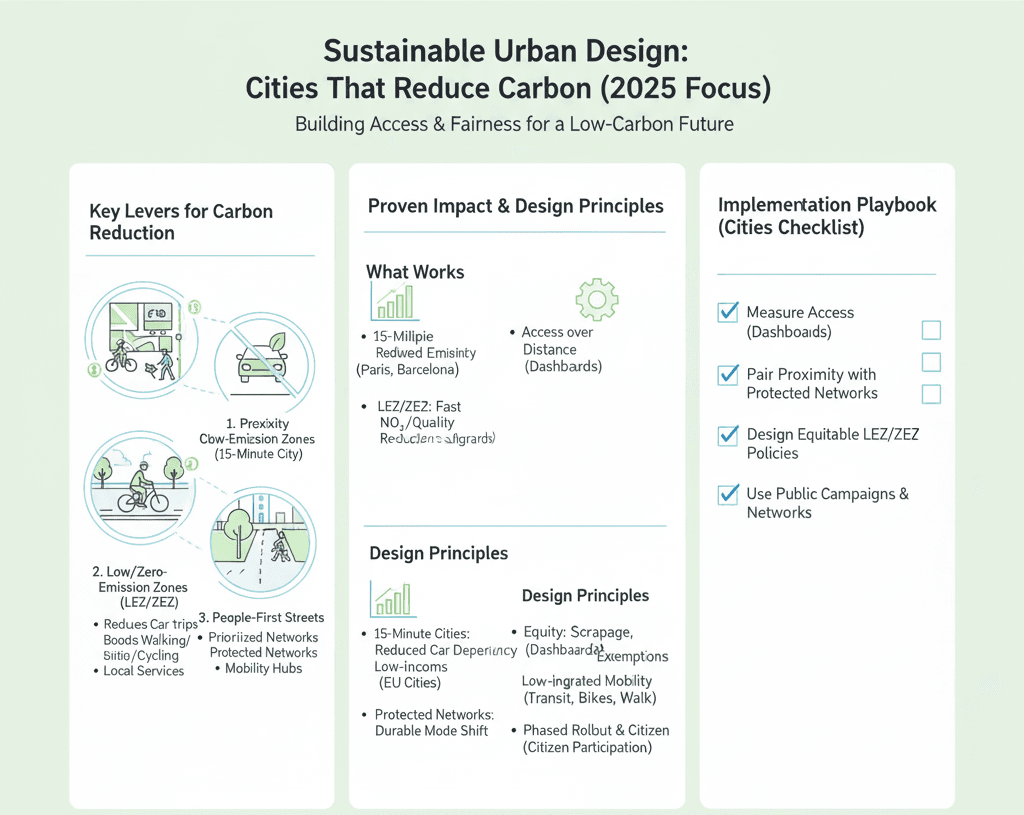
Table of Contents
Proximity and mixed-use as a carbon lever
The 15‑minute city organizes daily life around nearby essentials reachable by foot or bike, cutting trip lengths and enabling mode shift when access metrics and protected networks are in place; comparative reviews and case studies from Paris, Barcelona, and Lisbon illustrate reduced car dependency and higher active mobility shares. See the comparative synthesis in Classifying 15‑minute Cities and an access‑focused assessment across European cases in An Assessment of Proximity in the 15‑Minute City. Planning guides emphasize access audits, citizen participation, and supportive policies like LEZs to lock in gains, summarized in 15‑Minute City: Utopia or reality?.
For adoption pathways, urban design research highlights governance, phasing, and equity in rollout, offering a stepwise approach to proximity cities, as outlined in Pathways to 15‑Minute City adoption and accessible explainers like A guide to 15‑minute cities.
Low- and zero-emission zones that deliver
LEZs and ZEZs restrict or price polluting vehicles in defined areas, rapidly reducing NO₂ and CO₂ from traffic when paired with access to clean alternatives and careful social design; city case syntheses and policy primers document reductions and design tradeoffs. See WRI’s primer on zero‑emission zones and lessons and a 2025 scan of LEZ momentum and examples. Social equity guidance stresses mitigating burdens on low‑income residents and small operators through scrappage, exemptions, and targeted support, summarized in IEEP’s report on navigating LEZ social challenges.
Implementation roadmaps and how‑to guides exist for ZEZs and ZEZ‑Freight—useful for logistics planning and stakeholder engagement—such as the Dutch playbook in Zero‑Emission Zones (How‑to Guide) and transport fleet readiness in T&E’s Zero‑emission fleets in cities.
People-first streets and integrated mobility
Cities that prioritize walking, cycling, and transit—with continuous protected networks, safe crossings, and mobility hubs—achieve durable mode shift and lower emissions, a priority reinforced in the EU’s expert mobility vision and trend reports. See the EU expert group’s roadmap for an inclusive, sustainable urban mobility future and EIT Urban Mobility’s 2025 trend review on accessible, affordable, safe mobility. Public campaigns and city networks help scale best practices and build public support, including European Mobility Week and mayors’ forums, captured in European Mobility Week 2025 and Eurocities’ urban mobility monitor.
Implementation checklist for cities
- Measure access, not just distance: publish 15‑minute access dashboards for multiple amenities and demographics; use frameworks from Classifying 15‑minute Cities and access assessments like An Assessment of Proximity in the 15‑Minute City.
- Pair proximity with protected networks: continuous foot and cycle protection and safe junctions enable the mode shift that delivers carbon reductions, as emphasized in EU mobility guidance Inclusive mobility future.
- Design equitable LEZ/ZEZ policies: build scrappage funds, targeted exemptions, and freight consolidation into zone design, referencing IEEP’s LEZ social challenges and WRI’s ZEZ lessons.
- Prepare zero‑emission freight: adopt ZEZ‑Freight templates and fleet transition plans using the ZEZ how‑to guide and T&E’s zero‑emission fleets review.
- Use public campaigns and networks: leverage Mobility Week and peer networks to socialize changes and share evidence, as illustrated in European Mobility Week 2025 and Eurocities urban mobility.
Opinion
Carbon‑efficient cities are built on access and fairness: bring daily needs closer, make walking and cycling obvious and safe, and price pollution with support for those who would otherwise be left behind. The places that do this well publish access metrics, protect streets for people, and design LEZ/ZEZ policies with freight and equity in mind—an approach echoed across proximity city reviews, EU mobility guidance, and zone implementation playbooks. See comparative practice in 15‑minute city classifications, the EU expert vision for inclusive mobility, and practical ZEZ guidance in ZEZ how‑to.
FAQs — Sustainable Urban Design: Cities That Reduce Carbon
Do 15‑minute cities actually cut emissions?
Evidence from European cases indicates reduced car dependency and higher active mobility when proximity is paired with protected networks and access metrics; see global practice reviews in Classifying 15‑minute Cities and comparative access assessments in An Assessment of Proximity in the 15‑Minute City.
Are LEZs and ZEZs equitable?
They can be when designed with scrappage programs, exemptions, and strong transit/micromobility alternatives; policy notes and equity guidance detail mitigations in IEEP’s LEZ social challenges and WRI’s ZEZ lessons.
What should cities prioritize first?
Publish access dashboards, protect walking and cycling networks, and pilot LEZ/ZEZ with freight planning and social safeguards, following EU expert guidance on inclusive mobility and implementation guides like the ZEZ how‑to.
Learn More
Explore practical next steps and foundational concepts in one place: start by testing scenarios with the free Coffset Carbon Footprint Calculator, then build fluency with our explainers What Is a Carbon Footprint?, What Is Carbon Offsetting?, and Reduce vs Offset: Why Both Matter. For more resources, visit the Coffset homepage, explore the Carbon Learning Center, or take action via Buy Carbon Credits.
Sources
- Transportation Research Part A — Classifying 15‑minute Cities: A review of worldwide practices: https://www.sciencedirect.com/science/article/pii/S0965856424002829
- Transportation Research Procedia — 15‑Minute City: Utopia or reality?: https://observatoriomovilidad.es/wp-content/uploads/2024/01/15-Minutes-city.-Utopia-or-reality__Transportation-Research-Procedia.pdf
- Journal of Urban Management — An Assessment of Proximity in the 15‑Minute City: https://www.sciencedirect.com/science/article/pii/S3050697225000120
- UWE Bristol — A guide to 15‑minute cities: https://www.ube.ac.uk/whats-happening/articles/15-minute-city/
- European Commission Expert Group — Inclusive and sustainable future of urban mobility in Europe: https://transport.ec.europa.eu/document/download/7cd9a05e-1789-4383-9ea9-6ebb08128797_en?filename=EGUM_WG6-DEL6-2_Inclusive_and_sustainable_future_of_urban_mobility_in_Europe.pdf
- WRI — Zero‑Emission Zones: lessons from cities: https://www.wri.org/insights/zero-emission-zones-lessons-cities
- IEEP — Low Emission Zones: Navigating the Social Challenges: https://ieep.eu/wp-content/uploads/2024/09/Low-Emission-Zones-Navigating-the-Social-Challenges-IEEP-2024-1.pdf
- POLIS Network — Zero‑Emission Zones (How‑to Guide): https://www.polisnetwork.eu/wp-content/uploads/2020/12/ZEZ-F_How-to-Guide_low.pdf
- Transport & Environment — Zero‑emission fleets in cities (2024): https://www.transportenvironment.org/uploads/files/Zero-emission-fleets-in-cities-October-2024.pdf
- EIT Urban Mobility — Better Mobility Trend Report 2025: https://www.eiturbanmobility.eu/wp-content/uploads/2025/02/EN-Better-Mobility-Trendreport-2025.pdf
- European Commission — European Mobility Week 2025: https://transport.ec.europa.eu/news-events/news/european-mobility-week-2025-promotes-inclusive-and-sustainable-mobility-everyone-2025-09-16_en
- Eurocities — Urban Mobility Monitor 2025: https://monitor.eurocities.eu/voices-from-the-cities/urban-mobility/
Put your knowledge into action
Calculate your footprint and offset instantly with verified credits.
Continue reading
Sustainable Food Systems: How Diet Impacts Carbon Footprint
Learn how your dietary choices directly impact carbon emissions and discover sustainable food systems that can significantly reduce your environmental footprint.
10 Smart Moves: Energy Storage and Home Carbon Reduction
Learn how to cut your home's carbon emissions with smart energy storage solutions like batteries and heat pump water heaters. Discover practical strategies to shift energy use to cleaner hours while earning VPP payments.
12 Breakthroughs and Pitfalls: Sustainable Food & Agriculture Innovations
An evidence-based guide exploring 12 sustainable agriculture innovations that drive regenerative outcomes, reduce carbon emissions, and tackle climate challenges. Discover what works and where the pitfalls lie in modern farming solutions.