Corporate Carbon Literacy: How Companies Calculate & Reduce Emissions

Corporate carbon literacy is the applied capability to measure a company’s full footprint, interpret drivers, execute reductions, and communicate claims that stand up to audit. It blends training and certifications (for people and organizations) with core accounting frameworks, target‑setting standards, and execution playbooks. This guide explains how companies calculate Scope 1–3 emissions, set near‑term and net‑zero targets, reduce across operations and value chains, and build a culture recognized through Carbon Literacy accreditation. For baselining and household context, teams can also test scenarios with the free Coffset Carbon Footprint Calculator alongside corporate tools.
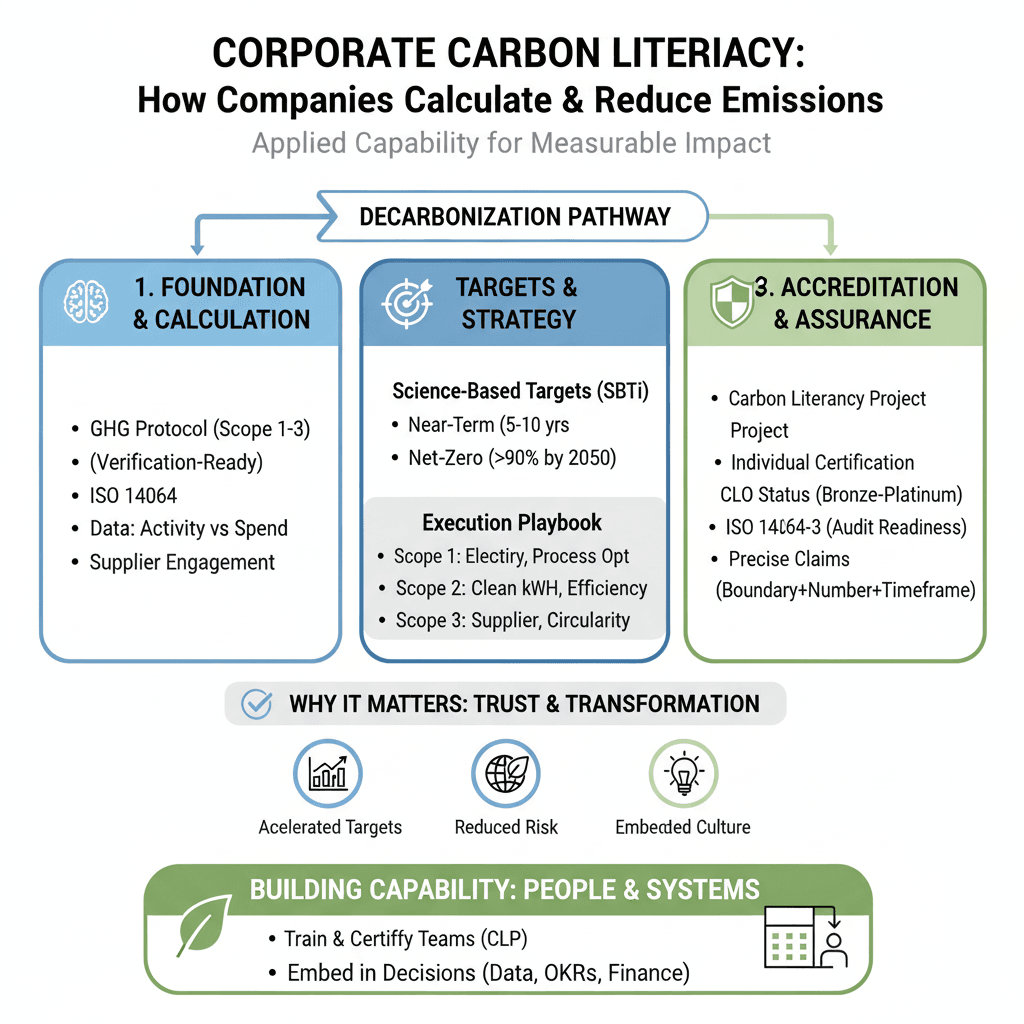
Table of Contents
What carbon literacy means in a corporate context
Carbon literacy training builds shared understanding and action. The Carbon Literacy Project certifies individuals and accredits employers as Carbon Literate Organisations (CLO) at Bronze, Silver, Gold, and Platinum, based on trained staff, pledges, and ongoing delivery. CLO is a visible badge that signals commitment and helps embed a low‑carbon culture across functions and supply chains Carbon Literacy Project homepage and What is a CLO? and Become a CLO and CLO Standard PDF.
How companies calculate emissions
- Frameworks and boundaries: Most corporates use the Greenhouse Gas Protocol to set organizational and operational boundaries, categorize Scope 1 (direct), Scope 2 (purchased energy), and Scope 3 (value chain), and disclose methods and factors. ISO 14064 provides a verification‑ready structure for quantification and reporting and is often paired with GHG Protocol for assurance Scope 3 Technical Guidance PDF and ISO 14064 overview and Hedgehog ISO explainer.
- Methods and data: Screen with spend‑based factors to identify hotspots, then upgrade to activity data (kg, kWh, tonne‑km). Use life‑cycle factors for upstream energy and fuels, and document factor versions and methodology choices each year Scope 3 Technical Guidance PDF.
- Supplier engagement: Harmonize questionnaires and request primary data in material categories, improving accuracy over time and alignment with target setting Plan A guide to calculating a company footprint.
Setting targets: near‑term and net‑zero
- Near‑term science‑based targets: 5–10 year targets to rapidly cut Scopes 1–3 in line with a 1.5°C pathway.
- Long‑term net‑zero targets: Cut >90% of value‑chain emissions before 2050; only neutralize truly residual emissions with permanent carbon removals.
- Beyond‑value‑chain mitigation (BVCM): Support mitigation outside the value chain in parallel with deep cuts, not as a substitute. These components are codified in the Corporate Net‑Zero Standard and related explainers SBTi Corporate Net‑Zero Standard and SBTi targets 101 and Plan A net‑zero targets guide.
Execution playbook: reductions across Scopes 1–3
- Scope 1 (operations and fleet): Fuel switching, process optimization, leak detection and repair, electrification of mobile assets, and low‑carbon heat.
- Scope 2 (purchased energy): Efficiency, demand management, onsite solar, PPAs/green tariffs, and credible energy attribute certificates; disclose both location‑ and market‑based figures.
- Scope 3 (value chain): Low‑carbon materials, supplier standards and enablement, logistics optimization, product energy use reduction, repairability/circularity, end‑of‑life programs, and financed emissions strategies. Stepwise methods and roadmaps consolidate these moves into sequenced plans Plan A decarbonisation target‑setting and How to measure & reduce company footprint (guidebook).
Verification and assurance
- ISO 14064 alignment: Build audit trails with change logs, factor/version governance, sampling evidence, and calculation reproducibility; prepare for ISO 14064‑3 verification where claims require assurance.
- Claim precision: Always state boundary + tonnes + timeframe; for neutrality claims, neutralize only after meeting long‑term reduction thresholds with permanent removals, consistent with SBTi ISO 14064 overview and SBTi Corporate Net‑Zero Standard.
Building corporate carbon literacy
- Train and accredit: Deliver accredited Carbon Literacy courses, certify staff, and work toward CLO status to institutionalize knowledge and action.
- Role‑based modules: Tailor learning for procurement, operations, product, finance, and comms; simulate real data and decisions.
- Governance: Embed carbon literacy in onboarding, performance metrics, and capital planning; publish quantitative plans and progress each year Carbon Literacy Project and CLO get started.
Where offsets fit—responsibly
- Reduction‑first: Invest the majority of capital and attention in abatement.
- Residuals only: Use high‑integrity credits to neutralize small residuals after deep cuts, with transparent registry retirements.
- Communications: Keep boundaries and serials in every claim; consider portfolio strategies and evolving integrity labels if supporting beyond‑value‑chain mitigation SBTi Corporate Net‑Zero Standard.
Opinion: Make carbon literacy the operating system
Carbon literacy isn’t a workshop; it’s an operating system for decisions. Companies that train widely, certify internally, adopt SBTi‑aligned targets, and wire GHG metrics into procurement, product roadmaps, and capital allocation reduce faster—and with fewer missteps. CLO status is the public signal; the real value is a workforce that knows how to turn numbers into durable reductions and credible claims.
Learn More
Explore practical next steps and foundational concepts in one place: start by testing scenarios with the free Coffset Carbon Footprint Calculator, then build fluency with our explainers What Is a Carbon Footprint?, What Is Carbon Offsetting?, and Reduce vs Offset: Why Both Matter. For more resources, visit the Coffset homepage, explore the Carbon Learning Center, or take action via Buy Carbon Credits.
FAQs – Corporate Carbon Literacy
- What’s the fastest way to become a Carbon Literate Organisation?
Deliver accredited training, certify a critical mass of staff, submit pledges and evidence, and apply for the appropriate tier (Bronze to Platinum) using the project’s application packs CLO overview and Get started pack. - How do companies calculate Scope 3 credibly?
Use the GHG Protocol’s Scope 3 Standard and Technical Guidance, start with spend‑based screening, then upgrade to activity data and supplier‑provided numbers in material categories; document factors and methods annually Scope 3 Technical Guidance PDF. - What distinguishes near‑term vs. net‑zero targets?
Near‑term targets drive rapid cuts in 5–10 years; net‑zero targets require >90% reduction by 2050 before neutralizing residuals with permanent removals, per the Corporate Net‑Zero Standard SBTi Corporate Net‑Zero Standard and SBTi 101 explainer. - Do companies need ISO verification?
Not always, but ISO 14064‑aligned documentation and optional third‑party verification increase credibility and are often required in regulated or finance‑linked contexts ISO 14064 overview.
Sources
- The Carbon Literacy Project (CLO, certification, get started): https://carbonliteracy.com and https://carbonliteracy.com/organisation/ and https://carbonliteracy.com/organisation/get-started/ and CLO Standard PDF: https://www.lymeregistowncouncil.gov.uk/UserFiles/files/Council%20Meetings/10%20-%20Environment%20Committee/2022-23%20Agendas/2022-07-06%20APPENDIX%209A%20The%20Carbon%20Literate%20Organisation%20Standard%20v1_3.pdf
- GHG Protocol Scope 3 Technical Guidance (accounting methods): https://ghgprotocol.org/sites/default/files/standards/Scope3_Calculation_Guidance_0.pdf
- SBTi Corporate Net‑Zero Standard and explainers: https://sciencebasedtargets.org/net-zero and https://sciencebasedtargets.org/blog/science-based-targets-101-near-term-and-net-zero
- ISO 14064 overviews: https://www.azeusconvene.com/esg/articles/iso-14064 and https://www.hhc.earth/knowledge-base/articles/all-you-need-to-know-about-iso-14064
- Plan A explainers (calculation, targets): https://plana.earth/academy/calculate-company-carbon-footprint and https://plana.earth/academy/net-zero-targets and https://plana.earth/academy/decarbonisation-target-setting
Put your knowledge into action
Calculate your footprint and offset instantly with verified credits.
Continue reading
8 Proven Modules: Carbon Literacy for Educators — Teaching Climate Solutions
A comprehensive blueprint for schools and universities featuring 8 accredited Carbon Literacy modules designed specifically for educators. Includes ready-to-teach toolkits, action-based assessments, and current climate indicators.
9 Proven Steps: Intermediate Corporate Carbon Accounting — Reporting & Verification
Master intermediate corporate carbon accounting with practical steps for reporting, scope 2 dual totals, scope 3 hotspots, and ISO 14064-1 verification. This comprehensive guide provides actionable insights for companies advancing their carbon management practices.
10 Practical Moves: Net Zero Strategies for Mid-Size Companies
A comprehensive guide to implementing credible net zero strategies for mid-size companies. Learn how to set science-based targets, reduce emissions across scopes 1-2, engage suppliers, and establish effective reporting systems.