Energy Transition at Home: How to Decarbonize Your Household

Decarbonize your household is both a one‑time design choice and a repeatable routine. The design choice is to electrify what burns, clean the kilowatt‑hour, and tighten the envelope. The routine is to operate the home on greener hours, maintain efficient settings, and keep shaving waste every quarter. This guide lays out a practical, evidence‑informed roadmap—covering space and water heating, cooking, controls, demand response, and envelope upgrades—so emissions fall quickly while comfort and reliability improve. To put numbers behind the plan and track progress, use the free Coffset Carbon Footprint Calculator (https://coffset.org/carbon-footprint-calculator/).
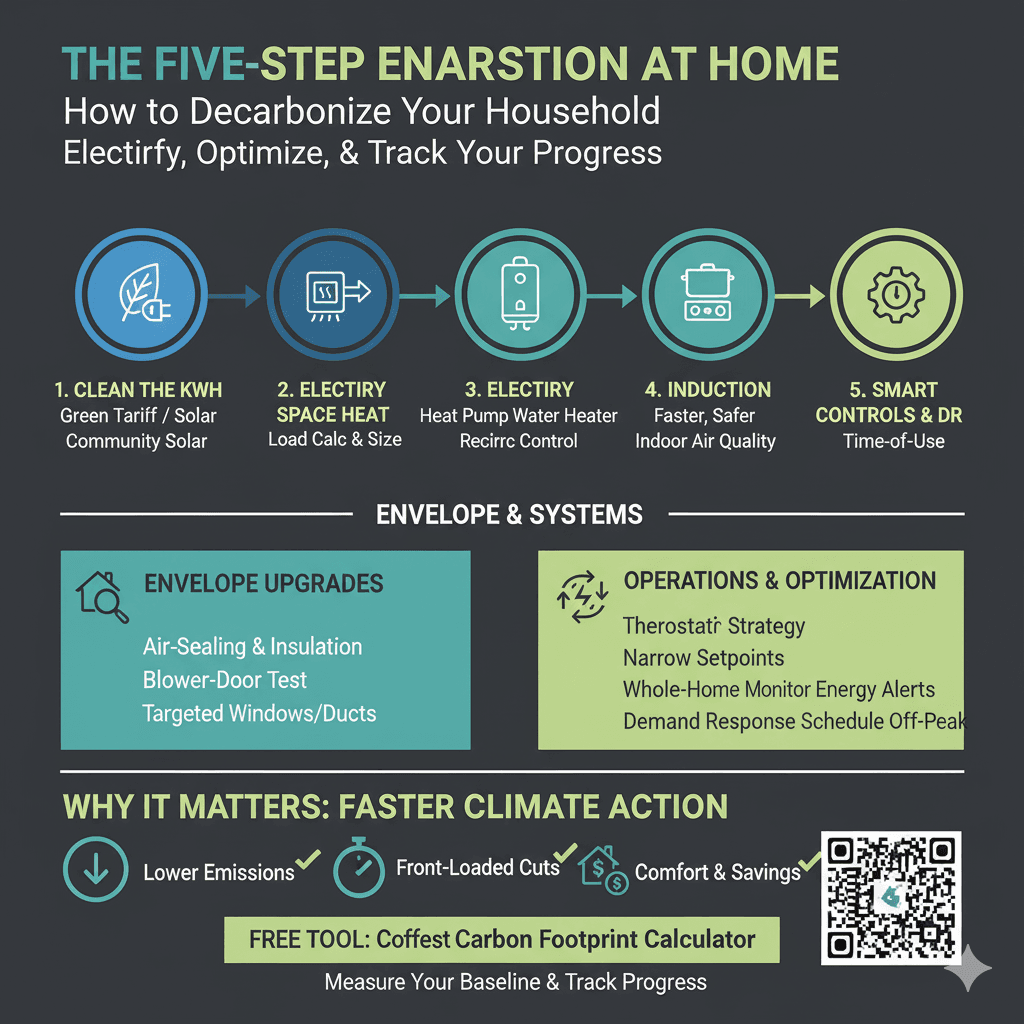
Table of Contents
Why electrify heat first
Space and water heating dominate household energy emissions in many regions. Modern heat pumps can deliver 2–4.5× the heating output per unit of electricity compared with resistance or gas furnaces, making them a central lever in building decarbonization pathways. Analyses highlight that widespread heat pump adoption could materially cut building‑sector CO₂ if paired with cleaner electricity and sound retrofit practice Building decarbonization with heat pumps and Heat pumps white paper.
The five‑step household energy transition
- Clean the kWh
Switch to a green electricity tariff or community solar; plan rooftop solar if feasible. Cleaner supply multiplies the benefits of electrification and efficiency Five steps to electrify your home. - Electrify space heating
At equipment turnover, install cold‑climate air‑source or ground‑source heat pumps sized with a proper load calc. Sequence with air‑sealing and insulation to reduce required capacity and improve comfort Building decarbonization with heat pumps and Air‑to‑water retrofit example. - Electrify water heating
Adopt heat pump water heaters (HPWH). Follow retrofit best practices on tank sizing, condensate handling, ventilation, and recirculation controls to preserve efficiency and comfort HPWH Retrofit Best Practices and HPWH job aids. - Induction and electric cooking
Switch from gas to induction for faster boil times, fine control, and better indoor air quality; pair with a vented hood and make‑up air where needed Five steps to electrify your home. - Smart controls and demand response
Use programmable/learning thermostats and utility time‑of‑use or demand‑response programs to pre‑heat/cool on greener hours. Research shows heat pumps can shift loads reliably with control strategies that protect comfort and lower peaks Demand response with heat pumps and Practical DR control options and NBER analysis on TOU heat pump tariffs.
Envelope first, then equipment
- Air‑sealing and insulation
Seal attic planes, rim joists, and penetrations before adding insulation; verify with a blower‑door test. A tighter envelope lowers the required heat pump size and improves steady‑state efficiency Five steps to electrify your home. - Windows and ducts (targeted)
Prioritize duct sealing and balancing if ducts run outside the conditioned space; consider interior storms or phased window upgrades only after sealing/insulating. - Ventilation and IAQ
Use HRV/ERV where appropriate to maintain indoor air quality with heat/moisture recovery during tighter operation Equitable home electrification toolkit.
Water heating: details that matter
- Sizing and location
Right‑size HPWH tanks for household patterns and consider semi‑conditioned spaces; mitigate noise and provide adequate airflow per manufacturer specs HPWH job aids. - Recirculation control
Replace uncontrolled recirc pumps with on‑demand or timer/learning controls to prevent standby losses that erode HPWH efficiency HPWH Retrofit Best Practices. - Load shifting
Heat water during off‑peak/greener windows using built‑in scheduling; coordinate with utility TOU and demand‑response programs to reduce cost and carbon NBER TOU heat pump study.
Controls and operations for everyday savings
- Thermostat strategy
Maintain narrower setpoint bands for heat pumps to avoid triggering inefficient backup; enable weather compensation where available. - Whole‑home monitoring
Use home energy monitors to find phantom loads; set alerts for prolonged auxiliary heat or unusual kWh spikes. - TOU and DR participation
Enroll in utility demand‑response programs; set scenes for pre‑conditioning and scheduled loads (laundry, dishwasher, EV charging) to run off‑peak while keeping comfort intact Demand response with heat pumps and Control options study.
Planning and financing your transition
- Roadmap and sequencing
Follow a staged plan: audit and sealing → HPWH → space heat pump → induction → rooftop solar/storage. Tools and checklists from electrification planners can streamline decisions Home electrification planner and Electrification roadmap examples. - Incentives and rates
Review local incentives, low‑interest financing, and TOU tariffs; align upgrades to capitalize on rebates and bill savings. - Equity and access
Seek programs that support low‑income households with weatherization and electrification packages designed for comfort, health, and bill stability Equitable home electrification toolkit.
Opinion: Structure beats effort
The fastest way to decarbonize a home is to make the efficient way the default. Three structures do most of the work: blower‑door‑verified sealing before insulation, heat pumps with smart scheduling, and a green tariff (or solar) to clean the kilowatt‑hour. Add an HPWH and induction when convenient, monitor for auxiliary heat, and let the house run itself on greener hours. Comfort rises, bills fall, and emissions drop—without chore‑like vigilance.
Learn More
To take the next step on your low‑carbon journey, try the free Coffset Carbon Footprint Calculator (https://coffset.org/carbon-footprint-calculator/) to establish a precise baseline and identify your top opportunities for impact. After reducing what you can, offset the rest with verified projects that accelerate climate solutions. Explore more of our resources to stay informed: What Is a Carbon Footprint? (https://coffset.org/what-is-a-carbon-footprint/), What Is Carbon Offsetting? (https://coffset.org/what-is-carbon-offsetting/), Reduce vs Offset: Why Both Matter (https://coffset.org/reduce-vs-offset-why-both-matter/). Each guide helps you cut emissions credibly while building lasting habits for a net‑zero future.
FAQs – Decarbonize Your Household
- What should be upgraded first to decarbonize a home affordably?
Air‑sealing and targeted insulation, followed by HPWH and space heat pumps at equipment turnover. Clean the kWh with a green tariff or community solar for immediate emissions benefits Five steps to electrify your home and Building decarbonization with heat pumps. - How do heat pumps perform with demand‑response and TOU rates?
Studies show heat pumps can shift loads to greener hours with proper controls while maintaining comfort, cutting peaks and costs Demand response with heat pumps and Control options study and NBER TOU analysis. - Are heat pump water heaters noisy or hard to fit?
HPWHs require airflow and condensate handling; job aids and best‑practice guides cover noise, ventilation, and compact installs. Recirculation should be controlled to avoid standby losses HPWH job aids and Retrofit best practices.
Sources
- McKinsey – Building decarbonization with heat pumps: https://www.mckinsey.com/industries/electric-power-and-natural-gas/our-insights/building-decarbonization-how-electric-heat-pumps-could-help-reduce-emissions-today-and-going-forward
- RMI – Five Steps to Electrify Your Home: https://rmi.org/5-steps-to-electrify-your-home/
- HPWH Retrofit Best Practices (RHA/TECH): https://bsesc.energy.gov/sites/default/files/2024-09/RHA%20Best%20Practices%20for%20the%20Retrofit%20Installation%20of%20Heat%20Pump%20Water%20Heaters%20US%20Final_0.pdf and Job Aids: https://bsesc.energy.gov/sites/default/files/2024-09/HPWH%20Job%20Aids%20General%20US%20Final%20Compressed_0.pdf
- Demand response with heat pumps (open‑access): https://pmc.ncbi.nlm.nih.gov/articles/PMC9976642/ and SAGE study: https://journals.sagepub.com/doi/full/10.1177/01436244221145871
- NBER Working Paper – Heat pumps and TOU tariffs: https://www.nber.org/system/files/working_papers/w33036/w33036.pdf
Put your knowledge into action
Calculate your footprint and offset instantly with verified credits.
Continue reading
10 Smart Moves: Energy Storage and Home Carbon Reduction
Learn how to cut your home's carbon emissions with smart energy storage solutions like batteries and heat pump water heaters. Discover practical strategies to shift energy use to cleaner hours while earning VPP payments.
9 Proven Steps: Guide to Renewable Energy Adoption at Home
Learn 9 proven steps to successfully adopt renewable energy at home, including solar power installation, energy storage solutions, and effective strategies to reduce your carbon footprint while saving money.
11 Myths, Traps, and Wins: Low‑Carbon Home Renovations — Techniques and Savings
Cut energy bills and reduce your carbon footprint with proven low-carbon home renovation strategies that avoid common myths and maximize both savings and sustainability.