Greenwashing Explained: How to Spot It and What To Do Instead

Greenwashing is the use of misleading environmental claims to make products, services, or organizations appear greener than they are. It can be subtle—vague buzzwords, nature‑themed packaging, selective data—or brazen, like unverifiable “carbon neutral” labels without evidence. This guide explains what greenwashing is, common tactics, how to verify real impact, and what to do instead—so climate‑conscious consumers and teams can make decisions they can stand behind.
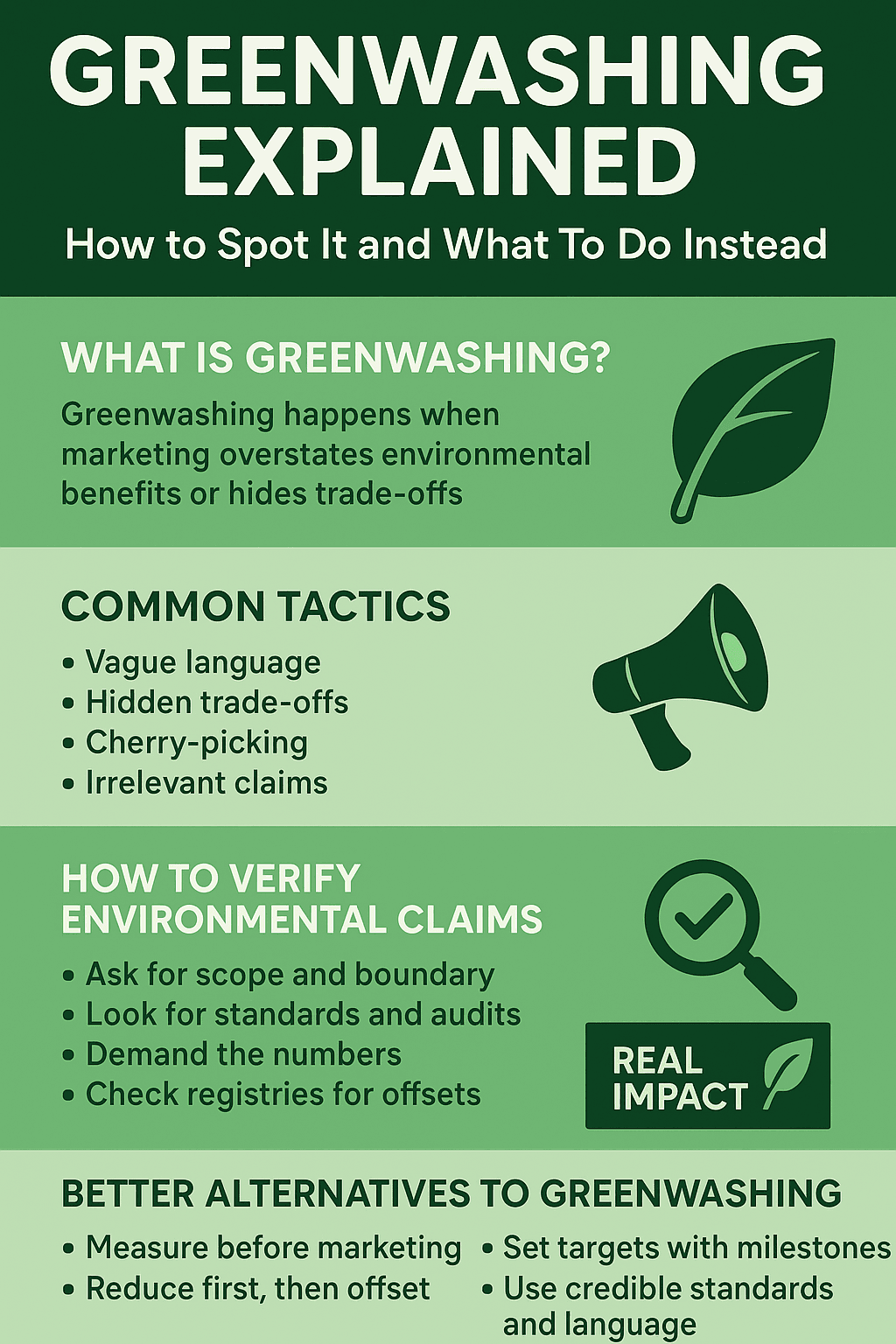
Table of Contents
What Is Greenwashing?
Greenwashing happens when marketing overstates environmental benefits or hides trade‑offs. It often relies on terms like “eco‑friendly,” “natural,” or “sustainable” without clear definitions, or uses selective statistics and imagery to imply a smaller footprint. Regulators and NGOs increasingly warn against these practices and encourage evidence‑backed claims, transparent data, and independent verification.
Why Greenwashing Persuades
- Familiar buzzwords and symbols: Leaves, earth tones, and “green” logos create instant impressions of responsibility.
- Information overload: Long claims with selective metrics or narrow baselines make scrutiny harder.
- The halo effect: Highlighting one green attribute distracts from more material impacts elsewhere in the business.
The Most Common Greenwashing Tactics
- Vague language: Words like “planet‑friendly,” “clean,” “non‑toxic,” or “green” without scope, metrics, or timeframes.
- Hidden trade‑offs: Promoting recyclable packaging while the product or supply chain drives the majority of emissions.
- Cherry‑picking: Advertising a small percentage improvement (e.g., “50% more recycled content”) off a tiny baseline.
- Irrelevant claims: Labeling items “CFC‑free” when CFCs are already banned; claiming “biodegradable” without conditions.
- Unverified “carbon neutral” badges: No methodology, inventory boundary, or credit retirement details.
- Nature‑washing: Earthy packaging and imagery without substantive operational changes.
How to Verify Environmental Claims
- Ask for scope and boundary: What part of the product or company is covered? Whole lifecycle or just packaging?
- Look for standards and audits: Are claims verified against recognized frameworks and checked by independent third parties?
- Demand the numbers: Emission baselines, percent reductions, timelines, and methodologies should be published.
- Check registries for offsets: If claims involve carbon credits, look up the serials and retirement in public registries.
- Compare the whole picture: Do major impacts (materials, energy, transport, end‑of‑life) align with the claim?
Better Alternatives to Greenwashing
- Measure before marketing: Calculate emissions with a transparent method, disclose scopes, and explain assumptions.
- Set targets with milestones: Time‑bound, science‑aligned goals with interim checkpoints and annual progress updates.
- Reduce first, then offset: Prioritize internal reductions; offset only residual emissions with verified, retired credits.
- Use credible standards and language: Avoid buzzwords; specify boundaries, magnitudes, and timeframes.
What Responsible Claims Look Like
- “We reduced Scope 2 emissions 42% from a 2019 baseline by switching to renewable electricity and efficiency upgrades.”
- “This product’s cradle‑to‑grave footprint is 7.8 kg CO₂e based on a third‑party reviewed lifecycle assessment; methods and factors are published.”
- “We retired 10,000 tCO₂e of Verified Carbon Standard credits from a methane capture project; serials and retirement records are linked.”
Opinion: The One Rule That Stops Greenwashing Early
The simplest habit to prevent greenwashing is to refuse any claim that can’t fit a three‑part test on one line: boundary + number + timeframe. If a claim cannot state exactly what part of the business it covers, by how much it changed, and over what period, it’s marketing, not measurement. Teams that adopt this rule rarely publish vague copy—and quickly discover where they need better data instead of better adjectives.
What Coffset Recommends
- Get the numbers first using the Coffset Carbon Footprint Calculator, then plan reductions across home energy, travel, and lifestyle.
- When offsets make sense, choose verified credits with transparent documentation and public retirement.
- Communicate with specificity: define scopes, share baselines, and report progress annually.
FAQs – Greenwashing Explained
What is greenwashing?
Greenwashing is making misleading environmental claims—through language, imagery, or selective data—to appear greener than reality.
How can I spot greenwashing quickly?
Look for vague buzzwords, missing numbers, lack of boundaries, absence of third‑party verification, and no links to methods or registries.
Are “carbon neutral” labels legitimate?
They can be—but only when they disclose inventory boundaries, reduction steps, credit standards, serial numbers, and retirement records. Without this, be cautious.
What’s a credible alternative to greenwashing?
Measure transparently, reduce first, and communicate with boundary, number, and timeframe. If offsets are used, document credit quality and retirement.
Call to Action
Want to communicate impact with confidence? Start by measuring real numbers. Use the Coffset Carbon Footprint Calculator to quantify household, travel, and lifestyle emissions, plan reductions, and offset only what remains—with documentation to back up claims.
Keep Learning: Related Reads from Coffset
- What Is a Carbon Footprint? Understand CO₂e, scopes, and high‑impact actions to prioritize reductions first.
- What Is Carbon Offsetting? Learn standards, project types, and how to choose high‑quality credits.
- Reduce vs Offset: Why Both Matter See how “reduce first, then offset” forms a credible, science‑aligned strategy for individuals and organizations.
Sources
- Investopedia overview of greenwashing: https://www.investopedia.com/terms/g/greenwashing.asp
- WWF guide to spotting greenwashing: https://www.wwf.org.uk/learn/guide-to-greenwashing
- EU guidance and actions on green claims: https://environment.ec.europa.eu/topics/circular-economy/green-claims_en
- European Parliament explainer on regulating green claims: https://www.europarl.europa.eu/topics/en/article/20240111STO16722/stopping-greenwashing-how-the-eu-regulates-green-claims
- Zero Carbon Analytics guide to spotting greenwashing in sustainability reports: https://zerocarbon-analytics.org/wp-content/uploads/2024/02/How-to-spot-greenwashing-in-a-sustainability-report_1.pdf
UN page on greenwashing tactics and risks: https://www.un.org/en/climatechange/science/climate-issues/greenwashing
Put your knowledge into action
Calculate your footprint and offset instantly with verified credits.
Continue reading
Leadership in Sustainability: Driving Change in Organizations
Transform your organization through sustainability leadership by aligning governance, strategy, and targets. Deliver measurable carbon offsetting outcomes across your entire value chain.
Green Finance Deep Dive: Bonds, ETFs, and Beyond
Explore comprehensive carbon offsetting strategies through green finance instruments including labeled bonds, sustainability-linked bonds, and climate-benchmarked ETFs. Learn how to build credible green investment allocations with proven KPIs and stewardship practices.
8 Proven Modules: Carbon Literacy for Educators — Teaching Climate Solutions
A comprehensive blueprint for schools and universities featuring 8 accredited Carbon Literacy modules designed specifically for educators. Includes ready-to-teach toolkits, action-based assessments, and current climate indicators.