8 Key Milestones: Global Climate Targets — From Paris Agreement to National Plans

Global Climate Targets: From Paris Agreement to National Plans traces how the Paris framework’s temperature goals translate into national pledges, five‑year reviews, and near‑term actions after the first Global Stocktake at COP28. The Paris Agreement established the long‑term goal to hold warming well below 2°C and pursue efforts to limit it to 1.5°C, with countries submitting and strengthening Nationally Determined Contributions (NDCs) every five years in a public registry, guided by periodic stocktakes to close ambition and implementation gaps. See the UNFCCC’s overview of the Paris Agreement, the legal text of the Agreement, and the UN explainer on its goals.
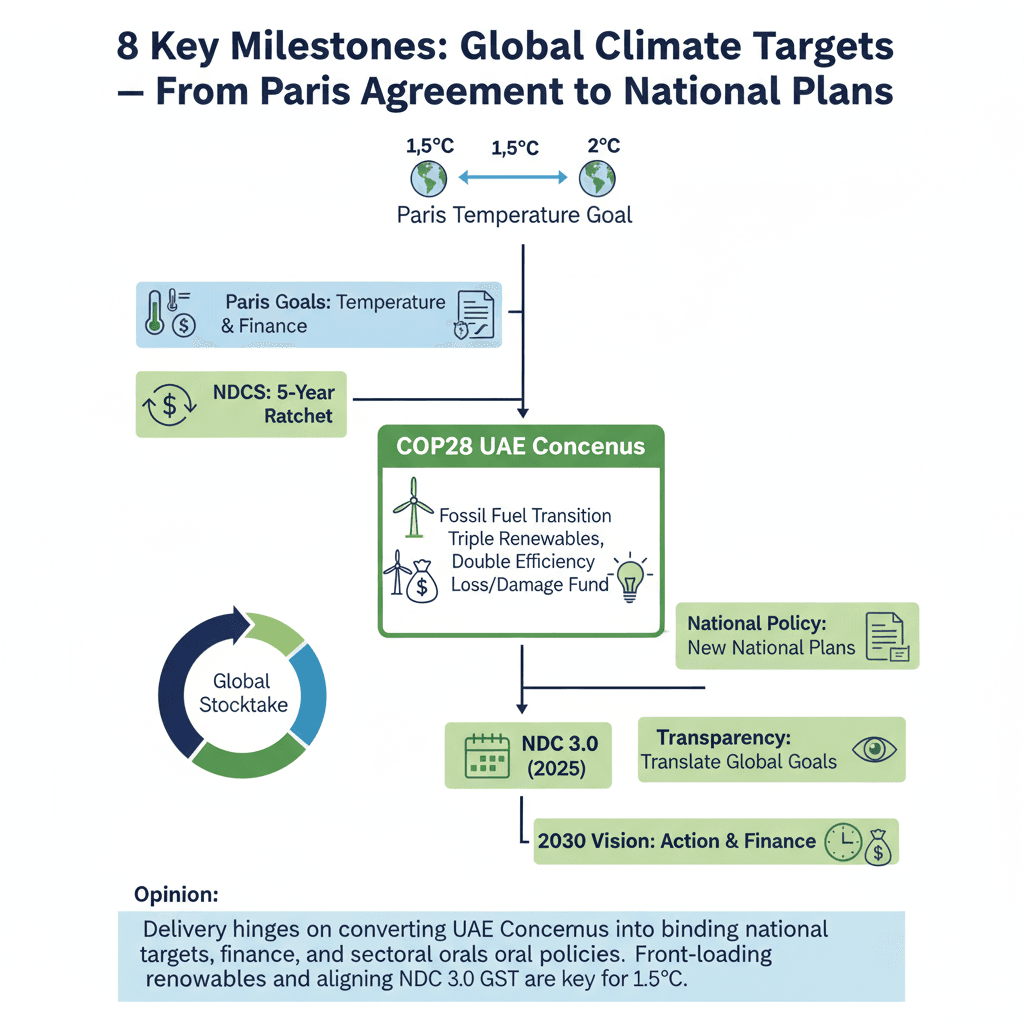
Table of Contents
Introduction
The first Global Stocktake concluded at COP28 (the UAE Consensus) and called for transitioning away from fossil fuels in energy systems, tripling renewables, and doubling energy efficiency by 2030, while operationalizing the Loss and Damage Fund—outcomes now informing NDCs due in 2025 (NDC 3.0). Read the UNFCCC pages on the Global Stocktake, the UNFCCC’s COP28 summary, and the EU’s digest of the UAE Consensus outcomes.
Milestone 1 — Paris temperature and finance goals
Article 2 sets the temperature goals and a finance aim to align flows with low‑emission, climate‑resilient development, forming the anchor for mitigation, adaptation, and support. These objectives and the peaking/neutrality pathway appear in the official Paris text and are summarized in the UNFCCC Agreement overview and UN’s public explainer on the Paris Agreement.
Article 4 establishes successive NDCs that each Party shall prepare, communicate, and maintain, reflecting progression and the highest possible ambition, again detailed in the Agreement text and the UNFCCC overview page on the Paris Agreement.
Milestone 2 — NDCs and the five‑year ratchet
Countries submit NDCs, update them every five years, and record them publicly, with guidance to provide clarity, transparency, and understanding (ICTU) and to account for emissions and removals consistently. See the UNFCCC overview of NDCs and the public NDC Registry, as well as the UNFCCC’s NDC 3.0 page on the 2025 submissions informed by the stocktake in NDC 3.0.
Technical guides reinforce ICTU and accounting expectations for national teams preparing 2025 submissions, including regional guidance on reporting elements and timelines in a 2024 NDC reporting guidance note.
Milestone 3 — The Global Stocktake (GST)
Article 14 creates the GST to assess collective progress toward Paris goals across mitigation, adaptation, and finance, informing the next round of NDCs and cooperation. See the UNFCCC’s hub for the Global Stocktake, and accessible explainers from WRI on why the GST matters and what it measures in this overview.
Academic and policy explainers clarify governance, scope, and the role of UNFCCC subsidiary bodies SBSTA and SBI in conducting the GST and synthesizing inputs, as summarized by the LSE Grantham explainer on what the GST is.
Milestone 4 — COP28 UAE Consensus outcomes
The COP28 outcome invites Parties to transition away from fossil fuels in energy systems in a just, orderly, and equitable manner, accelerate renewables (tripling by 2030) and efficiency (doubling by 2030), and advance coal phase‑down and subsidy reforms, alongside operationalizing the Loss and Damage Fund. See the UNFCCC’s COP28 key takeaways and the EU’s summary of the overall outcome.
Commentaries note the need for clearer interim timelines and finance to translate goals into delivery, highlighting finance as the next battleground—points echoed in analyses of the stocktake’s implications for stakeholders in a 2024 business summary.
Milestone 5 — NDC 3.0 deadline and scope (2025)
The next full round of NDCs is due in 2025, informed by the GST and expected to be progressive, with Parties encouraged to enhance mitigation, adaptation, and means of implementation; the UNFCCC’s page details expectations for NDC 3.0. Public registries and deadlines, including the February 2025 submission window flagged by civil society briefings, drive national planning cycles, as noted in a 2025 reminder on the NDC deadline context.
Sectoral integration and social priorities (e.g., food security and poverty reduction) are being woven into NDCs as countries prepare 2025 updates, per a 2025 guidance note on NDC opportunities in the Global Alliance document.
Milestone 6 — From global goals to national policy
NDCs outline country‑specific targets, policies, and instruments such as carbon pricing, renewable standards, efficiency goals, and land‑use measures; the UN overview explains how NDCs embody national efforts in this NDC explainer. Guidance on ICTU, accounting, and sectoral detail supports comparability and credibility, as described in the 2024 NDC reporting guidance.
Robust national tracking helps align budgets and investments with Paris‑consistent pathways, consistent with the role of the GST in informing updates and cooperation in WRI’s GST overview.
Milestone 7 — Accountability and transparency systems
The Enhanced Transparency Framework requires regular reporting and technical expert reviews to build trust and credibility; aggregated insights feed into the GST cycle, as laid out in Paris Articles and summarized in the UNFCCC Paris Agreement overview and legal text. Public registries like the NDC Registry operationalize transparency on pledges and updates.
Stocktake explainers stress that successful GSTs go beyond assessment to guide stronger national plans and cooperation, a purpose central to WRI’s GST explainer and LSE Grantham’s institutional summary on GST governance.
Milestone 8 — What success looks like by 2030
Translating the UAE Consensus into national action implies national targets that collectively triple renewables and double efficiency by 2030, coupled with concrete measures to transition away from fossil fuels this decade and finance to deliver. UNFCCC summaries of COP28 highlight these benchmarks in the key takeaways, while the EU’s account traces operationalization of loss and damage finance and the mitigation signal in the overall outcome.
NDC 3.0 is the venue to encode these shifts in national policy architectures, followed by transparency reports and the next GST to assess collective progress, per the UNFCCC pages on NDC 3.0 and the Global Stocktake hub.
Opinion
The Paris engine is working as designed—set goals, measure progress, and ratchet up ambition—but delivery now hinges on converting the UAE Consensus into binding national targets, finance packages, and sectoral policies ahead of 2030. Countries that front‑load renewables and efficiency, align NDC 3.0 to GST findings, and strengthen transparency will shape a credible path to 1.5°C, consistent with the Paris framework, the GST’s role, and the COP28 outcomes.
FAQs — Global Climate Targets: From Paris Agreement to National Plans
What are the Paris Agreement’s core goals?
Hold warming well below 2°C and pursue 1.5°C, strengthen adaptation, and align finance with low‑emission, climate‑resilient development, per the Paris text and the UNFCCC overview.
How do NDCs work?
Countries submit and update national plans every five years with growing ambition; pledges are recorded in a public NDC Registry and guided by ICTU/accounting expectations, summarized in UNFCCC pages on NDCs.
What did the first Global Stocktake change?
COP28’s UAE Consensus called for transitioning away from fossil fuels, tripling renewables, and doubling efficiency by 2030 while operationalizing loss and damage finance—signals now informing NDC 3.0, per the UNFCCC COP28 summary and the EU’s outcome note.
Where can the latest NDCs be found?
On the UNFCCC’s public NDC Registry with additional guidance and updates on NDC 3.0 and the Global Stocktake hub.
Learn More
Explore practical next steps and foundational concepts in one place: start by testing scenarios with the free Coffset Carbon Footprint Calculator, then build fluency with our explainers What Is a Carbon Footprint?, What Is Carbon Offsetting?, and Reduce vs Offset: Why Both Matter. For more resources, visit the Coffset homepage, explore the Carbon Learning Center, or take action via Buy Carbon Credits.
Sources
- UNFCCC — Paris Agreement overview: https://unfccc.int/process-and-meetings/the-paris-agreement
- UNFCCC — Paris Agreement (official text): https://unfccc.int/sites/default/files/english_paris_agreement.pdf
- UN — The Paris Agreement (public explainer): https://www.un.org/en/climatechange/paris-agreement
- UNFCCC — Global Stocktake hub: https://unfccc.int/topics/global-stocktake
- WRI — Explaining the Global Stocktake: https://www.wri.org/insights/explaining-global-stocktake-paris-agreement
- LSE Grantham — What is the Global Stocktake?: https://www.lse.ac.uk/granthaminstitute/explainers/what-is-the-global-stocktake/
- UNFCCC — COP28 key takeaways: https://unfccc.int/cop28/5-key-takeaways
- European Commission — COP28 overall outcome and EU reactions: https://employment-social-affairs.ec.europa.eu/news/cop28-overall-outcome-eu-reactions-2024-01-24_en
- UNFCCC — NDCs explainer: https://unfccc.int/process-and-meetings/the-paris-agreement/nationally-determined-contributions-ndcs
- UNFCCC — NDC Registry: https://unfccc.int/NDCREG
- UNFCCC — NDC 3.0 (2025 updates): https://unfccc.int/ndc-3.0
Put your knowledge into action
Calculate your footprint and offset instantly with verified credits.
Continue reading
9 Proven Steps: Climate Change Economics — Carbon Pricing & Market Mechanisms
Learn the fundamentals of carbon pricing through 9 proven steps covering carbon tax vs cap-and-trade systems, EU ETS, CBAM, and high-integrity credits. Essential guidance for businesses and policymakers navigating climate economics.
Climate Policy Basics for Individuals
Climate policy basics for individuals: carbon pricing, standards, and incentives explained—learn how policy makes low‑carbon living easier.
8 Proven Modules: Carbon Literacy for Educators — Teaching Climate Solutions
A comprehensive blueprint for schools and universities featuring 8 accredited Carbon Literacy modules designed specifically for educators. Includes ready-to-teach toolkits, action-based assessments, and current climate indicators.