Leadership in Sustainability: Driving Change in Organizations

Leadership in Sustainability succeeds when it treats climate and social impact as a business model transformation, not a reporting exercise—anchoring board oversight, strategy, incentives, and learning to measurable outcomes that evolve with shifting policy and stakeholder expectations, as recent leadership reviews and executive surveys emphasize. Recent integrative reviews and conference board priorities highlight governance clarity, business integration, nature and water risk, supply chain transparency, ROI discipline, and regulatory readiness as the center of gravity for 2025 leadership agendas. See an integrative review of sustainability leadership goals in Sustainability leadership: An integrative review and 2025 executive priorities captured in Top 10 Corporate Sustainability Priorities for 2025.
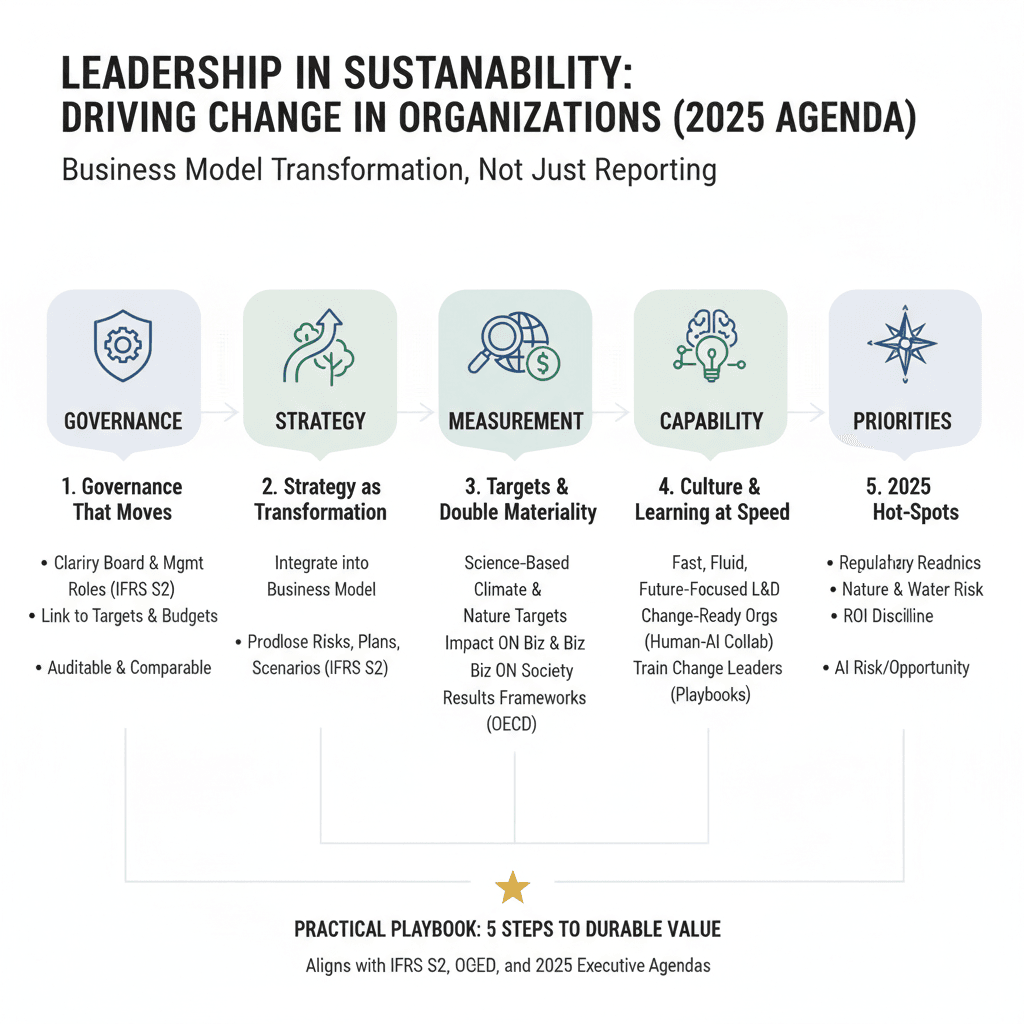
Table of Contents
Governance that moves outcomes
- Clarify board and management roles for climate oversight in line with IFRS S2, naming responsible bodies, cadence, and committee mandates so governance becomes auditable and comparable across peers. IFRS S2 requires explicit disclosure of the governance body, terms of reference, and management’s role in integrating climate into decisions, as summarized by the IFRS navigator and practical issuer examples. See the standard overview at IFRS S2 Climate‑related Disclosures and a sample governance mapping in IFRS S2 Climate‑Related Disclosure (issuer example).
- Build a climate governance structure that ties board and management committees to targets and budgets; issuers illustrate cascaded structures with board committees and management‑level climate committees formalized in public reports. See a published governance chart in GPSC IFRS S2 Sustainability Disclosure Standard 2024.
Strategy as transformation
- Treat sustainability as a transformation of the business model—products, operations, supply chains, and revenue mix—rather than a side program; research emphasizes experimentation, capital reallocation, and cross‑functional integration to deliver durable value. See perspective on business‑model change in Sustainability as a Business‑Model Transformation and practical strategy alignment in Getting Strategic About Sustainability.
- Align with IFRS S2 strategy requirements: disclose risks/opportunities, effects on the model and value chain, transition plans, financial impacts, and resilience under scenarios; this links strategy to capital planning and accountability. See the IFRS navigator and practitioner explainer in IFRS S2 Climate‑related Disclosures and a practitioner guide in What is IFRS S2?.
Targets, metrics, and double materiality
- Set science‑based climate and nature targets with near‑term and long‑term milestones, and measure both impact on the business and the business’s impacts on society and nature—double materiality—so strategy decisions remain robust as regulations expand. Reviews and policy trackers show double materiality and nature‑positive agendas rising for 2025. See leadership priorities including biodiversity and water stewardship in Top 10 Corporate Sustainability Priorities for 2025.
- Build results frameworks that connect finance to outcomes with clear indicators, baselines, and learning cycles; recent OECD guidance offers practical checklists to improve results frameworks across programs. See toolkit guidance in Effective Results Frameworks for Sustainable Development.
Culture, capability, and learning at speed
- Make leadership development “fast, fluid, and future‑focused,” scaling learning in context and building change‑ready organizations with reciprocal human‑AI collaboration to accelerate problem‑solving and decision‑making. A 2025 study of 1,100+ L&D leaders highlights upskilling, change‑readiness, and scalable learning as core to modern leadership. See the summary in 2025 Global Leadership Development Study.
- Train sustainability change leaders in frameworks and tools that translate ambition into delivery; cohort‑based programs and playbooks help spread change methods across functions. See a cohort‑based program outline in Sustainability Change Leadership Program.
Supply chain and policy navigation
- Deepen supplier transparency and due diligence as regulations evolve; 2025 priorities put supply‑chain scrutiny and policy shifts at the top of executive agendas, requiring cross‑border coordination and narrative discipline. See the executive memo in Top 10 Corporate Sustainability Priorities for 2025.
- Track macro shifts in sustainability language and stakeholder dynamics; mixed‑methods research suggests companies are adapting rather than abandoning climate goals under political pressure, requiring resilient governance and communications. See analysis in Are Companies Actually Scaling Back Their Climate Commitments?.
Practical leadership playbook
- Define board and committee mandates per IFRS S2 and publish a governance map similar to public issuer examples like this IFRS S2 disclosure.
- Publish a strategy aligned to IFRS S2 with a credible transition plan and scenario analysis; align disclosures with practical guidance like What is IFRS S2?.
- Set science‑based climate and nature targets; use an outcome‑based results framework from OECD results guidance.
- Invest in leadership and change capabilities at scale per the 2025 Global Leadership Development Study and deploy cohort programs like Sustainability Change Leadership.
- Prioritize 2025 hot‑spots: supply chain transparency, water, biodiversity, AI risk/opportunity, and ROI proof points from Top 10 Corporate Sustainability Priorities for 2025.
Opinion
Sustainability leadership in 2025 is less about adding an ESG section and more about rewiring how boards govern risk, how strategies allocate capital, and how teams learn and execute across functions and suppliers. Organizations that pair IFRS‑grade governance and strategy with results frameworks and rapid capability building will weather policy volatility and deliver durable value, a throughline across IFRS S2, leadership reviews, and executive priority memos. See the formal disclosure requirements in IFRS S2 Climate‑related Disclosures, integrative leadership research in Sustainability leadership: An integrative review, and the 2025 priority map in Top 10 Corporate Sustainability Priorities for 2025.
FAQs
How should boards document climate oversight?
Disclose responsible bodies, mandates, and cadence per IFRS S2 Climate‑related Disclosures, and publish committee structures similar to issuer examples such as this IFRS S2 governance mapping.
What turns “ESG strategy” into real transformation?
Tie climate and nature to product roadmaps, capex, supply chains, and scenarios—moving beyond reporting into experimentation and capital allocation per Sustainability as a Business‑Model Transformation and Getting Strategic About Sustainability.
What capabilities matter most for leaders in 2025?
Change‑readiness, rapid upskilling, and scalable, in‑context learning—prioritized by L&D leaders globally in the 2025 Global Leadership Development Study.
How do we show ROI and resilience amid policy shifts?
Adopt results frameworks linking finance to outcomes from OECD results guidance and address 2025 hot‑spots (supply chain, water, biodiversity, AI) from Top 10 Corporate Sustainability Priorities for 2025.
Learn More
Explore practical next steps and foundational concepts in one place: start by testing scenarios with the free Coffset Carbon Footprint Calculator, then build fluency with our explainers What Is a Carbon Footprint?, What Is Carbon Offsetting?, and Reduce vs Offset: Why Both Matter. For more resources, visit the Coffset homepage, explore the Carbon Learning Center, or take action via Buy Carbon Credits.
Sources
- IFRS Foundation — IFRS S2 Climate‑related Disclosures: https://www.ifrs.org/issued-standards/ifrs-sustainability-standards-navigator/ifrs-s2-climate-related-disclosures/
- Amphenol — IFRS S2 governance disclosure example: https://amphenol.com/docs/ifrs-disclosure
- GPSC — IFRS S2 governance structure example (2024): https://www.gpscgroup.com/storage/download/sustainability/environmental/climate-change-management/20240628-gpsc-ifrs-s2-sustainability-disclosure-standard-2024-en.pdf
- OECD — Effective Results Frameworks for Sustainable Development (2024): https://www.oecd.org/content/dam/oecd/en/publications/reports/2024/11/effective-results-frameworks-for-sustainable-development_4fc13688/aaa4bb52-en.pdf
- Harvard Business Review — Sustainability as a Business‑Model Transformation (2025): https://hbr.org/2025/05/sustainability-as-a-business-model-transformation
- Harvard Business Review — Getting Strategic About Sustainability (2025): https://hbr.org/2025/01/getting-strategic-about-sustainability
- Harvard Business — 2025 Global Leadership Development Study: https://www.harvardbusiness.org/insight/2025-global-leadership-development-study/
- The Conference Board (posted on Harvard Law) — Top 10 Corporate Sustainability Priorities for 2025: https://corpgov.law.harvard.edu/2025/06/24/top-10-corporate-sustainability-priorities-for-2025/
Put your knowledge into action
Calculate your footprint and offset instantly with verified credits.
Continue reading
Green Finance Deep Dive: Bonds, ETFs, and Beyond
Explore comprehensive carbon offsetting strategies through green finance instruments including labeled bonds, sustainability-linked bonds, and climate-benchmarked ETFs. Learn how to build credible green investment allocations with proven KPIs and stewardship practices.
8 Proven Modules: Carbon Literacy for Educators — Teaching Climate Solutions
A comprehensive blueprint for schools and universities featuring 8 accredited Carbon Literacy modules designed specifically for educators. Includes ready-to-teach toolkits, action-based assessments, and current climate indicators.
9 Proven Steps: Community-Led Carbon Reduction — Local Projects That Work
Learn 9 evidence-based community carbon reduction strategies that deliver real results. From community solar to heat pump bulk purchases, discover local projects that make a measurable climate impact.