Carbon Footprint Assessment Tools: What Professionals Use

Professionals use a mix of recognized standards, mature software, and curated datasets to deliver credible, audit‑ready carbon footprint assessments. This guide explains which carbon footprint assessment tools align with the GHG Protocol and ISO 14064, where product life cycle assessment fits, and how to choose a stack that scales from baselining to assurance.
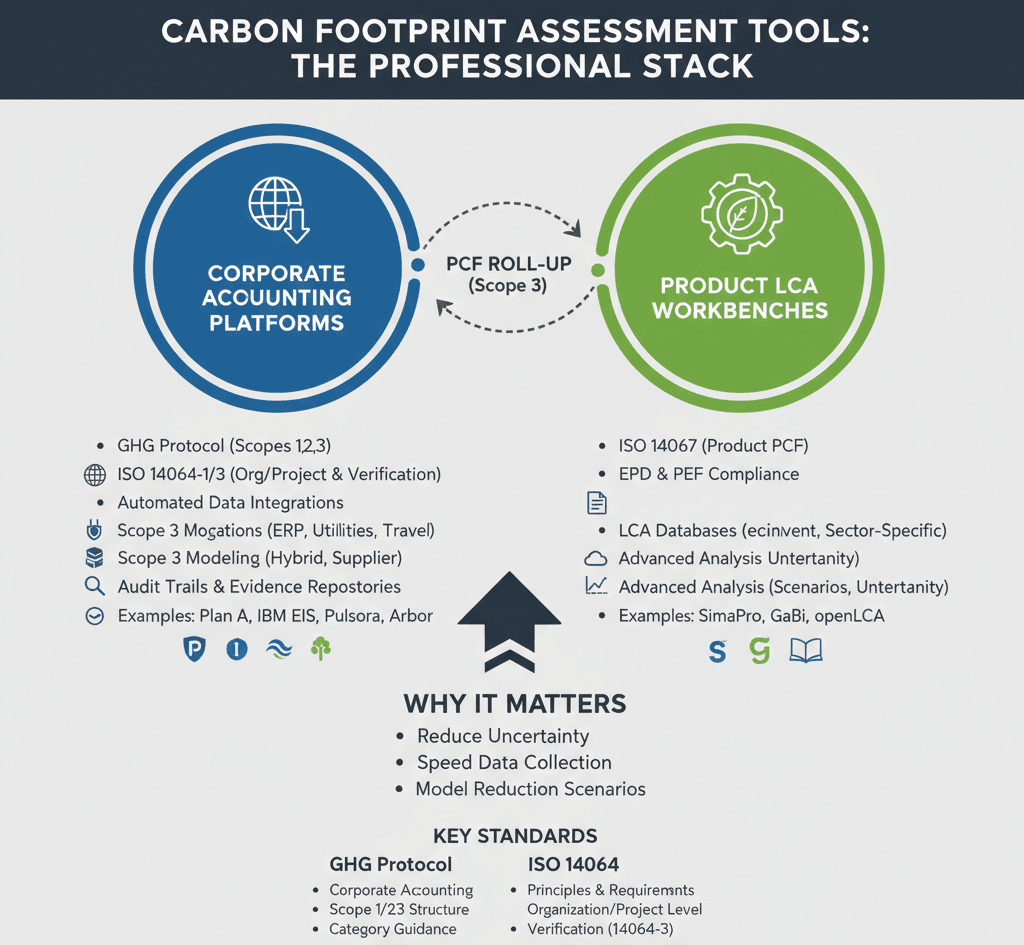
Table of Contents
Why professional tooling matters
Robust carbon footprint assessment tools reduce uncertainty, speed up data collection, and align outputs with verification requirements. A well‑chosen toolchain also helps teams navigate Scope 3, model reduction scenarios, and prepare disclosures that withstand third‑party review.
Core standards professionals follow
- GHG Protocol for corporate accounting and Scope 1–2–3 structure; see calculation tools and guidance for category‑specific methods GHG Protocol calculation tools and guidance.
- ISO 14064 for principles, requirements, and verification at organization and project levels; commonly paired with GHG Protocol for audit‑ready reporting ISO 14064-1 and overview pages from certification bodies.
- Product footprinting uses ISO 14067 and LCA methods; outputs often roll into corporate Scope 3 purchased goods and services, capital goods, and use‑phase modeling Plan A overview of ISO 14064/14067.
The pro tool stack at a glance
- Corporate carbon accounting platforms: automate data collection, emission factor mapping, Scope 3 category models, and reporting aligned to GHG Protocol/ISO 14064. Market reviews highlight options like Plan A, IBM EIS, and others with verification‑ready outputs and integrations Plan A roundup and independent lists Pulsora review, Arbor comparison.
- LCA software for product footprints: SimaPro, GaBi, and openLCA are the mainstays for ISO 14067 studies, EPDs, and PEF compliance, with access to ecoinvent and sector databases SimaPro Craft, LCA software overviews, and comparative deep dives GaBi vs SimaPro vs openLCA.
- Methods and guidance libraries: category‑specific Scope 3 calculation tools, spend‑to‑activity hybrid methods, and verification protocols from GHG Protocol and ISO committees GHG Protocol and explainers on GHG vs ISO alignment msg global.
How to choose a corporate carbon accounting platform
1) Framework alignment (non‑negotiable)
- GHG Protocol category coverage with transparent mapping to emission factors.
- ISO 14064‑1 compatible exports and audit trails; support for ISO 14064‑3 verification workflows GHG vs ISO guidance, ISO references.
2) Data model and integrations
- Connectors for ERP, utility, travel, procurement, and logistics data; automated meter and invoice parsing.
- Factor libraries with version control; region‑specific electricity factors and supplier‑specific data ingestion data challenges overview.
3) Scope 3 modeling depth
- Hybrid (spend + activity) approaches, supplier engagement modules, and scenario tools for abatement planning.
- Category templates for purchased goods/services, capital goods, use‑phase, and end‑of‑life Plan A roundup.
4) Assurance readiness
- Complete audit trails, change logs, sampling, and verification packs aligned to ISO 14064‑3.
- Evidence repositories and role‑based access for third‑party validators ISO 14064 verification context.
What professionals use for product carbon footprints (PCF)
- SimaPro (and GaBi/openLCA) with ecoinvent and sector data for ISO 14067 studies, EPDs, and PEF; advanced features include scenario modeling, sensitivity analysis, and Monte Carlo uncertainty to document robustness SimaPro Craft.
Tool selection depends on database access, bill‑of‑materials granularity, allocation methods, and compatibility with corporate Scope 3 roll‑ups LCA software overview.
Reference kits and calculation aids
- GHG Protocol’s calculation tools and scope/category guidance shorten setup time and improve consistency across inventories GHG calculation tools.
ISO 14064 companion explainers from national standards bodies and training providers help teams prepare for verification NSAI overview.
Opinion: Build a two‑tier stack, not a monolith
Teams get farther by pairing one corporate platform with one LCA workbench than by forcing everything into a single tool. The platform handles activity data, Scope 3 categories, dashboards, and audits; the LCA workbench handles design‑grade product models and uncertainty. Connect them with a simple interface for PCF roll‑ups into Scope 3. This two‑tier approach is cheaper to verify, easier to swap parts in, and future‑proofs the stack as standards evolve.
FAQs – Carbon Footprint Assessment Tools
What’s the difference between the GHG Protocol and ISO 14064?
GHG Protocol structures corporate accounting (Scopes 1–2–3) and provides category‑level guidance, while ISO 14064 defines principles, requirements, and verification at organization and project levels. Most professional inventories use GHG Protocol for methods and pair outputs with ISO 14064‑compatible documentation for assurance.
Which carbon footprint assessment tools are best for product footprints?
Specialist LCA software such as SimaPro, GaBi, and openLCA are preferred for ISO 14067 product carbon footprints because they support high‑quality databases (e.g., ecoinvent) and advanced analyses like scenario modeling and uncertainty assessment.
How do I prepare for ISO 14064‑3 verification?
Ensure clear boundaries, factors with versions, reproducible calculations, change logs, and evidence (invoices, meters, supplier data). Export verification packs from the accounting platform, and align terminology and categories with both GHG Protocol and ISO documentation.
What features matter most in a corporate carbon accounting platform?
Look for GHG Protocol coverage, ISO‑ready exports, deep Scope 3 modeling (hybrid methods), strong integrations, factor governance, and verifiable audit trails. These determine accuracy, speed, and verification success more than UI polish.
Learn More
To take the next step on your low-carbon journey, try the free Coffset Carbon Footprint Calculator to establish a precise baseline and identify your top opportunities for impact. After reducing what you can, offset the rest with verified projects that accelerate climate solutions. Explore more of our resources to stay informed: What Is a Carbon Footprint?, What Is Carbon Offsetting?, Reduce vs Offset: Why Both Matter. Each guide helps you cut emissions credibly while building lasting habits for a net-zero future.
Sources
- GHG Protocol calculation tools and guidance: https://ghgprotocol.org/calculation-tools-and-guidance
- GHG Protocol overview: https://ghgprotocol.org
- ISO 14064‑1 information: https://www.iso.org/standard/66453.html
- ISO 14064 context via NSAI: https://www.nsai.ie/certification/management-systems/carbon-accounting/
- ISO & LCA overview for PCF/14067: https://plana.earth/academy/iso-14064
- Life cycle assessment with SimaPro: https://simapro.com/life-cycle-assessment/
- LCA software overview: https://lca-software.org
- LCA tools comparison (GaBi, SimaPro, openLCA): https://dei.so/lca-software-showdown-a-deep-dive-into-lca-for-experts-gabi-simapro-and-openlca/
- Carbon accounting software roundups: https://www.pulsora.com/blog/best-carbon-accounting-software-tools, https://www.arbor.eco/blog/top-11-carbon-accounting-software-for-2024-arbor, https://plana.earth/academy/best-carbon-accounting-software-2023
- Data collection challenges in carbon accounting: https://www.carbon-direct.com/insights/carbon-footprint-data-collection-common-challenges-and-how-to-solve-them
Put your knowledge into action
Calculate your footprint and offset instantly with verified credits.
Continue reading
Life Cycle Assessment (LCA): Advanced Carbon Footprint Calculations
Master advanced carbon footprint calculations using Life Cycle Assessment (LCA) methodology. Learn comprehensive techniques for accurate environmental impact measurement and carbon offsetting strategies.
Sustainable Food Systems: How Diet Impacts Carbon Footprint
Learn how your dietary choices directly impact carbon emissions and discover sustainable food systems that can significantly reduce your environmental footprint.
Sustainable Urban Design: Cities That Reduce Carbon
Learn how cities can reduce carbon emissions through sustainable urban design principles including 15-minute proximity planning, people-first streets, and low-emission zones. Discover innovative approaches that prioritize both environmental sustainability and social equity in urban development.